Metering
- Metering Evalutation
- Wired vs Wireless meters
- CalinMeter
- A2EI Data
- NFE metering strategy + Glen Street-EMS
- Phase Balancing Recommendation (Sezibwa)
- Sezibwa meter replacement log
Metering Evalutation
| Attribute | Cost (money) | Interoperability | long term relationship | Deployment Readiness | Build Quality |
| Inhemeter |
3 | 5 | 3 | 3 | 5 |
| Gomelong Meter (no PLC meter with built-in relay) | |||||
| Sagewood Meters | |||||
| Calin Meter | ? | 5 | 5 | ? | 5 |
| Spark Meter | 3 | 1 | 3 | 1 | 5 |
| China Brandless Meter |
5 | 1 | 3 | 3 | 1 |
| iSmart Meter | 1 | 5 | 3 | 1 | 3 |
| Hoptele Meter | 3 | 5 | 5 | 5 | 3 |
Inhemeter
China/UG based OEM. Edwin Cho is our contact. 0 774 667667, +86 135 3210 1631. 1way Meter boxed FOB 46Usd
Cloud Vending System 100 USD per month up to 1000 meters
Free On Board (FOB)
Which means not including shipping and inland transport and any clearance fees
Sagewood
Sagewood is a UK based logistics supplier. +44 7831 135528 - Manoj
Got some feedback on this one . Here goes…
Hi Hilary, all good am still in china snd heading back tomrrow to uk.
China was on national holidays from 30 April to today May 5.
Now working on it.
I have discussed with the team - Due to small number of meters for the system, we suggest a cloud version so you don’t have to invest in hardware. Many endusers are doing this.
Meters we can handle but MOQ is around 2000 metres.
Or we can manufacture them to very with other orders. So you don’t have to worry about MOQ.
Allow me few days and I revert back.
Hoptele
China supplier / OEM. Single phase PLC meter. Wall mount with PLC support and inbuilt relay. DIN rail mount with PLC support but no inbuilt relay. 70 US per meter. No vending system.
Gomelong
China based supplier, has a local distributor in Uganda. Gomelong Meter (no PLC meter with built-in relay). May have none PLC option. Pricing for "digital meter" (probably with no relay) 127k UGX per unit.
Spark Meter
Kenya based. Proprietary system (Meters + AMI). 70 USD per meter. Comes with a DTU that requires line of sight to meters. 1 DTU per 2000 meters max. 600 USD per year per DTU.
Calinmeter
Have a DIN rail PLC with built-in relay. Waiting on quote. May also have AMI
iSmart
Found these ones online. They also have a PLC with built-in relay.
Wired vs Wireless meters
Wireless open standards
Comparison
| Protocol | Frequency | Range | Data Rate | Topology | Power Usage |
|---|---|---|---|---|---|
| Zigbee | 2.4 GHz, 915/868 MHz | Short | Up to 250 kbps | Mesh, Star | Very Low |
| LoRaWAN | 868/915 MHz | Long | 0.3–50 kbps | Star | Extremely Low |
| Wi-SUN | 868/915 MHz | Medium to Long | 50–300 kbps | Mesh | Low to Medium |
| Bluetooth LE | 2.4 GHz | Short | 125 kbps–2 Mbps | Star, Mesh | Very Low |
| IEEE 802.11ah | Sub-GHz (~900 MHz) | Medium | Up to Mbps | Star, Tree | Low |
| IEEE 802.15.4 | Various | Short–Medium | 20–250 kbps | Mesh, Star | Very Low |
| Thread | 2.4 GHz | Short | 250 kbps | Mesh | Very Low |
Recommended for Residential Microgrid Applications in Uganda:
-
LoRaWAN: If covering a large geographical area (kilometers), due to its excellent range, penetration, and low power use.
-
Wi-SUN: For robust, medium-to-large-scale smart metering networks, especially if a mesh topology is desirable.
-
Zigbee/Thread: Ideal for dense residential areas where devices (meters) are closer together, benefiting from low power and reliable mesh networking.
Wired Open standards
Comparison
| Protocol | Standard | OSI Layers | Medium | Topology | Range | Data Rate | Typical Application Areas | Remarks |
|---|---|---|---|---|---|---|---|---|
| G3-PLC | ITU-T G.9903 | Layers 1-2 | Power Lines | Mesh, Star | Up to several km | 2.4–35 kbps | Smart grids, AMI, smart meters | Robust, designed for noisy environments; supports IPv6, strong security |
| PRIME | ITU-T G.9904 | Layers 1-2 | Power Lines | Mesh, Star | Up to several km | 21–128 kbps | Smart metering, distribution automation | Optimized for higher-speed PLC, widely used in European smart meter rollouts |
| IEEE 1901.2 PLC | IEEE 1901.2 | Layers 1-2 | Power Lines | Mesh, Star | Up to several km | 2.4–500 kbps | Smart grids, smart cities | High interoperability, IPv6 support; ideal for utility and smart city deployments |
| M-Bus (Meter-Bus) | EN 13757 | Layers 1-2 | Twisted pair cable | Bus | Up to ~1 km | 0.3–38.4 kbps | Meter reading (water, heat, gas) | Widely used in Europe; reliable, low-cost wired solution |
| KNX | ISO/IEC 14543-3 | Layers 1-2 | Twisted pair cable | Bus, Star, Tree | Up to ~1 km | 9.6 kbps | Building automation, home control | Open standard for building automation, popular in Europe |
| BACnet MS/TP | ASHRAE 135 | Layers 1-2 | RS-485 twisted pair | Bus | Up to ~1.2 km | 9.6–115.2 kbps | Building automation, HVAC controls | Common in building and industrial automation; robust, scalable |
| Ethernet | IEEE 802.3 | Layers 1-2 | CAT5/CAT6 cable | Star, Tree | Up to ~100 m | 10 Mbps–100 Gbps | Networking backbone, smart buildings | High-speed, standard networking; widely supported across industries |
| RS-485 (EIA-485) | EIA-485 | Layers 1-2 | Twisted pair cable | Bus | Up to ~1.2 km | Up to 10 Mbps | Metering, industrial control systems | Simple, robust, widely used for serial data transmission |
| CAN Bus | ISO 11898 | Layers 1-2 | Twisted pair cable | Bus | Up to ~1 km | Up to 1 Mbps | Automotive, industrial automation | High reliability, robust error detection, common in harsh environments |
Recommended Wired Protocols for Residential Microgrid Metering (Uganda)
-
PLC-based (e.g., G3-PLC or IEEE 1901.2):
-
Ideal due to existing infrastructure (power lines).
-
Good for scalable, reliable deployments.
-
-
RS-485:
-
Robust, simple wiring suitable for smaller clusters.
-
Common for direct-wired connections (local clusters).
-
-
M-Bus:
-
Suitable if integrating gas, water, or heat metering alongside electricity
-
Comparison between wired and wireless
| Aspect | Wireless Option (Wi-SUN/LoRaWAN) | Wired Option (G3-PLC, RS-485) | Recommendation |
|---|---|---|---|
| Installation Cost | 🟢 Lower | 🔴 Higher (cabling, labor) | Wireless ✅ |
| Maintenance Cost | 🟡 Moderate (battery replacements) | 🟢 Low (no batteries required) | Wired ✅ |
| Reliability | 🟡 Medium (environment dependent) | 🟢 High (consistent, stable) | Wired ✅ |
| Scalability | 🟢 High (easy additions) | 🔴 Moderate to low (harder additions) | Wireless ✅ |
| Range/ Coverage | 🟢 Good (with repeaters) | 🟢 Excellent (using PLC) | Wired (PLC) ✅ |
| Security | 🟡 Good (depends on setup) | 🟢 Very Good | Wired ✅ |
| Installation Time | 🟢 Short | 🔴 Longer | Wireless ✅ |
| Physical disruption | 🟢 Minimal | 🔴 High (trenching, wiring) | Wireless ✅ |
💡 Recommended Choice: Hybrid or G3-PLC
📌 Primary Recommendation: G3-PLC (Wired)
Given your scenario (dense apartment blocks with existing electrical infrastructure and meters located closely on the ground floor), G3-PLC offers significant advantages:
-
Low Ongoing Maintenance: No batteries to manage.
-
High Reliability: Stable signal leveraging existing wiring.
-
Cost-effective (long-term): Minimal ongoing costs after initial installation.
-
Robust & secure: Highly suited for apartment complexes.
📌 Alternate Recommendation: Hybrid (PLC Backbone + Wireless Endpoints)
If flexibility or future expansions matter, consider a hybrid setup:
-
Use G3-PLC within each block to connect meters reliably to a local gateway.
-
Connect block gateways to a central system via wireless (Wi-SUN or LoRaWAN). This reduces physical disruption between buildings while maintaining the reliability within each block.
This hybrid method provides the best of both worlds—flexibility and low maintenance.
Links
CalinMeter
We got the API docs here: Calin_API_for_NFE.postman_collection.json
User Manuals
- User instructions for the CA168-S Single-phase electricity meter (1).pdf
- CA168 Din Rail Meter- Technical Specification (1).pdf
- Installation Guide - Calin LoraWAN Smart Meters.pdf
⚡ CalinMeter Status Codes – Postpaid Quick Reference & Action Guide
📑 Common Meter Status / Short Codes (Postpaid Use)
|
Code |
Meaning |
Action |
|---|---|---|
|
01 |
Cumulative total active kWh consumption |
Record/check usage trend |
|
14 |
Load threshold |
Compare with customer load, adjust if configured too low |
|
31 |
Current total active power |
Check load at moment of query |
|
35 |
Current total power factor |
If persistently low, investigate load/PF correction |
|
40 |
Number of meter cover open events |
Check tamper log; reseal if necessary |
|
41–45 |
Last 1st–5th cover open times |
Verify tamper history |
|
46 |
Number of overload trip events |
Review load demand; advise upgrade if frequent |
|
47–51 |
Last 1st–5th overload trip times |
Identify when overloads occurred |
|
52 |
Number of power down events |
Check supply reliability |
|
53–57 |
Last 1st–5th power down times |
Cross-check with outage records |
|
58 |
Number of phase down events |
Investigate supply-side issues |
|
87 |
Reason for relay disconnecting |
Use table below for action |
Perfect — let’s build a lookup table that maps your AMI responses (1000–1025) directly to the Code 87 disconnect sub-codes, with meaning and field action tailored for postpaid deployments.
⚡ AMI Operating Status Code Lookup (Postpaid Mode)
|
AMI Code |
Code 87 Sub-Code |
Meaning |
Field Action |
|---|---|---|---|
|
1000 |
00 |
Relay Closed (normal supply) |
✅ No action, meter supplying load. |
|
1001 |
1 |
No Credit |
(Ignore in postpaid) — not applicable. |
|
1003 |
3 |
Over Power (load exceeded threshold) |
Check load vs. configured trip limit; advise reduction or adjust threshold. |
|
1004 |
4 |
Relay Test |
No action needed — relay was tested. |
|
1005 |
5 |
Open Upper Cover (tamper) |
Reseal cover + enter clear tamper token. |
|
1006 |
6 |
Open Terminal Cover (tamper) |
Reseal cover + enter clear tamper token. |
|
1007 |
7 |
Remote Disconnect |
Confirm backend/HES instruction; reconnect if not intentional. |
|
1008 |
8 |
Not-active (meter not commissioned) |
Commission meter (default code: 12345). |
|
1009 |
9 |
Over Current |
Inspect load for surges; advise customer or adjust protection. |
|
1011 |
11 |
Over Voltage |
Supply voltage too high; report to utility/feeder operator. |
|
1012 |
12 |
Under Voltage |
Supply voltage too low; report to utility/feeder operator. |
|
1013 |
13 |
Current Reverse (possible tamper/wiring issue) |
Inspect wiring; correct polarity; clear tamper if needed. |
|
1014 |
14 |
Open Enclosure Cover (tamper) |
Reseal + enter clear tamper token. |
|
1015 |
15 |
Magnetic Field Interference (tamper) |
Investigate possible magnet tampering; clear tamper. |
|
1016 |
16 |
Current Imbalance |
Check for abnormal phase imbalance; troubleshoot load. |
|
1017 |
17 |
Neutral Line Interference |
Inspect neutral wiring/tamper. |
|
1018 |
18 |
Bypass (illegal connection) |
Investigate and escalate if confirmed. |
|
1021 |
21 |
Voltage Imbalance |
Investigate feeder phase imbalance. |
|
1022 |
22 |
Thermal Overload |
Meter overheating; check ventilation/load; allow cooling. |
|
1023 |
23 |
Low Power Factor |
Check load PF; recommend correction (capacitors). |
|
1024 |
24 |
Tariff Error |
Backend tariff configuration issue; escalate to AMI admin. |
|
1025 |
25 |
Remote Reconnect + Local Trip |
Local condition (e.g., overload/tamper) persists; troubleshoot before reconnection. |
✅ Key Notes for Postpaid Teams
-
Ignore credit-related codes (1001, and codes tied to tokens/residual amounts).
-
Focus on tamper (1005, 1006, 1014, 1015, 1018), load/power quality (1003, 1009, 1011–1013, 1016–1023), and backend issues (1007, 1024, 1025).
-
Always check AMI Code → Action before deciding if a site visit is required.
Would you like me to now regenerate the PDF reference card with this full 1000–1025 lookup table included, so your team doesn’t need to flip between guides?
✅ Quick Action Guide Summary
Examples
Example #1
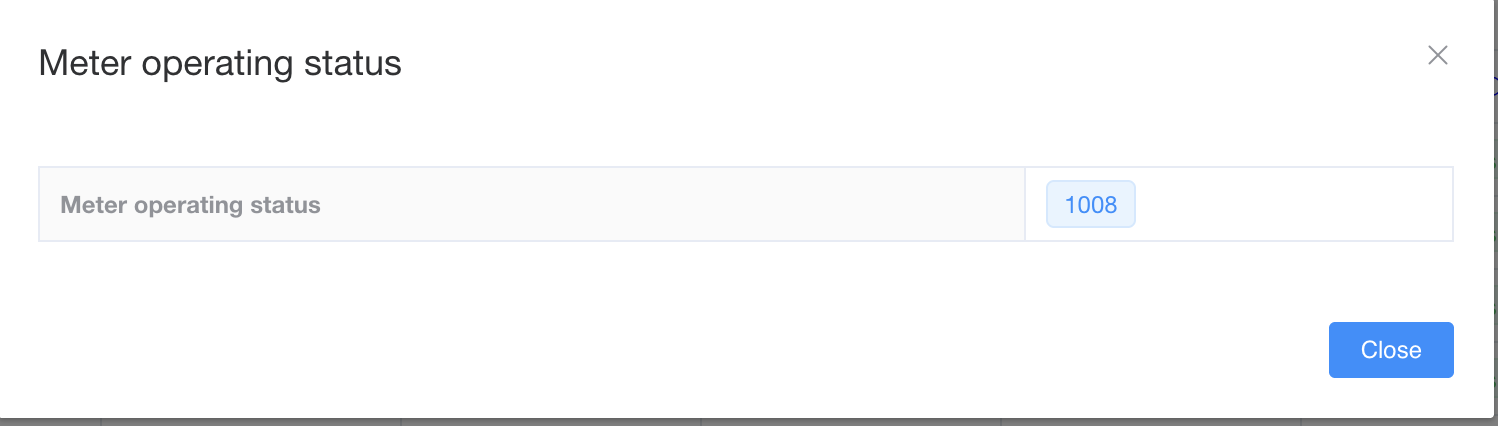
You query the meter for meter operating status and you get back this
Answer
Meter operating status = 1008
Step 1: Interpret the Code
-
In many AMI/CalinMeter integrations, codes like 1000 and 1008 map directly to relay/disconnect statuses (Code 87 sub-codes).
-
1008 = Sub-code 8 under Code 87.
-
From the guide:
-
8 → “Not-active” → Meter not commissioned.
-
Step 2: What This Means in Postpaid Setup
-
The meter is physically installed, but it hasn’t been commissioned.
-
In this state, the meter will not supply power, regardless of load or tariff configuration.
Step 3: Field Action (from Quick Action Guide)
-
Action: Commission the meter using the commissioning token/code.
-
Default commissioning code is 12345.
-
Enter this via the CIU (Customer Interface Unit) or backend if supported.
-
-
Once successfully commissioned:
-
Tamper detection is activated.
-
Relay will close and supply will start flowing.
-
✅ Summary:
Your AMI response of 1008 means “Meter not commissioned.”
👉 To resolve: Enter 12345 (or your site-specific commissioning token) on the CIU/backend to activate the meter.
Example #2
Answer
Great — let’s now map 1000 through the same guide.
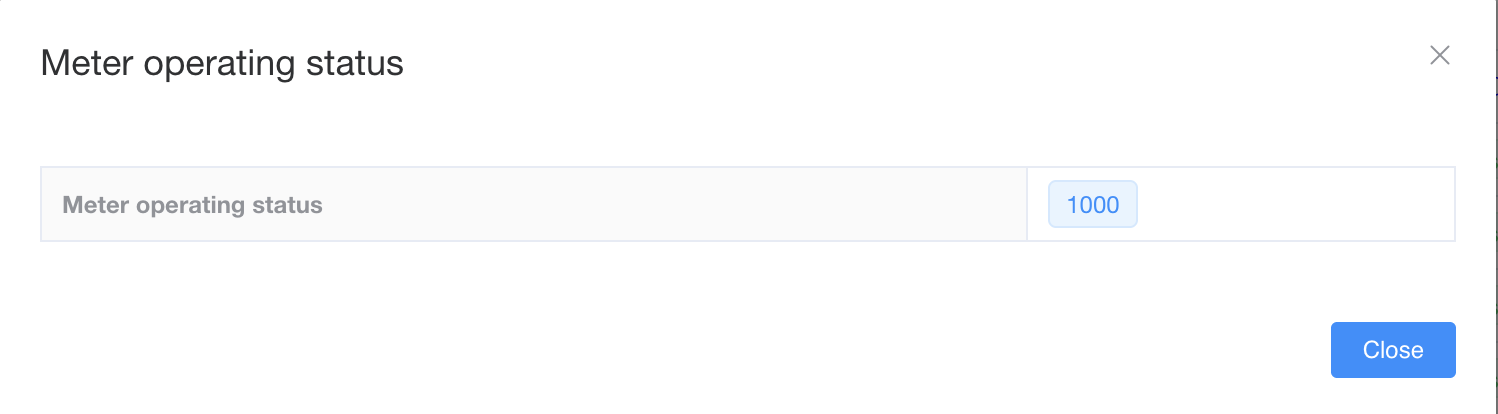
Case: Meter operating status = 1000
Step 1: Interpret the Code
-
In the AMI integration, 1000 corresponds to Code 87 sub-code 00.
-
00 → “Relay Closed”.
Step 2: What This Means in Postpaid Setup
-
The meter is active and commissioned.
-
The relay is closed, meaning the meter is supplying electricity normally.
-
No tamper or abnormal condition is blocking supply.
Step 3: Field Action (from Quick Action Guide)
-
Action: No intervention needed.
-
Record this status if troubleshooting, since it confirms the meter is healthy and delivering power.
✅ Summary for your case:
Your AMI response of 1000 means “Relay Closed – supply ON.”
👉 Everything is normal; no technician action required.
⚡ So together:
-
1000 = Relay Closed (meter supplying power)
-
1008 = Not-active (meter not commissioned; activate with commissioning code)
A2EI Data
Thank you for showing interest in our data and our efforts here at the A2EI!
We are happy to provide you with our latest data releases from our Solar Killed the Generator Star Project in Nigeria, our clean cooking pilots, and our research into productive-use appliances in East Africa. Please find a detailed summary of each dataset and latest release below.
Please drop us a line via datadatadata@a2ei.org if you have any comments or questions, or in case you would like to unsubscribe from receiving updates.
Most recent data releases SKGS
06.04.2022 The A2EI set out to provide the sector with an open-source hardware
solar business system. Two years later, we have not only made the solar
generator available, but sold over 1,000 systems. Every solar
generator is sending real time data on consumption and system state,
which allows the A2EI to share millions of data points with the sector
as open-source data.
Please download our SKGS Project Update and Data Release Report here.
Download the associated data and readme here.
29.04.2020 To
date, we have over 215 smart meters (and counting) connected to small
scale generators and grids in Nigeria, located within multiple markets
across several regions.
You can download the raw data, the meter list as well as the README here.
Find some brief release notes here.
Please find the Executive Summary here.
02.06.2020 Please find our analysis of generator usage during COVID-19 here.
Latest data releases Clean Cooking
15.11.2021 In a new comprehensive data release report, the A2EI analyses the entire data collected by our smart meters monitoring the usage of electric pressure cookers (EPCs) by 100 pilot users in rural Tanzania from March 2020 to May 2021.
Please download the data release report here.
Download the data frames here.
Download the Readme here.
16.07.2021 The A2EI has been part of a feasibility study to pave the way for mass distribution of electric hotplates to rural households in Malawi. Please download the Study of Hotplate & Grid Use in Rural Malawi here and access the associated data here.
Latest data releases Productive Use
14.07.2021 We are sharing our learnings of successful ventures in the agricultural productive use appliance sector by our first "Entrepreneur in Residence", Imara Tech, and are proposing a way forward that we believe could increase the likelihood for successful product development. Download the summary of learnings here.
21.09.2020 The Access to Energy Institute has developed a systematic methodology and published a report to jointly discuss the question what makes or breaks a successful solar-powered productive-use appliance - and to help find solutions for successful adoption and scaling.
Download the report here.
Please find the associated data and materials here.
Your feedback is very warmly welcomed. We believe that sharing our data is paramount to unlocking further entrepreneurship and engineering, which in turn will help us crack the many nuts of providing a reliable, clean and affordable universal energy supply. In our efforts to deliver meaningful data, we need your feedback in order to collect further data points and to make adjustments to our current measuring practices.
For now, we wish you a wonderful day...and cheerful data crunching!
All the best,
your A2EI Team
NFE metering strategy + Glen Street-EMS
Authoritative page for NFE's role in the IEEE Smart Village meshEMS / Street-EMS initiative. Compiled 2026-08-10 from the Element room "Smart Village Energy Interest Group" (full history back to 2026-04-24), the ISV Dev Kit BOM sheet, isv.wiki, and the Rev B/C line diagrams. No customer PII or financial ledgers on this page by policy.
What it is
Not a standalone NFE product. It is NFE's seat in an IEEE Smart Village (ISV) open-source initiative called meshEMS, hardware-branded Street-EMS, started at an IEEE / NESL hackathon in April 2026. Hardware and firmware are led by Glenn Algie (10power.com / NESL); the software and standards side is led by Adam Sauer (ISV Tech Committee chair). The working venue is the Element/Matrix room "Smart Village Energy Interest Group".
meshEMS is open-source firmware on an ESP32-S3 / ESP32-P4 module doing OpenAMI two-way metering and control over secure MQTT into OpenEMS. Deployed as a street-pole or pedestal low-voltage feeder cabinet that meters AND controls every tenant, it is designed to replace the per-tenant DIN-rail meters and the OpenEMS Raspberry Pi with a single integrated 9x15 cm EMS board.
How it fits NFE
- Today (pilot): CHINT DDSU666 smart meters plus a Raspberry Pi gateway over Modbus RTU / RS485, feeding OpenEMS. Current pedestal cabinet is roughly 80 x 60 x 25 cm, about USD 150 locally.
- Next generation: the Street-EMS cabinet folds the 3-phase meter, the per-tenant meters and the Pi into one EMS board plus an SSR bank, shrinking the cabinet (cheaper, fits indoor locations, easier to secure from theft and weather) and adding per-tenant remote control and local energy-policy automation.
The cabinet (Rev C, 9-tenant, 3-phase LV feeder)
Signal flow left to right:
- Incoming LV feeder L1/L2/L3 + N + PE. Each phase: a 63A main breaker (QF1/QF2/QF3), a mains-usage CT (CT4/CT10/CT16), then a UKK80 terminal block fanning out to up to 6 tenant ways per phase.
- Three Ivy RCMs (RCM1/2/3), one residual-current monitor per phase, for continuous leakage and neutral insight. Modbus UART to RS485 adaptor.
- Nine contactors K1..K9 (3 tenants per phase) for per-tenant remote connect/disconnect, each with a tenant-usage CT (CT1,2,3,7,8,9,13,14,15).
- Controller on the cabinet door: "Street-EMS w RGBW" = 3 stacked CircuitSetup 6-channel CT meters = 18 channels (9 tenant + 3 mains + 6 spare).
- Two 8-channel opto-isolated zero-crossing SSRs drive the 9 contactor coils (9 control lines, 3x3 per phase, 240 Vac sensitive).
- Backplate Power PCB: fused, TVS surge protected, 3x Myrra 44122 240-to-9 Vac, giving 5V 2A and 12V 1A.
Legend (Rev B with legend): QF circuit breaker, CT current transformer, K contactor, UKK80 distribution terminal block, RCM residual current monitor, SSR solid-state relay, PCB printed circuit board, EVSE EV charger. 1P+N one phase plus neutral. RS485 / Modbus UART / I2C communications.
Decisions ratified in the room (2026-07-25):
- 1P over 1P+N for tenant breakers and contactors (1P is cheaper; do not switch neutral except for EV).
- 80A over 63A rating, chosen to leave room for a future EV station at a new location later this year.
- Rev B to Rev C added the legend; the diagram is deemed complete with only a few unlabelled wires to clarify at the workshop.
Still open: the make-before-break 80A neutral / phase-transfer balancer ("neutral rebalancer transfer method and apparatus") and the EVSE port are marked spare-room / in-progress.
Firmware and energy-policy vision (Glenn)
Local, IFTTT-style per-tenant automation in C/C++ on the ESP32, not just remote on/off:
- Triggers: prepaid-token expiry, over-voltage, over-current, over-kW, over-kWh, over-generation, over-storage.
- Actions: SSR disconnect (normally-closed contactor coil), SMS alert, RGBW LED or e-paper warning at the tenant box, a flash-warning cadence before cutoff, and a graceful post-sunset lighting-only allowance (about 10-20 W for a few hours from battery when storage allows).
- Policy model: each tenant has a JSON "mode" (safety vs prepaid-shutdown automations) stored in ESP32 SPIFFS or SD as a persistent energy-model cache.
- Grid insight: continuous per-phase leakage detection, neutral-imbalance alerts, phase-loss detection.
Cloudless village
An ESP32-P4 with its own Ethernet NIC acts as a per-feeder aggregation node. Street-EMS units LAN-hop along the feeder ("feeder hops") to run an in-village pay-go portal and full UX with no broadband. Optional LoRa / Meshtastic mesh and power-line communication on top; optional low-cost village camera / audio snapshots.
Standards and interoperability (OpenAMI)
OpenAMI is the "actionable energy telemetry" layer, the utility-facing layer above a village feeder. Built on DLMS/COSEM (IEC 62056), SunSpec Modbus/JSON, MQTT, IEEE 1547-2018 (DER interconnection) and IEEE 2030.5 (Smart Energy Profile). Village Metering goals: billing, remote disconnect, theft detection. EnAccess Foundation is extending the OpenAMI codeset. Reference: isv.wiki (repo github.com/overview-solutions/isv-ai-wiki, MIT).
The workshop (immediate driver of the ISV Dev Kit BOM)
IEEE ISV awarded Glenn and Adam a 4-session, 9-hour hands-on workshop (assemble an EMS in about 15 minutes each, assemble a cabinet, run code challenges). IEEE funds the parts BOM. Plan: build 15-20 EMS units and 3-5 multitenant cabinets for participants to take home (about USD 50 each). Parts pre-ship to Albert, the ISV lead in Nairobi (AliExpress China to Nairobi direct; small PCB parts hand-carried, PSUs prebuilt on site). BOM total about USD 2,377 per batch (see the ISV Dev Kit BOM sheet).
Venues: PAC2026 Nairobi (September) and OSEAS Kigali, Rwanda (October, about EUR 50).
NFE attendance (as of 2026-08-10): Dansturn and Dismas are going to Kenya (Nairobi). Aaron, now back in Uganda, could join them. Kigali remains a possibility. Glenn asked NFE to co-lead the cabinet builds.
People and orgs
Glenn Algie (10power.com / NESL / IEEE ISV, hardware + firmware; also WMAC.CLOUD New Zealand, REI Cameroon). Adam Sauer (ISV Tech Committee chair, meshems software + OpenAMI, runs isv.wiki). Aaron Tushabe, Hillary Arinda, Dansturn, Dismas (NFE). Albert (ISV Nairobi lead). Abiodun Okunola (ISV Africa regional lead). EnAccess Foundation, EPRI Open Source, NESL.
Sources
- Element room "Smart Village Energy Interest Group" (
#smartvillage:matrix.nearlyfreeenergy.com), full history from 2026-04-24. - ISV Dev Kit BOM (Google Sheet
1AeAUrfL-Fu_j3xsBPjY555B0huxV0nnMtRjkDTFPjTE). - Line diagrams saved at
NFE/smart village energy interest group/(Rev B with legend, Rev C editable + PDF). - isv.wiki;
github.com/energy-iot.
Open items
- Confirm the Rev C legend back to Glenn (he asked).
- Decide and mobilize the NFE workshop attendance (Nairobi confirmed for Dansturn + Dismas; Aaron + Kigali possible).
- Fill the detailed per-tenant "Behind the Meter" companion page.
Phase Balancing Recommendation (Sezibwa)
Recommendation for re-assigning Sezibwa's single-phase customers across the three phases of the SRNE three-phase inverter, to fix a severe load imbalance. Uses meter IDs; the site operator maps these to customers.
Implementation status (2026-08-24)
The two minimal phase-balancing moves were completed on the morning of 2026-08-24:
- Completed: meter 003 moved from L1 to L2.
- Completed: meter 009 moved from L2 to L3.
- Outstanding (optional): meter 004 remains on L3; the optional move from L3 to L1 was not completed.
The expected post-change distribution is L1 5.9 / L2 7.3 / L3 7.6 kWh/day (28 / 35 / 37 percent), based on the historical load profile. Live measurements should be reviewed after sufficient post-change data has accumulated to confirm the achieved balance.
Baseline before the change (the problem)
Before the 2026-08-24 reconnections, meter_100's per-phase energy and per-customer voltage matching (all high-confidence), the current assignment and daily load is:
| Phase | Load (kWh/day) | Share | Customer meters (kWh/day) |
|---|---|---|---|
| L1 | 10.4 | 50 percent | 002 (5.7), 003 (4.5), 008 (0.1), 011 (0.1) |
| L2 | 5.1 | 25 percent | 009 (2.3), 007 (1.6), 010 (1.2) |
| L3 | 5.3 | 25 percent | 006 (2.7), 005 (2.1), 004 (0.5) |
Total site load about 20.7 kWh/day, so the ideal is about 6.9 kWh/day per phase. L1 carries half the site while L2 and L3 carry a quarter each.
Root cause: the two largest consumers, meter 002 (5.7) and meter 003 (4.5), are both on L1. Together they are 10.2 kWh/day, which already exceeds a balanced phase on its own.
Updated meter reference (after 2026-08-24 phase balancing)
This table records the wiring after the two completed moves. Initials only (no full names, per the customer-data rule). Modbus address is the meter's slave address; serial is the physical meter serial. Energy figures are historical averages used for the recommendation, not post-change measurements.
| Meter | Modbus addr | Serial | Customer (initials) | Previous phase | Current phase | Change status | Historical kWh/day |
|---|---|---|---|---|---|---|---|
| meter_002 | 2 | 200326019929 | NP | L1 | L1 | Unchanged | 5.7 |
| meter_003 | 3 | 200326020101 | KFH | L1 | L2 | Moved 2026-08-24 | 4.5 |
| meter_004 | 4 | 200326020199 | AB | L3 | L3 | Optional L3→L1 move outstanding | 0.5 |
| meter_005 | 5 | 200326020128 | KFH | L3 | L3 | Unchanged | 2.1 |
| meter_006 | 6 | 200326020209 | WS | L3 | L3 | Unchanged | 2.7 |
| meter_007 | 7 | 210302003356 | JN | L2 | L2 | Unchanged | 1.6 |
| meter_008 | 8 | 200326019807 | PO | L1 | L1 | Unchanged | 0.1 |
| meter_009 | 9 | 250902040373 | DK | L2 | L3 | Moved 2026-08-24 | 2.3 |
| meter_010 | 10 | 250902040216 | SN | L2 | L2 | Unchanged | 1.2 |
| meter_011 | 11 | 250902040311 | (unmapped) | L1 | L1 | Unchanged | 0.1 |
KFH holds two meters (003 and 005), now split across L2 and L3. Names are looked up live from the customer database by serial; the logical-to-service-ID map in the logger configuration had 009/010 transposed, so the physical serial remains authoritative.
Why phase balance matters
- Voltage quality. L1 carries roughly twice the current of L2/L3, so it has the largest voltage drop. Customers on L1 see the lowest voltage (dimmer lights, more appliance stress) while L2/L3 sit high. Balancing evens the voltage across customers.
- Backup capacity. The SRNE is a three-phase inverter with a per-phase output limit. During a grid outage (battery backup), an overloaded L1 can hit its per-phase limit and trip or brown out even though L2 and L3 have spare capacity and the total is within the inverter rating. Balancing maximises the backup the site can actually deliver.
- Losses. Imbalance drives neutral current and extra I2R losses in the distribution.
Note: this does not affect the battery arbitrage or solar economics. The three-phase inverter time-shifts the site's total energy across all phases, so the savings analysis is unchanged. Phase balancing is a separate power-quality and backup-reliability issue.
Implemented recommendation (minimal moves)
The following two reconnections were completed on 2026-08-24:
- Completed: meter 003 (4.5 kWh/day) moved from L1 to L2 — the key move, separating the two big loads (002 and 003).
- Completed: meter 009 (2.3 kWh/day) moved from L2 to L3 — rebalances L2 after taking on 003.
Expected result based on the historical load profile:
| Phase | Before | After 2 moves |
|---|---|---|
| L1 | 10.4 (50 percent) | 5.9 (28 percent) |
| L2 | 5.1 (25 percent) | 7.3 (35 percent) |
| L3 | 5.3 (25 percent) | 7.6 (37 percent) |
The max-minus-min spread drops from 5.3 to 1.7 kWh/day.
Outstanding optional third move for near-perfect balance: meter 004 (0.5) remains on L3. Moving it from L3 to L1 would give L1 6.4 / L2 7.3 / L3 7.1 (31 / 35 / 34 percent), spread 0.9.
The calculation
- Total daily energy about 20.7 kWh across three phases, so ideal is 20.7 / 3 = 6.9 kWh/day per phase.
- Current spread (heaviest minus lightest): 10.4 - 5.1 = 5.3 kWh/day.
- After the two moves: 7.6 - 5.9 = 1.7 kWh/day.
- After the optional third move: 7.3 - 6.4 = 0.9 kWh/day.
Loads are from the same meter data used across the Sezibwa economic analysis (meter_100 aggregate plus per-customer meters, over the March to August 2026 window). Note that meters 003 and 005 belong to the same customer (two service points); moving 003 to L2 leaves that customer with one meter on L2 and one on L3, which is fine.
Data provenance
Underlying data: the aggregate meter meter_100 plus the 10 customer sub-meters, over 2026-03-19 to 2026-08-10, from the modbus energy-logger archive (sources: pi-direct and nextcloud-import), i.e. the pre- and early-OpenEMS period. Load basis is a conservative 21.3 kWh/day.
Note (2026-08-20): the site has since migrated to OpenEMS, which is now the live source. OpenEMS-sourced daily figures from mid-August show inconsistencies (the aggregate roughly doubled exactly at the source switchover, and on some days the customer-meter sum exceeds the aggregate), so they are treated as a data-quality issue to resolve before use; this analysis stays on the validated archive. The baseline phase assignments reflect wiring observed up to about May 2026. The meter reference and implementation status above were updated for the reconnections completed on 2026-08-24; OpenEMS measurements should be used to verify the resulting live balance.
Sezibwa meter replacement log
Sezibwa meter replacement log
One entry per customer meter swap at Sezibwa (gateway gw-pi2). Record every system that points at a meter serial, because each one must be switched separately: the OpenEMS gateway config, the customer app (meter_sources) and the billing engine (MBE device + household link). Customers are identified here by Modbus address and serial only.
Summary
| Date | Modbus address | Old serial | New serial | Status |
|---|---|---|---|---|
| 2026-09-14 | 7 | 210302003356 | 200326020197 | All systems switched 2026-09-24; closing 244.54 kWh, opening 0.31 kWh |
2026-09-14: address 7, 210302003356 to 200326020197
Why it was replaced. The old meter stopped answering on the meters bus on 2026-08-29 at 23:07 UTC (logger issue #82). It was later found physically absent. Its last register value seen on the backend was 229.35 kWh on 2026-09-04.
New meter. CHINT DDSU666 serial 200326020197, on Modbus address 7. The first backend data is from 2026-09-14; the register read 16.16 kWh on 2026-09-24.
Systems switched:
| System | Change | Date | Reference |
|---|---|---|---|
| OpenEMS gateway (gw-pi2) | New meter component meter200326020197 on unit 7 |
2026-09-14 | microgrid-gateway PR #68 |
| Customer app | meter_sources row repointed to meter200326020197/ActiveConsumptionEnergy, history start 2026-09-14; daily usage backfilled 14 to 24 Sep with the production backfill script (11 days, sums match the register) |
2026-09-24 | this page |
| Billing engine (MBE) | New device "(new meter)" added on edge sezibwa-rentals-gw-pi2 as a Consumption meter | 2026-09-24 | this page |
| Billing engine (MBE) | Household billing device changed to the new device (Change billing device); old device now unlinked; invoice meter serial field set to 200326020197 by hand | 2026-09-24 | MBE UI gap reported: serial does not follow a device change |
Closing and opening readings (from the swap thread, Element product room, 2026-09-14). Old meter 210302003356 read 244.54 kWh just before removal. New meter 200326020197 read 0.31 kWh at installation (about 12:15 EAT), on Modbus address 19. The old meter's register kept counting while it was off the bus, so there is no unmetered gap: its closing reading covers 30 Aug to 14 Sep.
September bill. The billing engine takes one meter per household per period, so bill this customer with one manual reading (manualReadings in the generate call) that joins the two meters:
| Start | End | kWh | |
|---|---|---|---|
| Old meter | 223.52 (August end, when it went silent) | 244.54 | 21.02 |
| New meter | 0.31 | reading at September close | end minus 0.31 |
| Manual reading to enter | 223.52 | 244.54 + (new end - 0.31) | sum of both |
Check first that the August bill really ended this customer at 223.52 kWh.
Watch. A stray 0.35 kWh value appears on 2026-09-14 under the old channel name. That was the new meter answering on address 7 before its component was renamed, not the old meter.