Towards a Framework for Autonomous Microgrids
Table of Contents
-
Introduction
-
Core Concepts
-
Assets
-
Foundational Capabilities
-
Application Capabilities
-
-
Automation vs Autonomy
-
Levels of Operational Autonomy
-
Level 1 — Manual Local Operation
-
Level 2 — Automated Supervisory Control
-
Level 3 — Autonomous Supervisory Control
-
-
Operational Criticality
-
Safety-Critical Capabilities
-
Business-Critical Capabilities
-
Optimization Capabilities
-
-
Applying the Framework
-
Implications for a Microgrid OS
A picture is worth a thousand words
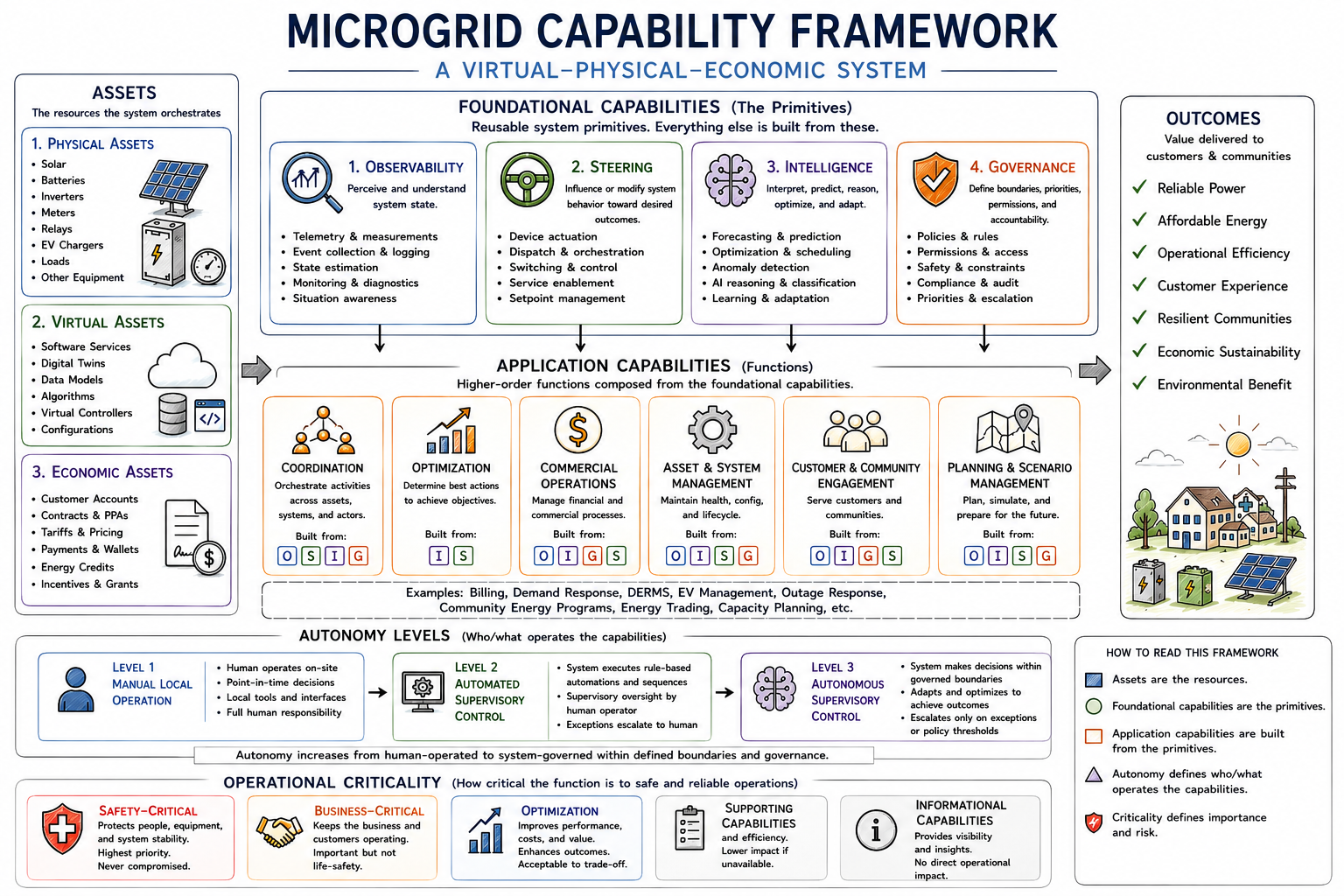
Introduction
As distributed energy resources become increasingly software-defined, microgrids are evolving from manually operated electrical systems into digitally coordinated energy platforms. This evolution creates a need for a clear framework describing the degree of operational autonomy assigned to different microgrid functions.
This document proposes a simple three-level autonomy model for microgrids inspired by concepts from industrial automation, supervisory control systems, and autonomous systems engineering.
Unlike autonomous vehicle frameworks that classify an entire vehicle into a single automation level, this framework applies autonomy levels to specific operational capabilities operating on specific assets.
For example:
-
Observing smart meter consumption
-
Steering battery dispatch
-
Observing EV charger utilization
-
Steering flexible loads
-
Forecasting solar production
Each capability may operate at a different level of autonomy.
A microgrid could therefore simultaneously contain:
-
Level 3 autonomous battery steering
-
Level 2 remote EV charger steering
-
Level 1 manual generator operation
This capability-oriented approach allows microgrids to evolve incrementally toward higher levels of operational autonomy.
Core Concepts
Assets
Assets are physical, digital, or economic components participating in the operation of the microgrid.
This framework groups assets into three primary categories.
1. Physical Assets
Physical assets are hardware systems that generate, store, distribute, consume, or protect electrical energy.
Examples include:
-
Smart meters
-
Battery energy storage systems (BESS)
-
Solar PV inverters
-
EV chargers
-
Diesel generators
-
Protection relays
-
Flexible loads
-
Distribution transformers
-
Remote disconnect relays
2. Digital Assets
Digital assets are software systems, communications systems, and computational services used to monitor, coordinate, optimize, and operate the microgrid.
Examples include:
-
Billing systems
-
Tariff engines
-
Payment systems
-
Forecasting systems
-
Customer identity systems
-
AI orchestration systems
-
SCADA platforms
-
DERMS platforms
-
Telemetry databases
-
Mobile applications
-
Notification systems
3. Economic and Contractual Assets
Economic and contractual assets represent the financial, commercial, and policy relationships governing the microgrid.
Examples include:
-
Customer accounts
-
Energy credits
-
Tariff structures
-
Power purchase agreements (PPAs)
-
Service tiers
-
Demand response agreements
-
Payment obligations
-
Credit limits
-
Utility interconnection agreements
These asset categories recognize that modern microgrids are not purely electrical systems. They are virtual-physical-economic systems integrating energy infrastructure, software platforms, and operational business logic into a unified operational environment.
Foundational Capabilities
Foundational capability domains are the core operational primitives from which higher-order microgrid behaviors and applications are constructed.
Rather than treating every operational function as a separate foundational capability, this framework identifies a small set of core capabilities that can be composed together to create more advanced orchestration, optimization, commercial, and autonomous behaviors.
These foundational domains operate across physical, digital, and economic assets.
1. Observability
Observability capabilities measure, record, analyze, and communicate system state.
Observability forms the awareness layer of the microgrid.
Examples:
-
Reading smart meter consumption
-
Monitoring battery state of charge
-
Detecting inverter faults
-
Measuring feeder voltage and frequency
-
Monitoring EV charging sessions
-
Customer usage analytics
-
Payment status monitoring
-
Event logging and telemetry collection
2. Steering
Steering capabilities execute operational actions intended to guide system behavior toward desired operational outcomes.
Unlike traditional low-level control systems, steering emphasizes adaptive orchestration, policy-driven operation, and outcome-oriented system management across distributed assets.
Steering forms the action layer of the microgrid.
Examples:
-
Disconnecting a load
-
Dispatching battery storage
-
Curtailing solar generation
-
Starting a backup generator
-
Setting EV charging limits
-
Executing demand response actions
-
Remote relay switching
-
Service disconnection and reconnection
3. Intelligence
Intelligence capabilities generate predictions, recommendations, classifications, reasoning, and adaptive operational decisions.
Intelligence forms the reasoning layer of the microgrid.
Examples:
-
Solar production forecasting
-
Load forecasting
-
Predictive maintenance
-
Fault prediction
-
Fraud detection
-
Adaptive operational policy selection
-
AI-driven energy management
-
Anomaly detection
-
Optimization modeling
4. Governance
Governance capabilities define and enforce operational rules, permissions, priorities, compliance requirements, and safety boundaries.
Governance forms the constitutional layer of the microgrid.
Examples:
-
Access control
-
Human override policies
-
Safety constraints
-
Regulatory compliance
-
Escalation policies
-
Operational audit logging
-
Cybersecurity enforcement
-
Service disconnection policies
-
Critical load protections
Application Capabilities
Operational application domains are higher-order business and operational functions constructed from combinations of the foundational capabilities.
These applications are not themselves foundational primitives. Rather, they emerge from orchestrating observability, steering, intelligence, and governance capabilities together.
Coordination
Coordination capabilities orchestrate workflows across systems, users, assets, and operational processes.
Coordination typically combines:
-
Observability
-
Steering
-
Governance
Examples:
-
Human escalation workflows
-
Multi-device orchestration
-
Customer notification systems
-
Utility coordination
-
Maintenance scheduling
-
Service provisioning workflows
-
Incident response coordination
Optimization
Optimization capabilities improve operational efficiency, economics, reliability, or customer experience.
Optimization typically combines:
-
Intelligence
-
Steering
Examples:
-
Energy arbitrage optimization
-
EV charging optimization
-
Demand response coordination
-
Forecast-driven battery dispatch
-
Load balancing
-
Power quality optimization
-
Asset utilization optimization
Commercial Operations
Commercial operations capabilities manage the economic and business functions of the microgrid.
Commercial operations typically combine:
-
Observability
-
Steering
-
Intelligence
-
Governance
Examples:
-
Customer billing
-
Tariff management
-
Payment processing
-
Credit management
-
Revenue collection
-
Energy credit accounting
-
Invoice generation
-
Service eligibility evaluation
-
Automated service disconnection and reconnection
Automation vs Autonomy
The distinction between automation and autonomy is foundational to this framework.
Automation
Automation refers to systems that execute predefined instructions or workflows under human-defined logic.
Examples:
-
Fixed battery charging schedules
-
Rule-based generator startup
-
Threshold-based load shedding
-
Remote switching by operators
-
Scheduled EV charger limits
An automated system follows instructions.
Autonomy
Autonomy refers to systems capable of independently managing operational objectives under changing conditions while operating within defined technical, economic, and safety constraints.
Examples:
-
Optimizing battery dispatch based on tariffs, weather forecasts, and outage probability
-
Dynamically prioritizing critical loads during constrained operation
-
Coordinating EV charging across multiple users to minimize peak demand
-
Predictive fault response and recovery
-
Adaptive energy management based on real-time conditions
An autonomous system manages outcomes.
Levels of Operational Autonomy
This framework distinguishes between:
-
Manual local operation
-
Automated supervisory control
-
Autonomous supervisory control
Level 1 — Manual Local Operation
At Level 1, foundational capabilities are operated directly by humans physically present at the asset location.
The asset itself provides the operational interface.
Examples:
-
Reading values directly from a smart meter display
-
Manually operating breakers or disconnects
-
Physically starting a generator
-
Local inverter configuration
-
On-site battery inspection
Operational Characteristics
| Question | Answer |
|---|---|
| Who monitors the system? | Human operators on-site |
| Who makes decisions? | Human operators on-site |
| Who executes actions? | Human operators on-site |
| Who handles failures? | Human operators on-site |
Characteristics
-
No remote supervisory capability
-
Human-driven operational awareness
-
Minimal software orchestration
-
Typically isolated or standalone systems
Relevant Standards
Relevant standards may include:
-
IEEE 1547 for DER interconnection behavior
-
IEEE 2030.7 for microgrid controller functional specification
-
IEC 61850 for power system communication models
At Level 1, however, most operational authority remains local and manual.
Level 2 — Automated Supervisory Control
At Level 2, foundational capabilities are supervised remotely through software platforms and communications networks.
Humans remain responsible for operational decisions, while software automates telemetry collection, visualization, alarms, workflows, and execution of predefined control logic.
Examples:
-
Remote smart meter monitoring
-
SCADA-based microgrid supervision
-
Rule-based battery dispatch
-
Remote EV charger management
-
Automated threshold alarms
-
Scheduled load control
Operational Characteristics
| Question | Answer |
|---|---|
| Who monitors the system? | Human operators remotely |
| Who makes decisions? | Human operators remotely |
| Who executes actions? | Automated systems under human-defined logic |
| Who handles failures? | Human operators with software assistance |
Characteristics
-
Remote visibility and control
-
Centralized supervisory software
-
Deterministic rule-based workflows
-
Human approval remains central
-
Software improves operational efficiency but does not independently manage system objectives
Relevant Standards
This level aligns closely with existing industrial automation and microgrid supervisory standards including:
-
IEEE 2030.7 — Specification of Microgrid Controllers
-
IEEE 2030.8 — Testing of Microgrid Controllers
-
IEC 61850 — Power system communication models
-
DNP3 and Modbus — Telemetry and control protocols
-
OpenADR — Demand response coordination
Level 2 corresponds closely to modern SCADA and DERMS architectures.
Level 3 — Autonomous Supervisory Control
At Level 3, foundational capabilities are operated autonomously by software systems capable of independently managing operational objectives within defined technical, economic, and safety constraints.
Humans define policies, operating boundaries, escalation procedures, and override authority, but the system continuously makes operational decisions without requiring constant human supervision.
Examples:
-
AI-driven battery optimization
-
Autonomous load orchestration
-
Dynamic outage response
-
Self-optimizing EV charging coordination
-
Predictive maintenance actions
-
Autonomous islanding and reconnection
-
Adaptive tariff-aware energy management
Operational Characteristics
| Question | Answer |
|---|---|
| Who monitors the system? | Autonomous software systems with human oversight |
| Who makes decisions? | Autonomous systems operating within defined policies |
| Who executes actions? | Autonomous software systems |
| Who handles failures? | Autonomous systems first, humans upon escalation |
Characteristics
-
Goal-oriented operational behavior
-
Context-aware decision making
-
Forecast-driven optimization
-
Dynamic adaptation to changing conditions
-
Human escalation rather than continuous supervision
-
Continuous optimization across multiple objectives
Key Requirements
Level 3 systems should include:
-
Human override capability
-
Policy enforcement mechanisms
-
Audit logging
-
Cybersecurity protections
-
Fallback operational modes
-
Confidence scoring and escalation logic
-
Safety envelopes and operational constraints
Relevant Standards
Existing standards partially address autonomous operation today. Relevant references include:
-
IEEE 2030.7 and 2030.8
-
IEC 62351 — Power system cybersecurity
-
NIST Cybersecurity Framework
-
Emerging AI governance and operational safety standards
Further industry standardization may be required to fully define autonomous microgrid operation.
Operational Criticality
Not all microgrid capabilities carry the same operational importance or risk.
This framework distinguishes between different classes of operational criticality.
Safety-Critical Capabilities
Capabilities whose failure or misuse could threaten human safety, equipment safety, or grid stability.
Examples:
-
Protection relay operation
-
Islanding and reconnection
-
Overcurrent protection
-
Emergency load shedding
-
Battery thermal protection
-
Voltage and frequency stabilization
These capabilities typically require strict operational constraints, auditability, and human override mechanisms.
Business-Critical Capabilities
Capabilities necessary for the commercial and operational sustainability of the microgrid business.
Examples:
-
Customer billing
-
Payment processing
-
Remote service disconnection
-
Tariff enforcement
-
Revenue collection
-
Customer account management
These capabilities are operationally important but must remain subordinate to safety-critical protections.
Optimization Capabilities
Capabilities intended to improve efficiency, economics, customer experience, or asset utilization.
Examples:
-
Energy arbitrage optimization
-
EV charging optimization
-
Demand response coordination
-
Forecast-driven battery dispatch
-
Predictive maintenance
-
Customer energy recommendations
Optimization capabilities should degrade gracefully without compromising safety or core operations.
Supporting Capabilities
Capabilities that support operational continuity, efficiency, maintenance, coordination, or administrative workflows, but whose temporary failure does not immediately compromise safety or core service delivery.
Examples:
-
Maintenance scheduling
-
Reporting systems
-
Asset inventory management
-
Customer notifications
-
Workforce coordination
-
Historical analytics
-
Non-critical integrations
Supporting capabilities improve operational effectiveness and resilience but are generally lower priority during constrained or degraded operations.
Informational Capabilities
Capabilities whose primary purpose is visibility, insights, diagnostics, learning, or reporting without direct operational authority over the system.
Examples:
-
Dashboards
-
Historical reporting
-
Data visualization
-
Energy usage insights
-
Community analytics
-
Educational interfaces
-
Public transparency portals
Informational capabilities provide situational awareness and decision support but typically do not directly influence operational behavior.
Applying the Framework
The framework is intended to classify autonomy at the capability level rather than the whole microgrid level.
Example:
| Asset | Foundational Capability Domain | Operational Function | Autonomy Level |
|---|---|---|---|
| Smart Meter | Observability | Usage telemetry | Level 2 |
| Battery Storage | Steering | Battery dispatch | Level 3 |
| Diesel Generator | Steering | Generator operation | Level 1 |
| EV Chargers | Observability | Charger monitoring | Level 2 |
| EV Chargers | Steering | Charging orchestration | Level 3 |
| Billing System | Commercial Operations | Automated billing | Level 2 |
| Smart Relay | Steering | Service disconnection | Level 3 |
This allows gradual evolution toward autonomy without requiring the entire microgrid to transition simultaneously.
Implications for a Microgrid OS
A Microgrid OS designed around this framework should:
-
Treat foundational capabilities as modular services
-
Support mixed autonomy levels simultaneously
-
Allow policy-driven escalation to humans
-
Maintain secure telemetry and control channels
-
Provide auditability and operational transparency
-
Support standards-based interoperability
-
Maintain operational safety boundaries
-
Support both edge and cloud orchestration architectures
The Microgrid OS becomes the orchestration layer coordinating assets, capabilities, policies, and autonomy levels across the energy system.