# Community Checkins

Agendas, Meeting notes and recordings for all our meetings

# Previous Meetings Recorded

- [NFE Checkin 10/04/2025](https://drive.google.com/file/d/1d8vu171CAKnuAbZ_33t_wV24mBxAruRx/view?usp=sharing)
- [NFE Checkin 17/04/2025](https://drive.google.com/file/d/1uRevLn_NPv4v9Br1RK8WmnmXMvsznAsR/view?usp=sharing)
- [NFE Checkin 25/04/2025](https://drive.google.com/file/d/1JBFqCfRX9aN--2r4xByb6TEg9zALSkUh/view?usp=sharing)
- [NFE Checkin 02/05/2025](https://drive.google.com/file/d/12o-2AAnjYZnZvXNKZL4Fp8grAIT17FWp/view?usp=sharing)
- [Meeting with Uzuzi Meter Supplier 07/05/2025](https://drive.google.com/file/d/1O_BVQiTiLPGmRacuugNwqOkYnc2knx5U/view?usp=sharing)

# NFE Checkin - 16/05/2025

Agenda

- Metering Evaluation review
- Pearl Marina Proposal Review
- Company tools Demos   
    
    - Element (Matrix)
    - Kimai (Time tracking)
    - NextCloud (Calendar and Email)
    - Bookstack (Team Documentation)

Action items

- Prepare Fundraising update for next meeting - Aaron
- Ordering meters from Top 3 providers - Aaron
- Need to locate manual for China Brandless meter - Dansturn
- Nansana Site inspection Open questions for next meeting - Dansturn   
    
    - Find out process for requesting/applying for bulk/sub meter from Umeme
- 

# NFE Checkin - 23/05/2025

- [Payment System Evaluation](https://bookstack.nearlyfreeenergy.com/books/product/page/billing-and-payment-system-evalutation)
- [Design of Sezibwa Rentals Microgrid ](https://bookstack.nearlyfreeenergy.com/books/business/page/microgrid-design)
    - Need to a separate switch to turn Umeme on/off
    - May need bypass on the inverter too for maintainance
    - How much last gasp mechanism does the Lora Gateway come with
    - How about meters? What happens before and after power goes off
    - Materials 
        - Meters + Lora Gateway
        - Wiring
        - Cabinet
        - Umeme switch on/off - circuit breaker
        - Civil works - cement
- No demos of company tools, keeping it short because Hillary has a hard stop (1.5 hours)

Action items

- Set up payment page - Aaron
- Follow up on shopping for materials - Dansturn
- Update micro design from notes above - Aaron
- Inventory management - How do we keep track of hardware we have - Aaron to propose something

# NFE Checkin - 30/05/2025

### Agenda 

- <s>Payment Processor demo</s>
- AMI demo 
    - CalinAMI
    - MicroPowerManager
- Other collaboration tools 
    - dashboard
    - calcom
    - Kimia
- <s>[BOQ](https://bookstack.nearlyfreeenergy.com/books/business/page/budget-phase-1-sezibwa-homes) for locally sourced items </s>
- <s>Physical layout for Sezibwa Rentals Microgrid </s>

### Action items 

- Pesapal - How to process refunds - Aaron
- Check on when money is received on the bank account - Aaron
- What is the process of becoming a 3 phase (bulk metering) customer - Dansturn 
    - Include how payments are made
    - What does UMEME reclaim/own? 
        - Meters?
        - Circuit breakers?
        - Wiring?
- [BOQ](https://bookstack.nearlyfreeenergy.com/books/business/page/budget-phase-1-sezibwa-homes) feedback - Dansturn 
    - Confirm that meter is for Code 10.2 not Code 20
    - Resize PDU (we need one for 10 meters)
    - Compare both suppliers instead combining and present both

# NFE Checkin - 06/06/2025

### Agenda 

- AMI demo 
    - [CalinAMI](http://calinami.nearlyfreeenergy.com:5301/)
    - [MicroPowerManager](https://cloud.micropowermanager.io/#/welcome)
- Other collaboration tools 
    - dashboard
    - calcom
    - Kimai
- Company Board and Structure updates
- Fundraising Updates

### Action items 

- - Ownership model - Aaron to present this next week
- Upload documents to Element/Bookstack - Dansturn 
    - Layout of Sezibwa rentals
    - BOQ excel

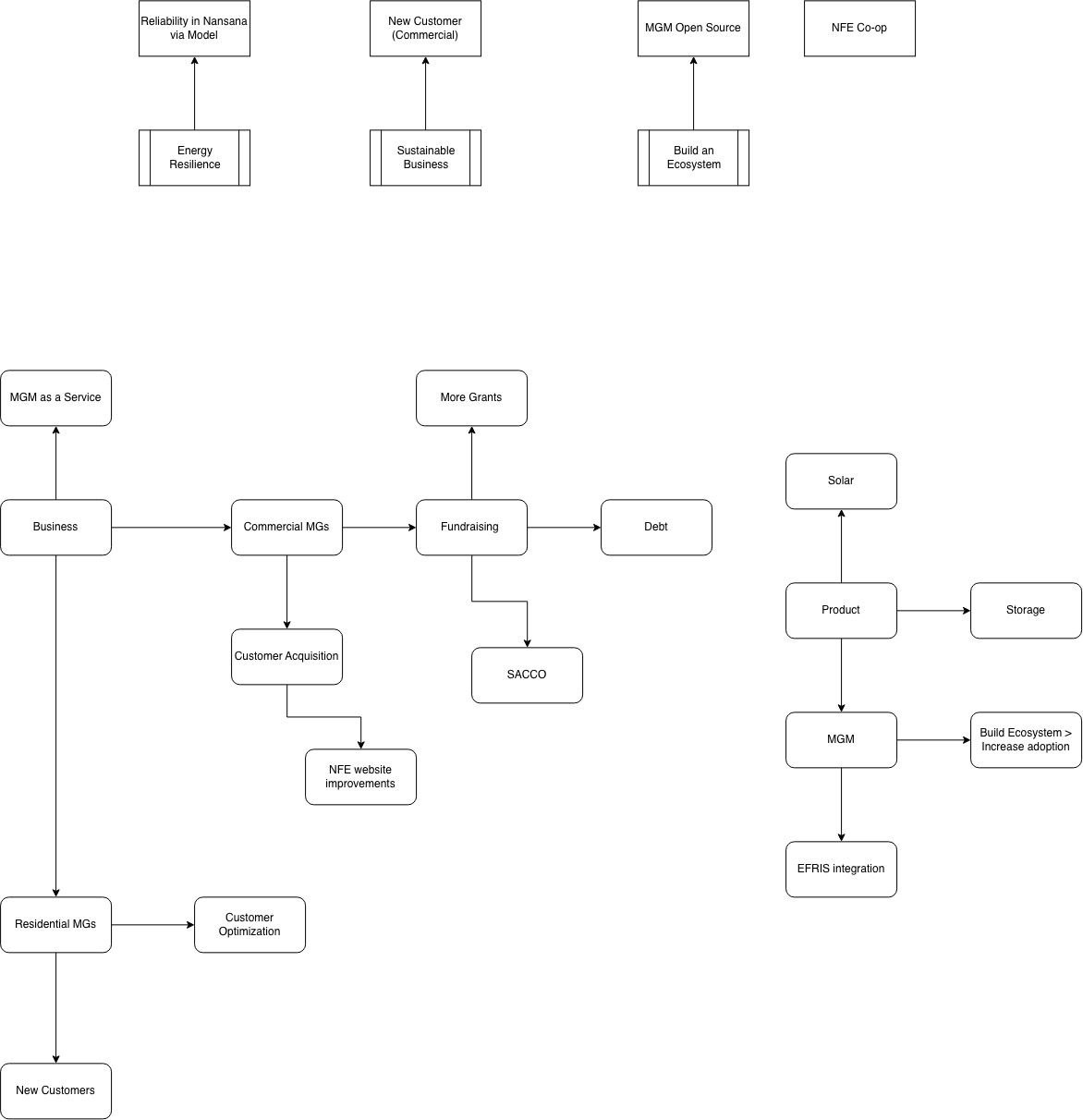
<div drawio-diagram="21"><img src="https://bookstack.nearlyfreeenergy.com/uploads/images/drawio/2025-06/drawing-5-1749871334.png" alt=""/></div>

**6/13/2025**

**Updates and Action items**

**- Dansturn**

- Purchase the PDU in which to put the meters in the course of next week
- complete the BOQ Excel with new revisions
- Receive the meters that arrived from China
- Application for 3 phase commercial from uedcl
- **Aaron**
    - fundraising update to be discussed next week.
    - Collaboration tools to be discussed next week.

- Expectations for next week 
    - [MicroPowerManager](https://cloud.micropowermanager.io/#/welcome)

# NFE Checkin - 20/06/2025

#### Agenda 

Operation Updates

- How to apply for Three Phase connection
- BOQ updates for Sezibwa Rentals

Fundraising updates

- We are tracking [our finances](https://opencollective.com/nfe) on open collective.
- Phase 1: Sezibwa Rentals - [funding status ](https://bookstack.nearlyfreeenergy.com/books/business/page/budget-phase-1-sezibwa-homes)
- Fundraising efforts - [Tracker](https://bookstack.nearlyfreeenergy.com/books/business/page/fundraising-tracker)

Other collaboration tools

- dashboard
- calcom

MicroPower Manager -

- Toggling Calinmeter on/off [in progress](https://github.com/EnAccess/micropowermanager/issues/743)
- Adding Calinmeters via LoraWAN gateway - [In analysis](https://github.com/EnAccess/micropowermanager/issues/742)

#### Action Items 

- Documentation that shows the relationship between the client (Sezibwa Rentals) and NFE. - Aaron can provide MOU
- Examples of Postpaid Bills - Hillary + Dansturn 
    - Code 10.2 to Code 50
- Load Schedule for Sezibwa Rentals - Aaron + Hillary
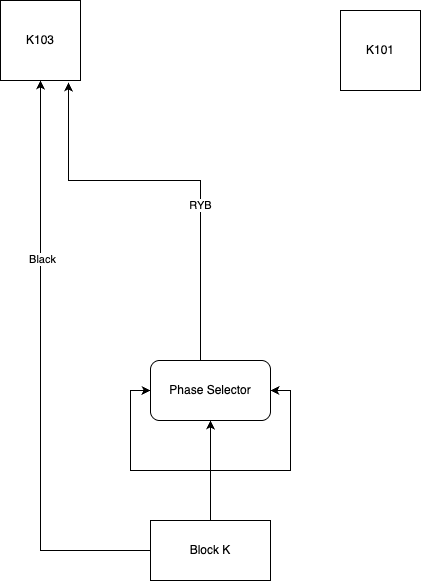
- Confirm that the 10.2 meter come with in built phase selector or if we need a phase selector - Dansturn
- Meeting early next week

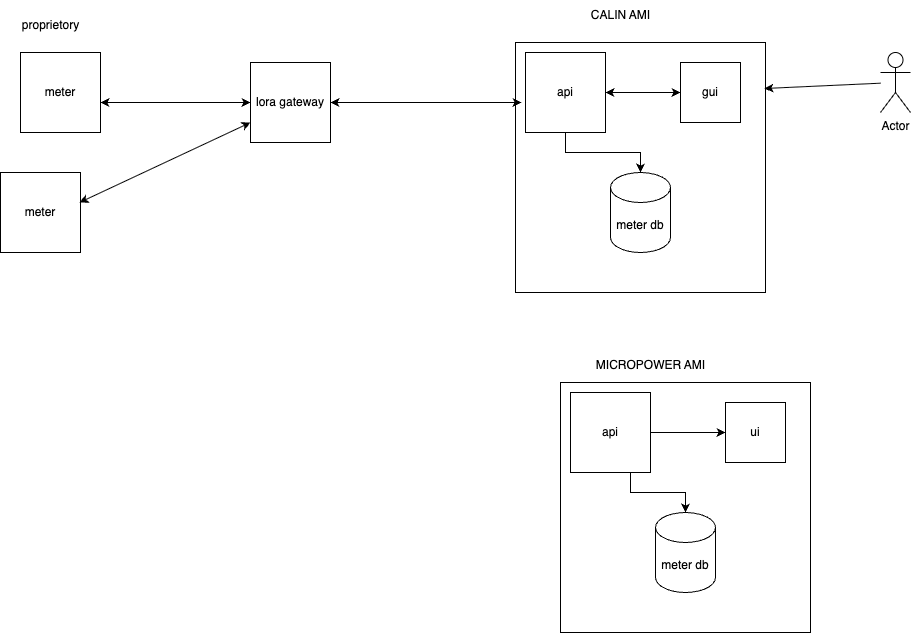
<div drawio-diagram="25"><img src="https://bookstack.nearlyfreeenergy.com/uploads/images/drawio/2025-06/drawing-4-1750480521.png" alt=""/></div>

# NFE Checkin - June 24th 2025

Action items

- Power bank for Gateway - Aaron
- Padlocks for gateway - Aaron
- Set up Calinmeters and Gateway - Dansturn
- Conference list needs compiling - Aaron

# NFE <> EnAccess Checkin

### Attendees 

- Aaron Tushabe - NFE
- Vivien - EnAccess
- Daniel - EnAccess

Meeting link: <span style="color: rgb(34, 34, 34); font-family: system-ui, -apple-system, 'Segoe UI', Roboto, Oxygen-Sans, Cantarell, Ubuntu, 'Helvetica Neue', 'Noto Sans', 'Liberation Sans', Arial, sans-serif, 'Apple Color Emoji', 'Segoe UI Emoji', 'Segoe UI Symbol', 'Noto Color Emoji'; font-size: 15px; font-style: normal; font-variant-ligatures: normal; font-variant-caps: normal; font-weight: 400; letter-spacing: normal; orphans: 2; text-align: left; text-indent: 0px; text-transform: none; widows: 2; word-spacing: 0px; -webkit-text-stroke-width: 0px; white-space: pre-line; background-color: rgb(255, 255, 255); text-decoration-thickness: initial; text-decoration-style: initial; text-decoration-color: initial; display: inline !important; float: none;"> </span>[https://meet.google.com/rpg-vpmw-zzh](https://meet.google.com/rpg-vpmw-zzh)

### Agenda 

- **Introductions**
- **Expectations** for NFE using EnAccess provided [MPM instance](https://cloud.micropowermanager.io/#/welcome) for [Sezibwa Rentals Pilot ](https://bookstack.nearlyfreeenergy.com/books/business/chapter/sezibwa-homes)
    - Daniel: For transparency: We haven't yet had the time to fully clarify and conceptionalise our ToS for MPM, w.r.t SLA/SLO/Uptime promises/Data security, but also pricing to cover the infrastructure costs etc... As a result we currently provide the MPM cloud service this "as-is".
    - Aaron: This is understood and when we are successful with the pilot, we'd like to collaborate on the posibility of agreeing on some Terms of Service or setting up NFE's self hosted instance. I think the community needs an instance to quickly evaluate MPM cheaply and quickly so I'd prefer we collaborate on improving the cloud.mpm.io experience more production ready for new joiners.
- **Support with Regular Community Calls** on MPM/EnAccess projects/materials 
    - Let's talk about how I can help, I have ideas but I some questions first 
        - Who do you recommend I pair with on this one. I am of the view that initiatives are more resilient if we have more than one human co-owning it so I'd like to have someone I pair with to get this going. I can reach out to Thulie add see if she's up for it
        - Anything that has been tried in the past that I should consider before proposing something?
- **NFE overview**
    - I have [a pitch deck](https://docs.google.com/presentation/d/1mNKqGWw_H6QyRjha-BIiT1UvxncdEzU3emUuIpv9T1g/edit?usp=sharing) I keep refining and [our bylaws](https://bookstack.nearlyfreeenergy.com/books/team/chapter/bylaws) share more about our ownership model

### Notes 

### Quick summary

During this meeting, Aaron, Vivien, and Daniel discussed the Nearly Free Energy mini-grid project, the history and current status of the Microgrid Power Manager (MPM) software, challenges related to community adoption and technical implementation, and potential collaboration on pilot deployment and funding sustainability.

### Action items for Aaron

- [ ]  Test and finalize the connection of the newly arrived smart meters with the existing LoRa gateway and the MPM system by the end of the week.
- [ ]  Reach out to Truly (community manager at EnAccess) to plan the first collaborative call focusing on MPM pilot.
- [ ]  Share detailed documentation of Nearly Free Energy’s funding model and business plans with Vivien and Daniel.
- [ ]  Investigate and propose any feature improvements or integration needed for MPM to support Nearly Free Energy’s pilot.
- [ ]  Continue applying for grants to sustain Nearly Free Energy operations and explore co-application opportunities with EnAccess.

### Action items for Vivien

- [ ]  Provide continued onboarding and support for Aaron on the MPM platform and relevant documentation.
- [ ]  Facilitate coordination between Aaron and Truly for community engagement and calls.
- [ ]  Share more detailed information about EnAccess’s current funding, support structure, and pricing policy as it develops.
- [ ]  Invite relevant stakeholders from REA Nigeria and Cameroon to join the community discussions and pilot support.
- [ ]  Assist in documenting prospective features and integrations for MPM in the public GitHub repository.

### Action items for Daniel

- [ ]  Support Aaron with technical guidance on MPM setup, infrastructure reliability, and data backup processes.
- [ ]  Monitor and assist with troubleshooting any compatibility issues between smart meters and MPM, especially regarding Colleen meters.
- [ ]  Ensure automated database backups are working effectively on the cloud infrastructure used for the pilot.
- [ ]  Help Aaron with understanding MPM functionalities, feature limitations, and contribute to the software documentation.
- [ ]  Participate in community management activities and support onboarding efforts for new users like Aaron.

# NFE Checkin - July 4th 2025

### Agenda 

- Sezibwa rentals BOQ review 
    - Open Questions
    - How we are funding it 
        - NFE will fund it
        - Kimbowas will contribute 1k to NFE
        - Arinda will contribute 1k to NFE
        - [Open Collective NFE account](https://opencollective.com/nfe)
- Calinmeter AMI Testing results review 
    - Outstanding issues
- Code 10 application 
    - Code 10 bills
- Github issues on Micropower Manager
- Meeting with Vivien

### Action items 

- Submit Contributions by tomorrow: Dansturn + Arinda
- Find remaining balance for Sezibwa rentals: Aaron
- Submit expenses for Sezibwa Rentals to Open Collective: Dansturn + Aaron
- Follow up with Scott on 
    - Last month meter reading feature: Arinda
    - Needed to retry commands a couple of times, why?: Arinda
- Build PDU and deploy next week: Dansturn
- Code 10 Application: Aaron

# NFE Checkin - July 9th 2025

Agenda

\-

# NFE Checkin 11/7/2025

<div id="bkmrk-"></div>### Agenda 

- Review of Last week's Action items
- Review of progress on PDU setup
- Discuss next steps concerning the power application.

### Review of Last week's Action items 

- Submit Contributions by tomorrow: Dansturn + Arinda == <span style="background-color: rgb(45, 194, 107);">Done</span>
- Find remaining balance for Sezibwa rentals: Aaron === <span style="background-color: rgb(224, 62, 45);">Aaron to update</span>
- Submit expenses for Sezibwa Rentals to Open Collective: Dansturn + Aaron == <span style="background-color: rgb(224, 62, 45);">Pending, Dansturn will submit receipts by Monday </span>
- Follow up with Scott on 
    - Last month meter reading feature: Arinda == <span style="background-color: rgb(224, 62, 45);">Scott hasnt been responsive. Follow up more</span>
    - Needed to retry commands a couple of times, why?: Arinda == <span style="background-color: rgb(224, 62, 45);">Has dependency on Scott, pending</span>
- Build PDU and deploy next week: Dansturn == <span style="background-color: rgb(230, 126, 35);">work in progress. to be done by Monday</span>
- Code 10 Application: Aaron ==. <span style="background-color: rgb(224, 62, 45);">Aaron to update when he wakes up</span>

### Action items for this week

- Complete meter assembly in the PDU by Monday 14th July == Dansturn
- Add stands and secure lock on the PDU and deliver to site by Monday 14th July == Dansturn
- Pull ABC (1 span) to the proposed service point. By Next meeting == Dansturn
- Push connection application in tandem with the pending PDU works == Dansturn
- Follow up Scott again === Hillary

# NFE Checkin 18/7/2025

### Agenda 

- Sezibwa Homes Phase 1 - Deployment Blockers 
    - New CODE 10 application - I tried applying [here](https://selfservicepro.uedcl.co.ug/pouc-ss-client-classic/) but I need a Cert Number
    - PDU Deployment Pictures
- Communication with Scott: Still unresponsive?
- Funding Updates 
    - Sezibwa Homes Phase 2 - 5k grant pledged by Energy IoT open source
    - Expense submissions

### Action items 

- Submit all outstanding expenses for Phase 1 - Dansturn
- Provide Cert Number for Code 10 application (6890377606518) - Dansturn
- Share deployment photography on [Bookstack](https://bookstack.nearlyfreeenergy.com/books/business/page/phase-1-pictorial)
- Customer contact information collected - Aaron
- Complete service cable installations - Dansturn
- Share Recoverable grant funding agreement with Team on - Aaron
- Checkin with Scott - Hillary

# NFE checkin 26/07/2025

### Agenda 

#### Previous action items 

- <s>Provide Cert Number for Code 10 application (6890377606518) - Dansturn </s>
- <s>Share deployment photography on [Bookstack](https://bookstack.nearlyfreeenergy.com/books/business/page/phase-1-pictorial)</s>
- Customer contact information collected - Aaron
- Complete service cable installations - Dansturn
- <s>Share Recoverable grant funding agreement with Team on - Aaron </s>
- <s>Checkin with Scott - Hillary</s>

#### New items to discuss

- Demo 
    - Self serve portal for UEDCL
    - Application approved notice
    - Recoverable grant agreement Template
    - Pictorial Phase 1
    - Dansturn meeting with Vivien follow ups
- Issues for Sezibwa Homes 
    - Umeme Meter box installed outside fence - is this an issue
    - Calin AMI bugs - can we launch with them
- Next steps 
    - Capture customer names and contacts - assign meters
    - Umeme billing portal - How will be get our monthly bill and how are we expected to pay

### Action items 

- Submit all outstanding expenses for Phase 1 - Dansturn
- Customer contact information collected - Aaron
- Complete service cable installations - Dansturn
- Schedule follow-up call with Vivien - Aaron
- Autarky (Titiana) Follow-up call - Aaron
- How to collect data from Chint three phase meter - Aaron/Dansturn

# NFE <> Power for All - July 31st 2025

Had a meet and great with [Joel](https://www.linkedin.com/in/joel-mugyenyi-46417b142/), [Alba](https://www.linkedin.com/in/alba-topulli-9a233a61/) and [Sumaya](https://www.linkedin.com/in/sumaya-mahomed-sustainability/) from power for all.

They shared plenty of questions and feedback on our model. Here's some resources they shared that I am following up on.

- [https://www.ze-gen.org/about-ze-gen/](https://www.ze-gen.org/about-ze-gen/) - TBD
- [https://a2ei.org/](https://a2ei.org/) Working on an open smart meter we could use. Downloaded their data [here](https://bookstack.nearlyfreeenergy.com/books/product/page/a2ei-data) and will reach out to [Thomas](https://www.linkedin.com/in/thomas-duveau-1b2514250/) about an open smart meter
- Oddessy - Battery vendor who may be able to help us with phase 2
- Band

I invited them to join [our advisory team](https://bookstack.nearlyfreeenergy.com/books/team/page/membership).

# NFE checkin 02/08/2025

### Agenda 

#### Action items from last week

- Submit all outstanding expenses for Phase 1 - Dansturn
- Customer contact information collected - Aaron 
    - Done. Entered [here](https://bookstack.nearlyfreeenergy.com/books/team/page/membership) and in [Calin AMI](http://calinami.nearlyfreeenergy.com:5301/)
- Complete service cable installations - Dansturn 
    - We have an extra home instead of the boys quoter
- Schedule follow-up call with Vivien - Aaron
- Autarky (Titiana) Follow-up call - Aaron
- How to collect data from Chint three phase meter - Aaron/Dansturn 
    - Made some progress, it's seeming too costly to get a calin meter that will measure this load, they want to sell us more than just the meter

#### New items 

- Fundraising updates, check the [tracker](https://bookstack.nearlyfreeenergy.com/books/business/page/fundraising-tracker)
    - Energy IoT and battery + inverter donations 
        - They have a battery (20kwh) for us but we need to ship it in from USA
        - She has an inverter for us, it's an 8kw inverter though
        - She will be drafting an MOU to communicate what EIoT needs out of this engagement
    - Applying for an EU grant (100k to 250k Euros) with EnAccess + Another company
- Business development 
    - Published a tracker for [potential customers](https://bookstack.nearlyfreeenergy.com/books/business/page/potential-customers), I will be following up on those next week.
- Setting up MicroPower Manager 
    - Still running into some issues that I am sharing with EnAccess on [Discord](https://discord.com/channels/1228240959473451060/1387523894948401192). We will launch without it and enable it later
- Updates from Location in Nansana 
    - Meter should have been installed
    - We are using UEDCL downstream breakers
    - We will not use the customer's solido
    - Safety risk if the solido is live - we need to terminate it - how?
- Calin AMI open issues

#### New Action items 

- Submit all outstanding expenses for Phase 1 - Dansturn
- Collect National IDs for all customers
- Complete service cable installations - Dansturn
- Follow up on shipping battery and inverter to Uganda by October - Aaron

# NFE Mid week 08/06/2025

### Agenda 

- Site layout review

### Action items 

- Review cost pf phase selectors and see if we can add them to phase 1.1- Dansturn
- Provide meter reference - Dansturn
- Reach out to our UEDCL connections - Hillary | Dansturn | Aaron

# NFE Checkin 8/8/2025

### Agenda 

### Action items from Last Week

- **Review cost of phase selectors and see if we can add them to phase 1.1- Dansturn**
    - to be shared.
- **Provide meter reference - Dansturn**
    - This was provided
- **Reach out to our UEDCL connections - Hillary | Dansturn | Aaron**
    - Meter paid for by Aaron. No meters currently. check meter proposed. Action item still active

### New updates

- Hopetelle meters arrived yesterday 7/8/2025 - 10 meters plus their DCU

### New Actions items

- Reach out to our UEDCL connections - **Hillary | Dansturn | Aaron**
- Review cost of phase selectors and see if we can add them to phase 1.1- **Dansturn**
- Suggestion to power the PDU with one of the existing power sources.- **Aaron**
- Get in touch with Hopetelle team about connecting meters to AMI, etc - **Aaron**
- Set up around 5 meters with a DCU as we await AMI communication - **Dansturn**
- Accountability for the money used for 3 phase extension and installation Umeme meter box, meter - **Dansturn | Aaron**

# NFE / SLS Energy / Energy IoT -intro meeting

### Quick summary

During this meeting, Arila, Merci, Léandre, and Aaron discussed a collaboration on an open-source microgrid project in Uganda, focusing on battery storage solutions, battery-as-a-service models, and integration with open-source energy management systems. They explored technical specifications, cost models, and operational challenges related to battery backup, grid outages, and energy trading platforms. The participants also considered opportunities for mentorship programs and local community involvement to support sustainable energy solutions.

### Action items for Arila

- [ ]  Facilitate the sharing of open-source hardware and software specifications (e.g., open BMS, hi-fi APIS) with Aaron and Léandre for integration and testing.
- [ ]  Share a diagram of the submetring panel and energy management setup with Léandre and Aaron.
- [ ]  Coordinate engagement with local universities and mentorship programs to involve students in the energy projects.
- [ ]  Support defining the Memorandum of Understanding (MoU) that will outline the pilot project's scope and transition to commercial stages.
- [ ]  Monitor progress and provide sponsorship funding for battery storage for the pilot project starting by October.

### Action items for Léandre

- [ ]  Provide detailed battery data sheets and specifications for the 48V 2.5 kWh and 5 kWh systems to Aaron and Arila via email.
- [ ]  Clarify and confirm the service pricing structure and cost model with Aaron for the pilot microgrid project in Uganda.
- [ ]  Share information about current battery monitoring systems and explore integration with open-source BMS and EMS solutions.
- [ ]  Assist in logistics and regulatory requirements for shipping batteries within East Africa, especially Uganda and Rwanda.
- [ ]  Engage in discussions to define the terms of collaboration and commercial agreements related to battery-as-a-service.
- [ ]  Consider sharing technology and expertise for the semi-mobile irrigation battery systems as a potential learning case.

### Action items for Aaron

- [ ]  Share detailed data on current microgrid capacity, battery needs, and outage patterns for community planning.
- [ ]  Provide feedback on battery service pricing and integration from Nearly Free Energy's perspective.
- [ ]  Collaborate with Léandre and Arila to develop a pilot project plan aiming to start battery deployment by October.
- [ ]  Facilitate contact with local community partners and potentially local universities for mentorship and project support.
- [ ]  Share research and documentation on grid outage causes and tariff structures with Léandre and Arila.
- [ ]  Maintain communications with Léandre and Arila to define the Memorandum of Understanding and commercial framework.

# NFE Checkin 03/08/2025

### Agenda

- Reach out to our UEDCL connections - **Hillary | Dansturn | Aaron**
- Review cost of phase selectors and see if we can add them to phase 1.1- **Dansturn**
- Suggestion to power the PDU with one of the existing power sources.- **Aaron**
- Get in touch with Hopetelle team about connecting meters to AMI, etc - **Aaron**
- Set up around 5 meters with a DCU as we await AMI communication - **Dansturn**
- <s>Accountability for the money used for 3 phase extension and installation Umeme meter box, meter - **Dansturn | Aaron**</s>
- Fundraising updates
- Battery research updates
- Lisencing updates, working with Sam Kizito

### Notes 

**Action items**

- Have a mid week checkin on Wednesday to confirm whether we can connect direcrtly - Aaron
- Review Hopetele documents to prepare for test connection next Saturday - Hillary
- Update Potential customer tracker with new leads - Hillary
- Apply Certificate of Registration - Aaron

# NFE checkin August 30th 2025

### Attendees 

- Dansturn
- Dismas - Green Volta Engineer
- Aaron

### Agenda 

- Going live in Sezibwa Microgrid
- CIUs - do we need them

### Notes 

- Dismas: Cables were laid to the Main house, R2 and R3. Connection to R3 was attempted and Meter input voltage was ~220V but output voltage was ~ zero.
- Dansturn: Aaron are the relays on
- Aaron: No, looks like they are off, I did not realize that their default state was off
- Dansturn: Dismas can you share photos of how you connected R3 for review
- Dismas: I did not take photos, I can go back and take photos today
- Dansturn: We need to always take photos, Dismas please make a check list so that you don't forget again
- Aaron: I can be available all morning to turn on meters
- Dansturn: CIUs, do we need to connect them
- Aaron: I don't think so, the CUIs seem to have no use in a postpaid billing world but Hillary thinks customers can use them to check monthly usage but not sure how yet. We may need them later for regulatory purposes but for now, we don't need to install them.
- Communication with Customers is in Progress: We shared this overview with them 2 days ago and NFE whatsapp account joined the whatsapp group of the neighborhood to help answer any questions. [https://app.simplenote.com/p/tdKJBq](https://app.simplenote.com/p/tdKJBq)
- VAT registration (and PAYE) was completed this week.

### Action Items 

- Dismas to return on site today and turn on at least 3 houses, Aaron will be available for remote access. Dansturn will be available to confirm physical connection design
- Hillary to investigate how we can use CUIs

# NFE Checkin - Sept 6th 2025

Going live - any blockers and questions

- How can we tell if UEDCL power is off? 
    - Check the gateway?
    - Let's ask Calimeter

Action items

- Get in touch with Dismas on going live today -Aaron
- Find out from Scott about how to change the low voltage cut off - Hillary

# NFE Weekly Checkin September 13th 2025

### Agenda 

- Fundraising Updates and requests for review
- <s>We are live: What next?</s>
    - <s>Operation strategy </s>
    - <s>Data analytics and reports: how do we take advantage of this </s>
    - <s>How can we tell if UEDCL power is off?</s>
        - <s>Gateway status will tell us</s>
    - <s>Yaka units</s>
- Retrospective on deployment 
    - What went well
    - What did not go so well
    - Things we can approve
- <s>Phase 1.1: </s>
    - <s>Do we need a new AMI</s>
    - <s>Low voltage on some phases </s>
    - <s>3 phase meter smart meter for UEDCL connection</s>
- Game plan for Phase 2
- New team members: Nickson
- Updates from LF Energy in Conference
- How do optimize our costs of materials eg cabling, meters, etc

### Actions 

- Schedule retro during next week's mid week checkin - Aaron
- Communicating with the Chint Meter - Hillary + Dansturn
- Recruiting an Resident Microgrid Manager (5k per hour) - Aaron
- Analytics and reports from Calinmeter - What else can we get from Calin AMI - Hillary
- URA monthly filling - We need to engage a person - Aaron
- Do we need a power backup for the Lora Gateway - Hillary
- Compliance and Safety inspection letter from Certified Engineer - Dansturn
- Submit expenses from Greenvolta - Aaron

# NFE Weekly Checkin September 19th 2025

### Agenda 

- Fundraising Updates and requests for review
- Game plan for Phase 2
- New team members: Nickson
- Phase 1.1: How do we resolve phase 1 current issues 
    - Phase selector
    - Reviewing Data from the meters/gateway

### Actions from previous meeting

- Schedule retro during next week's mid week checkin - Aaron
- Communicating with the Chint Meter - Hillary + Dansturn
- Recruiting an Resident Microgrid Manager (5k per hour) - Aaron
- Analytics and reports from Calinmeter - What else can we get from Calin AMI - Hillary
- URA monthly filling - We need to engage a person - Aaron
- Do we need a power backup for the Lora Gateway - Hillary
- Compliance and Safety inspection letter from Certified Engineer - Dansturn
- Submit expenses from Greenvolta - Aaron

Retro was conducted: https://ideaboardz.com/for/Sezibwa%20Phase%201%20Retro/5640560

# NFE Mid week Checkin September 25th 2025

- Sezibwa Phase 1.1 Progress updates
- Calinmeter Gateway issues
- Billing readiness
- Battery / Inverter evaluations updates

Notes

Actions

- Collect data for phase issues in Sezibwa - Aaron + Hillary
- Manage Calinmeter issues and refocus on new solutions -
- Follow up on FenCon battery/inverter pricing - Aaron
- Follow up on Gonahasa's Solar/Battery and inverter system - Aaron

# NFE weekly checkin October 11th 2025

General Updates

- [Usage and billing for September](https://nextcloud.nearlyfreeenergy.com/s/trBgcrG9Gfq2gtj):
- Battery evaluations: we have some local suppliers: See [SRNE](https://bookstack.nearlyfreeenergy.com/Compliance%20and%20Safety%20inspection%20letter%20from%20Certified%20Engineer%20-%20Dansturn)
- We have a URA person to help with monthly filling
- Engaged a lawyer on Certificate of registration from ERA -

Agenda

- Discuss usage and billing issues 
    - Postpaid - how is that going
    - Meter accuracy? UEDCL meter seemed to come up with less than our meters
    - Lora gateway issues relapsed
    - Waiting to configure daily report issues when China team is back from national holiday next week
    - Work involved in invoicing
- Phase 2 
    - Budget: We are at about 20m right now - should we begin the fundraising? 
        - Tushabe family contributed another ~1800 USD
        - Tondo and Greenvolta wanted to contribute
    - <s>Data on usage: still pending Calin AMI issues but we should be able to get it from Daily usage report </s>
    - Suppliers: SRNE currently looking like the best option

Pending Action items

- Compliance and Safety inspection letter from Certified Engineer - Dansturn
- Visit Nakulabye to complain about bill rates - Aaron
- Run last month reports for calinmeter - Aaron
- Collect data on phase variance - Hillary
- Phase 2 next steps - 
    - Meter 2.0 testing
    - Battery + Inverter testing
    - Budget and fundraising

# NFE Weekly - October 18th 2025

Previous actions

- Compliance and Safety inspection letter from Certified Engineer - Dansturn
- Visit Nakulabye to complain about bill rates - Aaron
- Run last month reports for calinmeter - Aaron
- Collect data on phase variance - Hillary
- Phase 2 next steps - 
    - Meter 2.0 testing
    - Battery + Inverter testing
    - Budget and fundraising

Agenda

- Fundraising updates and next steps
- Metering bottle necks
- Scope for Meter 2.0 testing 
    - Communication with AMI
    - Test with at least 5 meters
    - Need a rig with multiple sockets

Action

- Check with Calinmeter on status of pattern approval with UNBS - Aaron
- Check chint meter + calinmeter readings again for variance in October reading - Hillary
- Move gateway outside for a day or two, move it to main house - Aaron
- Collect data on phase variance for half week to inform phase selection - Hillary
- Mount Meters on a rig and deliver test rid to buwate, Hillary's garage - Dansturn / Hillary
- Running OpenEMS in a test environment - Hillary + Aaron

# NFE Weekly Checkin - October 25th 2025

Agenda

- Battery evaluation updates
- Fundraising Updates
- 100% paid up for September
- We have a mailing list manager (new app)

Action items

- Relocate new meters to Buwate Lab @ Arindas - Dansturn
- Onboard Sevo to help with Data modeling and analysis for battery sizing - Aaron
- Evaluate Zembo and other local suppliers for batteries - Dansturn

# NFE Weekly Checkin - Nov 1st 2025

### Agenda 

- Fundraising Continues 
    - Praxis not successful
    - Submitted [D-Prize (20K) ](https://d-prize.org/#application-process)
    - Up Next 
        - Tondo
        - Akampa
        - Tom
        - Sevo
        - Energy IoT (fiscal sponsorship at 10% fees)
        - Kickstarter
- Metering 2.0 
    - Working with Energy IoT to set up OpenEMS
- Initial [ROI Projections](https://matrix.to/#/!QltThtXhbdLCWFnsAx:matrix.nearlyfreeenergy.com/$dMwmG3L98uTENg2tMD4L9hlxrFnJFfbPFOCLkKmVohY?via=matrix.nearlyfreeenergy.com) for Phase 2
- Registering US entity to aid fundraising

### Action items 

- Export Daily usage data from CalinAMI to determine maximum demand - Aaron
- Possible Pilot for NFE USA - Aaron

# NFE Weekly Checkin - Nov 15th 2025

##### Previous meeting action items

- Export Daily usage data from CalinAMI to determine maximum demand - Aaron 
    - See initial results [here,](https://chatgpt.com/share/691815a5-d418-800c-beff-0c7f7f1c0526) Sevo also committed to doing similar analysis, waiting for his feedback
- Possible Pilot for NFE USA - Aaron

##### Actions Items

- 10 Hopetele meters with a board today 15th Nov 2025 to be delivered to Arinda's Buwate residence - Dansturn
- OpenEMS edge on raspberry pi running - Hillary
- Confirm installation guidelines from SRNE - Aaron
- Detailed breakdown of the Kyanja installation by midweek- Dansturn
- November invoices breakdown
- Midweek weekly check-in Thursday 6-7 am Ugandan time

# NFE Checkin - Jan 7th 2026

### Agenda 

- Roadmap review

### Action Items 

- What will postpaid using Metering 2.0 look like? Will the regulator approve? - Aaron
- Can we sell the product we currently have running at Sezibwa? - Dansturn and Aaron

# NFE weekly checkin - Jan 22nd 2026

### Agenda 

- Product at Sezibwa readiness
- Update on Metering 2.0
- Funding Updates

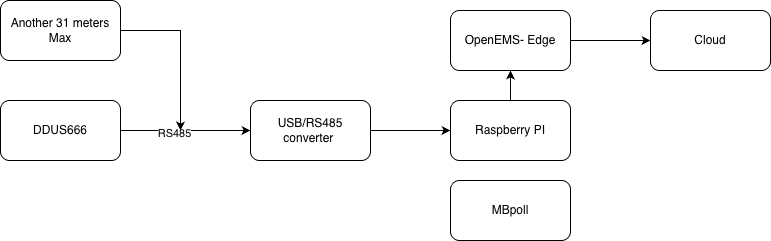
<div drawio-diagram="74"><img src="https://bookstack.nearlyfreeenergy.com/uploads/images/drawio/2026-01/drawing-4-1769060135.png" alt=""/></div>

### Action Items 

- What will postpaid using Metering 2.0 look like? Will the regulator approve? - Aaron
- Can we sell the product we currently have running at Sezibwa? - Dansturn and Aaron
- Ask Chint what UNBS approval this smart meter have? - Aaron
- Engage Hillary and Abdul for a session to guide on current blockers - Arinda
- Modbus security risks report - Arinda

# NFE weekly checkin - Jan 29th 2026

Notes

- Metering 2.0 Updates: We are ready to test openEMS edge during this Friday's working session
- Grant applications: we need an Estonian partner for ESTDEV and we need to continue pace of 1 funding application per week
- Whole House backup 
    - Pricing seems higher but maybe worth the value prop of 24 7 power
    - Demo Open Solar CRM

Action items

- Prepare open solar demo for next week - Aaron
- Pitch for Submetering to Lofty Skies customer - Aaron + Dansturn
- Review investor readiness checklist - Dansturn
- Time tracking reminders - Aaron

# NFE Checkin - Feb 6th 2026

Agenda

- OpenEMS
- Fundrasing Update

# NFE checkin - Feb 12 2026

### Deployment Checklist 

- Internet connectivity - orange
- Meter Modbus conversion - orange
- BOQ - green
- deployment pipeline - orange

### Action Items 

- Prepare hardware for gateway deployment to Nansana - Aaron 
    - Sourcing the right internet connectivity device
- AI workflow integration in Design/Quotation/BOQs - Dansturn
- Deploy gateway and 3 phase meter to Nansana - Dansturn
- Get meter unlock script from Hillary Zembo - Hillary

# NFE Weekly Checkin - March 21 2026

### Agenda 

- Demo for Metering 2.0 Changes
- Review of NFE business models: [https://bookstack.nearlyfreeenergy.com/books/business/page/draft-business-models-for-the-nfe-microgrid-os](https://bookstack.nearlyfreeenergy.com/books/business/page/business-models-for-the-nfe-microgrid-os)

### Action items 

- Data analysis from most recent dump from about 2 days of Grid meter data - Aaron
- Set up local environment (meter + pi ) for testing changes before deploying to production - Hillary
- Procedure for commissioning a new meter and setting up to log data - Hillary / Aaron
- Serial numbers from Nansana - Dansturn / Dismas

# NFE Tech Huddle - April 3rd 2026

### Quick summary

During this meeting, Aaron, Hillary discussed, the current meter-logging system, data buffering and aggregation approach, deployment pipeline, backup and metadata storage, and commissioning/precommissioning of meters.

### Action items for Aaron

- [ ]  Wrap up gateway deployment repo and onboard Hillary so he can use it going forward
- [ ]  NFE Web app integration with real (CSV) data via nextcloud once Hillary has populated sample meter data; coordinate timing for verification.

### Action items for Hillary

- [ ]  Implement and enable the 15-minute buffering and averaging approach (already in place) and ensure exported log entries represent averages for each 15-minute window; document the buffering logic.
- [ ]  Adjust the backup/upload timer to start with hourly uploads and monitor cost/performance; report recommended cadence after initial test period.
- [ ]  Deploy the meter services to the other production Pi and validate that the metadata folder is populated with meter folders (start tonight where possible).
- [ ]  Add a commissioning/precommissioning script that converts meters from the Chinese protocol to Modbus, assigns temporary address 1 for precommissioning, then writes the production address and serial number; document the commissioning procedure and constraints (e.g., stopping services may lock serial port). Onboard Dansturn to execute on this
- [ ]  Share the correct metadata/metadata folder link and confirm access is granted to Aaron; reorganize folder structure as discussed (metadata -&gt; customer -&gt; meter folders).
- [ ]  Test image building and deployment flow (VM build -&gt; push to main -&gt; CI build image -&gt; manual deploy) and document the exact deployment commands.
- [ ]  Test upgrading the client version in a staging environment and report any compatibility/security concerns before upgrading production.

Notes: Hillary already demonstrated the buffering (10s sampling, 15-min average) and the backup/upload service; team agreed to start with hourly uploads and scale as needed. Commissioning constraints and Modbus address conflicts were discussed; precommissioning workflow will be created to avoid on-site conflicts.

# Nfe Weekly checkin - 4th April 2026

### Agenda 

- Review of last week's action items
- Way forward based on feedback
- Discuss a little bit about the pre-commissioning process
- Backup battery updates
- Chint meter deployment plan

### Action items feedback

- Data analysis from the most recent dump from about 2 days of Grid meter data - Aaron - This was done. Preliminary 2-day feedback returned, with concern about the 45kw spikes. needs to be reviewed.
- Set up local environment (meter + pi ) for testing changes before deploying to production - Hillary- Done, testing would be better with a three-phase meter. Aaron also has a dev PI set up.
- Procedure for commissioning a new meter and setting up to log data - Hillary / Aaron - draft presented, to be optimized for Nansana
- Serial numbers from Nansana - Dansturn / Dismas - provided

### Action items 

- Procurement of meters - Dansturn
- Installation and commissioning - All
- Battery backup updates - Aaron

# Tech Huddle - Behind the Meter Connection for each customer

> How each customer is metered and controlled behind the bulk connection, in the Street-EMS design. Companion to the authoritative page "NFE metering strategy + Glen Street-EMS".

## The question

Behind NFE's single bulk utility connection sit many single-phase tenants. "Behind the meter connection for each customer" is how we meter, bill, and control each of them individually without a separate utility meter per tenant.

## Today (CHINT + Pi)

Each tenant has a CHINT DDSU666 postpaid meter on a DIN rail. A Raspberry Pi gateway polls them over Modbus RTU / RS485 and feeds OpenEMS. Billing is postpaid off the meter reads. Control (disconnect) is manual at the breaker.

## Street-EMS (next generation)

One cabinet meters and controls up to 9 tenants (3 per phase) with no per-tenant meter:

- **Metering:** 3 stacked CircuitSetup 6-channel CT boards on the EMS controller give 18 CT channels: one per tenant (9), one per phase mains (3), and 6 spare. Each tenant's usage is a dedicated CT (no separate meter box).
- **Control:** each tenant runs through a contactor (K1..K9) whose coil is driven by an opto-isolated SSR from the EMS. That is the per-customer remote connect/disconnect used for prepaid enforcement and protection trips.
- **Safety:** three Ivy residual-current monitors (one per phase) give continuous leakage and neutral-imbalance insight across all tenants on that phase.
- **Per-tenant policy:** the EMS holds a JSON "mode" per tenant (prepaid expiry, over V/I/kW/kWh, over-generation/storage), and can warn (RGBW LED or e-paper, flash cadence) before a graceful cutoff, optionally leaving a small post-sunset lighting allowance from battery.

Ratified: 1P (do not switch neutral except for EV), 80A rating for future EV. See the authoritative page for the full line diagram, firmware vision, and workshop context.

# NFE Checkin - 11th April 2026

### Agenda 

- Financial Model game plan: https://bookstack.nearlyfreeenergy.com/books/team/page/financial-model-game-plan-q2
- Sezibwa Site plan changes for phase 2: [https://bookstack.nearlyfreeenergy.com/books/business/page/sezibwa-site-plan-for-phase-2](https://bookstack.nearlyfreeenergy.com/books/business/page/sezibwa-site-plan-for-phase-2)
- Demos 
    - Pi deployment
    - Customer App v1

### Action items 

- Complete Kyanja energy/power audit inspection - recommendations - @Dansturn
- Get specsheets and dimensions for batteries and inverter - Aaron
- Decision on physical location of batteries and inverter - Hillary and Dansturn
- Data from NFE microgrids - How can we productize this (target for Q2) - Aaron

# NFE Checkin - May 16th 2026

### Agenda 

- Metering 2.0 Updates 
    - Customer App
    - OpenEMS 
        - Support for DDSU and DTSU
        - Deployment Automation for the gateway
    - MBE - Metering and Billing Engine 
        - New invoices
- New customers 
    - Pearl Marina
    - Kyanja
    - Kyaliwajala
- Phase 2 in Nansana 
    - Civil work
- Managing Customer Data
- Funding / 
    - Women Owned Green Business
    - LF Energy Summit 2026
- Metering 3.0 
    - Working with Glenn

Action items

- Update Customer App to show usage using billing markers - Aaron
- 

# NFE Checkin - May 23rd 2026

### Last week's Agenda 

- Metering 2.0 Updates 
    - Customer App -**successfully demoed**
    - OpenEMS 
        - Support for DDSU and DTSU - **both changes merged. release expected first june 2026.**
        - Deployment Automation for the gateway - **Not discussed**
    - MBE - Metering and Billing Engine 
        - New invoices - **Demoed**
- New customers 
    - Pearl Marina
    - Kyanja
    - Kyaliwajala
- Phase 2 in Nansana 
    - Civil work
- Managing Customer Data - **I want the link**
- Funding / 
    - Women Owned Green Business - **Green volta totally in (week 2 of 10)**
    - LF Energy Summit 2026 - **submission underway**
- Metering 3.0 
    - Working with Glenn - prepare for Nairobi workshop

Action items

- Update Customer App to show usage using billing markers - Aaron

### Agenda

- Metering 2.0 Updates 
    - OpenEMS  
        
        - Deployment Automation for the gateway
    - MBE - Metering and Billing Engine
- New customers 
    - Pearl Marina
    - Kyanja
    - Kyaliwajala
- Phase 2 in Nansana 
    - Discussion happening today - happening now
    - Architectural design of the connection

Action items

- Submit the LF energy paper - Aaron
- remove dependency of local pc for uploading customer data to superbase for free - Hillary
- Put demo together and do some testing on test pi for single phase next week - Aaron
- Set Dansturn's account up - Aaron
- BOQ with 1 variable line for the cheaper and more expensive location - Dansturn

# EnAccess <> NFE Checkin - June 2nd 2026

## Attendees

- Aaron T.
- Vivien B.
- Obinna I.
- Daniel M.

## Overview

The call focused on whether MPM should evolve to better support grid-connected mini-grids, especially postpaid billing, meter integrations, and monitoring of batteries/solar assets. The team agreed the current direction is promising for the Nigerian mini-grid use case, but emphasized that new capabilities should be integrated carefully so the platform remains technically coherent and maintainable.

## Why the conversation happened

Aaron raised a strategic question: whether the current MPM product is being pushed beyond its original design by supporting grid-connected mini-grids, or whether a new system should be built instead. Vivien and Daniel clarified that MPM was historically built as a mini-grid CRM and later adapted by solar home system companies by the newest work in Mozambique. However, new conversations with REI in Nigeria is increasingly steering it toward mini-grid needs again.

## Product positioning and strategic direction

Vivien explained that MPM’s roots are in mini-grid operations and CRM workflows, not solar home systems, even though solar home system companies adopted it over time. He noted that recent demand from Mozambique and a larger contract in Nigeria are driving more mini-grid-specific work, including OEM integrations, dashboard hardening, and other adaptations.

The team also discussed the upcoming PayGo Ops community edition, which may better serve some solar home system users. Vivien’s view was that this does not undermine MPM’s mini-grid identity; rather, it highlights that MPM should keep focusing on the mini-grid segment while remaining open to adjacent use cases where appropriate.

## Postpaid vs. prepaid metering

A major topic was Aaron’s observation that the pilot became easier when the team moved away from a proprietary prepaid meter setup and adopted postpaid billing. Aaron had originally feared that MPM might be too biased toward prepaid workflows, and wondered whether postpaid mini-grid support would require an entirely new system.

Daniel responded that prepaid metering is easier to support technically because the abstraction is straightforward: a customer pays, a tariff applies, and energy is delivered. Postpaid introduces more complexity because it requires tracking usage over a billing period, calculating debt/amount owed, and handling billing logic in a less linear way. Daniel said MPM already has some related concepts, but postpaid still requires careful design so the abstractions remain coherent.

## Metering and data acquisition lessons from the pilot

Aaron described the operational problems they faced with a Chinese vendor, Kalin: the meters claimed to support both prepaid and postpaid, but the vendor did not expose meter data directly. Instead, the team had to use proprietary middleware APIs hosted by the vendor, which caused reliability issues, token-lockout problems, slow support response times, and pressure to place larger orders before the pilot was stable.

To solve this, the team switched in March 2026 to locally sourced meters that are postpaid-only and expose data via RS-45/Modbus into a Raspberry Pi, which is then connected to the internet through a modem. This setup gave them direct access to meter data, reduced dependency on the vendor, and eliminated the operational risk of needing tokens from overseas just to unlock a customer meter.

Aaron also noted that the meters are physically clustered in a single PDU, which makes wired connectivity practical in this pilot. Vivien pointed out that this works for dense apartment-complex style deployments, but would not translate well to rural, dispersed mini-grids where wireless communication is usually more appropriate.

## Open-source monitoring and OpenEMS integration

Aaron said the pilot team had already contributed a plugin to OpenEMS so that usage data from the new meters can be read in real time. He suggested a future model where OpenEMS handles monitoring of meters, batteries, and solar assets, while MPM handles business functions such as billing, invoicing, and customer communication.

Daniel and Vivien were receptive to this division of labor. Vivien emphasized that the goal should be integration rather than rebuilding existing open-source tools. He referenced the existing Prospect integration as a model: ideally, MPM should connect with external monitoring systems in a way that lets users move seamlessly between tools rather than duplicating functionality.

## Battery and solar support

Aaron asked whether MPM was originally intended to handle batteries and solar generation data as part of mini-grid operations. Daniel clarified that this was not part of the original core focus. MPM’s main scope has been customer transaction management and business workflows, not system monitoring.

That said, Daniel acknowledged that there is a gray area where battery or solar data affects billing, and therefore may need to be integrated into MPM workflows. He stressed that system monitoring should not simply be bolted on as a disconnected feature. Instead, the team should think carefully about where such data belongs, how it is modeled, and how it can be integrated without making the product overly complicated.

## Billing, customer visibility, and invoicing features

Aaron demonstrated the pilot’s customer-facing web app, which lets customers see their usage, estimated bill, and end-of-month projection. The app refreshes automatically every six hours, with manual refresh available. This was intended to reduce uncertainty for customers and let them see charges before the monthly billing cycle closes.

He also showed the microgrid manager billing interface, where customer data is imported, billing cycles are created monthly, invoices are generated, and payment links are attached through a payment service. Aaron highlighted this as one of the strongest parts of the pilot and argued that MPM should gain similar invoicing capability, alongside an integrated payment-provider flow and an OpenEMS data source.

The group agreed that these were the most concrete candidate features to pursue. Aaron said his team could likely push the payment integration and invoicing work, while also helping define the OpenEMS plugin approach and continuing conversations with Nigerian partners.

## Nigeria and regulatory relevance

Vivien stressed that Nigeria is especially relevant because it has an active mini-grid market, including grid-connected mini-grids, structured regulation, and tariff systems that resemble the use case Aaron is working on. Aaron agreed, noting that Uganda’s regulator is increasingly looking to Nigeria as an example for policy development, and that his team is preparing a paper to make the case for adopting elements of Nigeria’s regulatory framework.

The discussion made clear that Nigeria is both a strong market for the problem and a promising source of practical solutions. Vivien also suggested Aaron could observe some conversations EnAccess has with other community members who are focussing on Mini-grids.

## Managing codebase complexity and simplification

Later in the call, Aaron asked whether there should be a roadmap for removing or disabling legacy features from MPM, since long-running applications tend to accumulate unused functionality. Daniel said the team had spent much of 2025 removing things, but had recently shifted toward adding new capabilities. He agreed that managing complexity is an ongoing concern.

Daniel distinguished between two kinds of simplification:

- user-facing simplification, such as hiding advanced options by default or using more sensible defaults;
- backend simplification, which is harder because core abstractions like “mini-grid” are deeply embedded in the codebase.

Obinna added that from his experience, the team usually receives feature requests rather than removal requests. He suggested that if the roadmap included clearer visibility into unused functionality, he could help identify features that no one appears to use and also warn when something that looks unused is actually used by someone else.

## Key takeaways

- MPM is still seen by the team as a mini-grid CRM, not just a solar home system platform.
- Postpaid support is viable, but it needs deliberate abstraction design.
- Direct meter integration and open data access are critical for reliable mini-grid operations.
- OpenEMS is a strong candidate for handling monitoring, while MPM should focus on billing, customer/account management, and payment workflows.
- The strongest near-term product opportunities are invoicing, payment-link generation, and an OpenEMS data-source integration.
- The team should continue exploring simplification opportunities, but removal of legacy code or features needs a more explicit process and roadmap.

# NFE checkin - June 6th 2026

**Agenda**

- Nansana phase 2 - budget review
- Metering 2.0 - what next
- Kyanja phase 1 - updates

**Notes and action items**

- Review phase 2 budget with contractor after the team made adjustments - Aaron/Dansturn
- Kick-off Pearl Marina and Kyaliwajala - Phase 1 - Aaron
- Metering 2.0 - blog post - Aaron
- Automated Billing with MBE and Customer App - Hillary

# NFE Mid week checkin - June 11th

Attendees

- Hillary
- Aaron

Agenda

- Deploying OpenEMs

Recording is [here](https://nextcloud.nearlyfreeenergy.com/s/oeF2naAPegwL9Yj)

# Hillary / Aaron - Tech Huddle - June 29th 2026

 [Meeting Transcription.txt](https://bookstack.nearlyfreeenergy.com/attachments/64)

Recording [here](https://drive.google.com/file/d/1wP4viSbs4frkvkwEFGnZ2L_d3ImyYyHU/view?usp=sharing)

# NFE Checkin - July 4th 2026

### Agenda 

- Storage 1.0 
    - Nansana Battery Deployment: Ready to go live, waiting for review by Dansturn
- Metering 2.0 
    - OpenEMS - what is pending?
- Billing 2.0 
    - MBE monthly invoices automated
    - Ifris invoices still manual but API available: needs work
- New customers 
    - Kyaliwajala - Not started
    - Kyanja 
        - Quoted, pending meter payment
        - Client also troubleshooting 3 phase connection
    - Garuga 
        - Survey completed, pending quotation
        - Initial civil work pending: not yet quoted
    - Funding for next phases not available
    - May need to get backup locations to help us get to 100 customers.. Right now we only have Kyanja and
- NFE annual tax returns 
    - Getting accounting help from Esther to file this. May need to switch to a better accounting system
- Fundraising and publicity 
    - Digital Energy Challenge Submitted - No feedback yet
    - ERA Symposium postponed to Feb 2027
    - Power Africa - Need to apply for sponsorship: [https://docs.google.com/forms/d/e/1FAIpQLSefYPSRGp7ur9f2-FIIYXo56T9WlCswwrue7\_1\_h6uc34TsDw/viewform](https://docs.google.com/forms/d/e/1FAIpQLSefYPSRGp7ur9f2-FIIYXo56T9WlCswwrue7_1_h6uc34TsDw/viewform)
    - IEEE Meet the Entreprenuer: https://ieee-powerafrica.org/meet-the-enterpreneur-competition/
    - EnAccess OSEA symposium in Rwanda: [https://www.oseas.org/attend](https://www.oseas.org/attend)
    - LF Energy Berlin: pending sponsorship application
    - Stanbic Bank Women's something?

# NFE Checkin - July 25th 2026

### Agenda 

- Demos for work from this week 
    - Nansana Deployment
    - OpenEMS development and deployment workflow
    - Storage 2.0 changes for OpenEMS edge
- Fundraising efforts 
    - OSEA
    - LF Energy
    - Power Africa 2026 : Feedback on Glenn's line diagram
    - Stanbic Regenerate Africa

Meeting title: Meeting Transcription  
Date/time started: 2026-07-25T03:21:56.000Z  
Participants: Hillary Arinda, Aaron Tushabe, Dansturn Kimbowa

Summary (up to three sentences)

- The team reviewed a one-line electrical diagram and system design for multi-channel metering, residual current monitoring, relays/contactors and an EV charging element, clarifying components, labeling and communication paths. They discussed participation and logistics for the Power Africa workshop (possible sponsorship, travel, equipment shipping) and follow-up workshop options (including Kigali), plus field issues at the Nantana site including cable heating, inverter behaviour and monitoring. Operational updates included Nascent system performance, inventory/cable returns, and fundraising/partnering progress for Regenerate Africa / GreenVoter pitches.

Action items by person

Aaron Tushabe

- [ ]  Follow up with the Power Africa organizer on sponsorship details, ticket coverage and logistics (equipment shipping / customs), and explore moving the workshop to Kigali as an alternative. (No fixed deadline given; follow up ASAP)
- [ ]  Resubmit feedback/questions on the one-line diagram to the designer, requesting clarifications on labels, arrows, RS485 routing, power sources, and contactor/relay sizing (63A vs 80A). (ASAP)
- [ ]  Arrange a call or workshop pre-meeting with the diagram author to hammer out unresolved technical details and confirm components to be supplied at the workshop. (ASAP)
- [ ]  Return leftover cables to Greenwater and coordinate inventory/accounting of site investments and invoices. (ASAP)
- [ ]  Follow up on Nascent site testing: schedule/perform additional on-site tests for inverter and EV charging scenarios to reproduce reported cable heating and collect temperature data (consider ordering a temperature gun). (No fixed deadline; prioritize before next site visit)

Hillary Arinda

- [ ]  Complete investigation into the Kenyan smart-meter provider (confirm pricing, product details, and contact) and bring back data for the team. (ASAP)
- [ ]  Review and comment on the one-line diagram legend and component labels (e.g., clarify RCM/RCB, feeder labels, meter channel assignments) and send consolidated clarifying questions to Aaron for designer follow-up. (ASAP)
- [ ]  Check LF Energy/sponsorship application status and report any updates to the team. (ASAP)
- [ ]  Assist with planning/testing for Nascent site monitoring (confirm what telemetry/BMS can report and advise on temperature monitoring approach). (Prior to next sprint completion)

Dansturn Kimbowa

- [ ]  Continue follow-up with grant/loan panels (GreenVoter / Regenerate Africa) and provide any additional financials or a revised pitch emphasizing social impact as requested; complete company ownership changes (legal paperwork) required for Women-in-Business grant eligibility. (Legal change/attorney steps planned for this week; follow up on grant outcome when notified)
- [ ]  Confirm whether he can attend Power Africa (or be listed as a speaker/participant) and coordinate accommodation/transport logistics if attending; report back on admission/fee status (possible free speaker pass). (ASAP)
- [ ]  Provide any specific technical questions or clarifications on the one-line diagram (nomenclature, contactor labels, relay/channels, RS485 routing) to include in the resubmission. (ASAP)

No other participants were assigned tasks.

# NFE Checkin - August 8th 2026

**Date:** 8 August 2026  
**Attendees:** Aaron Tushabe, Dansturn Kimbowa, Hillary Arinda  
**Duration:** ~2 hours 5 minutes

## 1. Nansana Pilot &amp; Battery Backup

The Nansana battery backup system is now live and billing has proceeded without major issues. Initial operation indicates a significant reliability improvement, particularly during the daytime. During outages, the batteries have generally supported the site for approximately 1–1.5 hours under heavier evening loads, and substantially longer when customers reduce high-consumption appliances.

A useful behavior has also emerged organically: residents notify each other when the site has switched to battery and encourage reduced consumption. The team agreed this should eventually be automated so customers are notified when they switch to backup power. This would both help extend battery runtime and make the reliability value of the NFE service more visible to customers.

The telemetry stack is not yet sufficiently stable to accurately measure and report outage duration, battery behavior and reliability over time. The immediate priority is therefore to stabilize telemetry and establish a reliable baseline before experimenting extensively with battery operating strategies.

### Battery Optimization

The current battery configuration primarily preserves stored energy for outages. The team discussed experimenting with **time-of-use arbitrage**, where batteries charge during cheaper off-peak periods and discharge during peak tariff periods while maintaining a minimum reserve for outages.

One possible configuration discussed was allowing discharge to approximately 50% during peak periods before reverting to grid supply. These experiments should only begin once telemetry is stable enough to compare their impact on both reliability and margins.

## 2. OpenEMS Migration &amp; Q3 Technical Priorities

The Q3 development objective remains to consolidate both **metering and battery monitoring onto OpenEMS**, creating a common technology stack for future deployments. Once the OpenEMS metering integration and automated billing flow are stable, NFE should have a more commercially scalable sub-metering platform.

Progress has been made integrating the inverter, although discrepancies between available documentation and the installed inverter firmware have required experimentation. The target is to resolve the outstanding inverter integration issues during the coming week.

The team also discussed configuration management within OpenEMS. For Q3, the current configuration-file/Felix UI approach will continue rather than building a new management interface. Building a separate interface was considered outside the current Q3 scope.

Some technical questions remain around:

- How OpenEMS writes configuration changes through to inverter registers.
- Whether charging windows can be changed through the currently exposed registers.
- How future automated optimization software would dynamically modify inverter settings.
- Whether some historical meter data needs to be backfilled into the new stack.

Historical backfilling was considered secondary to getting current data flowing correctly into OpenEMS.

## 3. Billing, Service Charge &amp; Economics

The team reviewed the economics of the Nansana site. It is still too early to determine whether battery installation has materially improved margins because:

- there has not yet been a full operating month;
- the initial battery charging introduced additional consumption;
- electricity tariffs changed during the period; and
- the NFE service charge was also adjusted.

The reliability improvement is already more apparent than the profitability impact.

The discussion highlighted the need for a more rigorous model for determining the appropriate monthly service charge. Future pricing should reflect both:

1. the value of improved reliability delivered to customers; and
2. NFE's actual operating and maintenance costs.

The existing service-charge adjustment was acknowledged as a reasonable pilot decision rather than a fully cost-derived commercial price.

## 4. Battery Funder / Data Sharing

The battery funder is aware that the backup system has been installed and has indicated willingness to potentially contribute an additional small amount toward installation costs. Aaron has a follow-up meeting scheduled for Monday to provide an update and review the roadmap.

The original arrangement requires NFE to share operational data. The team agreed there is no need to make historical data migration a blocker. Existing spreadsheet records can be shared for earlier periods, while newer telemetry can be exported from the current database/OpenEMS stack.

## 5. Analytics Layer / AI-native Operations

The current system collects telemetry into InfluxDB, but NFE does not yet have a defined analytics layer.

The team revisited the broader Microgrid OS architecture and discussed potentially avoiding a dashboard-heavy analytics approach. One promising direction is an **LLM-powered operational analytics interface** sitting over the telemetry data, potentially using MCP or a similar interface to allow users to ask questions such as:

- Which outages lasted longer than three hours this week?
- What is the site's reliability trend?
- How has a particular battery configuration affected consumption or uptime?

The analytics architecture should be revisited as part of future/Q4 Microgrid OS planning.

## 6. Nairobi Workshop — Generation 3 Hardware

The Nairobi workshop is proceeding, with **three sponsored participation slots** currently available.

The team clarified that the objective should not simply be to attend or observe the workshop. The explicit goal is to leave Nairobi with a pathway toward **Generation 3 of the NFE microgrid/sub-metering stack**.

The generations were framed as:

**Generation 1**

- Proprietary hardware.
- Proprietary software.
- Imported equipment.
- Higher equipment and licensing costs.

**Generation 2**

- Locally available but still proprietary meters/hardware.
- Open-source software through OpenEMS.
- Lower hardware cost and reduced software lock-in.

**Generation 3**

- Open hardware that NFE can assemble locally.
- Open-source firmware/software.
- Components that can be repaired or replaced individually.
- Greater control of the full stack.
- Significantly lower per-customer hardware costs.

A preliminary BOQ discussed during the meeting suggested an equipment cost of roughly **US$64 per customer** for the workshop hardware configuration, although this still needs validation.

The team acknowledged that moving the workshop prototype into a production-grade NFE system will require additional engineering, testing, enclosure/assembly work and software integration.

## 7. UNBS Certification

A key open issue for Generation 3 hardware is regulatory approval.

Once NFE begins assembling its own metering hardware and using it for customer billing, **UNBS certification/calibration requirements** will become important. The team needs clarity on:

- the applicable certification process;
- costs;
- testing/calibration requirements;
- documentation required; and
- whether certification applies to the complete assembled PDU, individual meters, or both.

This will determine whether the open-hardware approach remains economically attractive relative to using already-certified commercial meters.

## 8. Customer Pipeline

### Chanjala / Three-phase Connection

The outstanding issue remains the three-phase supply/meter installation. UMEME appears ready to install once the required meter payment and outstanding site-side issues are addressed.

The team discussed proceeding with the meter installation while treating any problems with the customer's internal/network infrastructure separately.

### Dansturn Home Installation

Dansturn would like NFE monitoring installed at his home so that he can better understand his electricity consumption.

This is also considered a useful test environment because it provides the engineering team with a site that is easier to access than Nansana. The same installation can help refine the product before installing for Edward and other individual customers.

Target discussed: **Monday/Tuesday during the coming week**, subject to technician availability.

## 9. Target Customer Strategy

The team revisited whether NFE should prioritize new construction or existing sites.

The conclusion was that existing developments with:

- active electricity consumption;
- meaningful numbers of customers; and
- an immediate reliability problem

remain the more attractive near-term market.

New developments can still be considered where the developer bears the upfront metering/infrastructure cost, but NFE should avoid tying up its own capital for years waiting for occupancy and consumption to ramp up.

## 10. Conferences &amp; Industry Engagement

### Nairobi

NFE currently has three sponsored passes and expects to send the founders/team, subject to individual availability.

### Kigali

The team is also exploring participation in a Kigali event. Aaron will investigate whether NFE can obtain passes and potentially participate as workshop facilitators or presenters.

The team agreed to resume a physical working session on **Friday**, with Nairobi preparation being one of the main priorities.

## 11. Fundraising &amp; Corporate Readiness

NFE is awaiting outcomes from current grant opportunities and needs to identify additional fundraising avenues, particularly to support further deployment work at Pearl Marina and other sites.

The team also briefly discussed ensuring NFE's equity/shareholding documentation is properly organized ahead of future grant, investment or corporate due-diligence processes.

---

# Action Items

<table id="bkmrk-action-owner-timing-"><thead><tr><th>Action</th><th>Owner</th><th>Timing</th></tr></thead><tbody><tr><td>Stabilize OpenEMS telemetry so outage, battery and reliability metrics can be reliably collected</td><td>Aaron / Hillary</td><td>August priority</td></tr><tr><td>Complete outstanding inverter/OpenEMS integration work</td><td>Aaron / Hillary</td><td>Target: next week</td></tr><tr><td>Move remaining Nansana meters onto the common OpenEMS monitoring/dashboard stack</td><td>Technical team</td><td>During August</td></tr><tr><td>Design automated customer notification when the site switches to battery backup</td><td>Hillary / Technical team</td><td>After telemetry stabilization</td></tr><tr><td>Establish a reliability baseline before testing new battery dispatch configurations</td><td>Technical team</td><td>After telemetry stabilization</td></tr><tr><td>Test peak/off-peak battery dispatch strategies and measure effect on reliability and margins</td><td>Technical team</td><td>After baseline is established</td></tr><tr><td>Develop a more rigorous cost/service-charge pricing model for future commercial sites</td><td>Aaron / Team</td><td>Before next larger commercial deployment</td></tr><tr><td>Meet battery funder, provide deployment update and discuss roadmap/data-sharing expectations</td><td>Aaron</td><td>Monday</td></tr><tr><td>Clarify how OpenEMS writes settings to inverter registers and how automated control could modify those settings</td><td>Aaron / Hillary</td><td>Technical investigation</td></tr><tr><td>Revisit Microgrid OS analytics-layer architecture, including LLM/MCP-based querying over telemetry</td><td>Aaron / Hillary</td><td>Q4 planning</td></tr><tr><td>Review Nairobi workshop BOQ/components and ensure the team understands the proposed hardware architecture</td><td>Aaron, Hillary &amp; Dansturn</td><td>Before Nairobi</td></tr><tr><td>Define a concrete **Generation 3 deliverable/plan** for the Nairobi workshop</td><td>All</td><td>Before Nairobi</td></tr><tr><td>Investigate UNBS certification/calibration requirements and likely costs for NFE-assembled meters/PDU</td><td>Team — owner to be confirmed</td><td>Before Generation 3 production deployment</td></tr><tr><td>Follow up on Chanjala three-phase meter installation</td><td>Aaron</td><td>Ongoing</td></tr><tr><td>Arrange monitoring installation at Dansturn's home</td><td>Aaron / Technician; Dansturn to coordinate availability</td><td>Target Monday/Tuesday</td></tr><tr><td>Use Dansturn installation as a nearby development/test environment before rolling out to Edward and similar customers</td><td>Technical team</td><td>After installation</td></tr><tr><td>Investigate Kigali conference/workshop passes and participation</td><td>Aaron</td><td>Follow-up</td></tr><tr><td>Hold physical NFE working session focused on Nairobi preparation</td><td>All</td><td>Friday</td></tr><tr><td>Identify additional fundraising opportunities for upcoming deployments</td><td>All</td><td>Ongoing</td></tr><tr><td>Ensure NFE shareholding/equity documentation is organized for future grants/investment processes</td><td>Founders</td><td>Upcoming</td></tr></tbody></table>

# NFE Checkin - August 29th 2026

### Agenda 

- Fundraising 
    - Debt/Asset financing updates - Stanbic
- Q3 goals - Product Goals 
    - Metering 2.0
    - Storage 1.0
    - EFRIS integration
- Expanding the team 
    - Rajeshwa - Embedded Systems Engineer
    - Chemutai - Accounting
- Customers 
    - Pearl Marina - New requirements
    - Lofty Skies -
- PowerAfrica Readiness
- Calin Meters
- Other China Meters

**Participants:** Aaron Tushabe, Dansturn Kimbowa, Hillary Arinda

### 1. Power Africa / Nairobi

NFE has received travel support for the upcoming Power Africa/IEEE-related activities in Nairobi. The current support appears to include reimbursement of Uganda–Nairobi bus transport up to **US$150/person**, accommodation, airport transfers and most meals. The main outstanding question is the approximately **US$300 conference registration fee**, which was the item NFE had originally hoped would be sponsored.

Aaron's attendance remains tentative because of possible travel restrictions, while Dansturn is expected to attend if possible. The team also discussed the possibility of participating in related activities in Rwanda later in October.

**Decision:** Continue preparing for Nairobi, but clarify whether registration fees can also be covered.

---

### 2. Financing NFE deployments

Aaron reported on his discussion with Stanbic's renewable-energy financing team.

Two financing structures were discussed:

- **Working-capital financing:** requires collateral and is less suitable for NFE's current requirement.
- **Asset financing:** appears substantially better aligned with NFE because the loan can specifically finance solar/battery equipment whose project cash flows repay the loan.

Indicative Stanbic terms are **up to about 15% per annum**, potentially lower for larger transactions, with financing periods potentially extending considerably longer for larger projects.

However, the bank may require:

- audited financial statements;
- evidence of project cash flows;
- project/site due diligence;
- appropriate property/site documentation;
- a qualified/approved EPC or equipment supplier;
- appropriate equipment warranties and maintenance arrangements.

This highlighted an important issue for NFE: procurement, installation and maintenance are currently somewhat separated. For bank-financed projects it may be advantageous to structure these more formally around an EPC relationship with clear manufacturer authorization, installation responsibility and warranties.

For the proposed **~UGX 4 million solar investment at Nansana**, the team estimated repayment at roughly **UGX 190k–200k/month over two years**, depending on the bank's calculation methodology.

The discussion was not simply about obtaining UGX 4 million. The strategic value would be learning the bank's financing process and establishing a financing pathway that could later support much larger deployments such as Pearl Marina.

Dansturn raised the counterargument that debt can encourage progressively larger borrowing and therefore increases risk. Aaron's view was that project-level asset financing can be appropriate where the asset and its project cash flows support the loan and the lender's remedy in a failed project is largely tied to the financed assets.

**Working direction:** Continue investigating the Stanbic facility rather than dismissing it. The team generally considered 15% potentially workable, although Hillary would prefer a lower rate if one is available.

---

### 3. NFE accounting readiness

The financing discussion reinforces the need for NFE's financial records to become audit-ready.

Aaron has started migrating the company's accounting into **Zoho Books** and needs to finish bringing the records up to date before engaging an auditor.

The team also discussed Esther's role supporting the books. Aaron had proposed a **UGX 50,000 monthly stipend**, while Esther asked whether she could receive equity instead.

The existing NFE equity-for-work framework requires roughly **five hours of regular contribution per month**. At the current transaction volume, the bookkeeping work probably does not yet reach that threshold.

**Working position:** Continue with cash compensation for now rather than allocating equity, while leaving open the possibility of equity if the finance workload grows sufficiently.

---

### 4. Nansana battery operation and arbitrage

Hillary raised a concern about whether customer demand could undermine the economics of battery arbitrage.

If customer load exceeds inverter capacity, the inverter may move into bypass/grid operation. This could be particularly important during evening peak periods, when NFE expects battery discharge to reduce grid consumption and improve margins.

The team needs to understand the exact inverter behavior under:

- available grid power;
- available battery energy;
- sufficient battery power capacity;
- but customer instantaneous load exceeding inverter output capacity.

The team also reviewed recent energy summaries and noticed surprisingly little reported battery discharge, despite known instances where the site has operated on battery.

This raises the possibility of a **reporting/algorithm problem rather than an actual absence of discharge**.

**Decision:** Investigate the battery discharge reporting before relying heavily on the existing daily summaries.

The team also agreed that NFE **does not need to wait for solar installation before testing battery arbitrage**. With grid supply currently relatively stable, this is actually a good opportunity to begin controlled peak-discharge experiments.

---

### 5. Phase balancing and low-voltage problem at Nansana

Following the recent phase-balancing work, one customer has reported that high-load appliances such as the microwave/hot plate are not operating properly.

The leading hypothesis is a **loose electrical connection, particularly a neutral connection**, producing acceptable unloaded voltage but excessive voltage drop once significant current flows.

The site technician was expected to visit the site and:

1. tighten/check all relevant terminals;
2. test voltage;
3. have the customer switch on a significant load such as the microwave;
4. verify that voltage remains stable under load.

The recent balancing work has nevertheless significantly improved phase distribution. The approximate phase allocation is now around:

- L1: 28%
- L2: 35%
- L3: 37%

A further meter transfer could potentially move this toward roughly **31/35/34**, but this is not urgent because the current distribution is already substantially better than before.

The additional move requires suitable **16 mm² copper cable**, which is not currently available.

---

### 6. Improve the physical meter installation

While reviewing the Nansana installation, the team agreed that the current wiring arrangement is functional but not sufficiently clean or scalable for future commercial deployments.

Particular attention should be given to the RS485/Modbus wiring and the general routing of conductors.

The team discussed developing something more analogous to a **busbar/distribution arrangement** so connections are organized rather than looping and hanging between devices.

**Principle:** Nansana can remain an experimental installation, but the next installation—particularly Pearl Marina—needs a significantly cleaner and more repeatable hardware design.

---

### 7. Pearl Marina engineering proposal

Aaron met with Pearl Marina's engineering/management representatives to understand what would be required for formal approval.

They want a proper engineering proposal showing:

- the purpose of the microgrid;
- locations of batteries;
- proposed solar installation;
- metering architecture;
- electrical integration with existing infrastructure;
- assurance that the installation will not interfere with existing utility equipment;
- assurance that the roof/building will not be damaged.

They also want the proposal and drawings reviewed by a qualified/certified engineering firm. **Multiconsult** was mentioned as one firm they already work with and would likely trust.

Dansturn explained that the starting point should be Pearl Marina's existing **as-built electrical/MEP drawings**. These would allow NFE to overlay the proposed system architecture.

For the solar component, NFE also needs the **roof plan**. The roof plan establishes available area, while structural calculations or information from the structural engineer will be needed to determine allowable loading from the proposed panels.

**Decision:** Prioritize completing the Pearl Marina proposal rather than pursuing the other stalled development immediately.

The second project discussed remains potentially viable but construction has slowed because the developer appears to have funding constraints.

---

### 8. Additional embedded-systems engineering support

Hillary described another engineer with skills in:

- C;
- C++;
- embedded systems;
- chip/hardware design.

The team believes this person could be particularly relevant to the IEEE/open-hardware work.

Hillary will introduce him to the material already shared in NFE's IEEE Smart Village collaboration channel, including the previous workshop documentation and NFE's broader **generation/capability roadmap**.

The goal is not merely to have him study individual technical documents, but to understand NFE's direction toward increasingly open, locally maintainable hardware.

---

### 9. Calin meters and EnAccess

The team confirmed that NFE no longer has a strong commercial use for the decommissioned Calin meters.

EnAccess is interested in them for MicroPowerManager integration/testing, particularly because Calin meters are apparently used considerably in West Africa.

**Decision:** NFE is willing to donate the available used meters to EnAccess provided EnAccess covers shipping.

The meters should be clearly described as **used**, and EnAccess should understand that NFE cannot guarantee continued access to Calin's hosted AMI/API.

The broader lesson remains that relying on vendor-hosted APIs creates long-term platform risk. NFE prefers equipment with interfaces that can be accessed directly and independently.

---

### 10. Smart Metering Crisis Response opportunity

The team discussed the new OSEA/EnAccess **Smart Metering Crisis Response** initiative following the collapse/distress of major meter providers.

Approximately a quarter-million connections across numerous countries may be affected.

Emergency funding is being used to preserve existing platforms, including attempts to obtain source code and encryption keys so affected operators can continue operating deployed meters.

However, the initiative is also considering what a **long-term, vendor-independent architecture** should look like.

Aaron has already positioned NFE as a potential contributor.

This fits strongly with NFE's Microgrid OS thesis:

> Operators should be able to integrate directly with meters through documented interfaces, while the management layer remains open source and self-hostable if necessary.

There may therefore be both a technical collaboration opportunity and potentially access to catalytic funding.

The team should follow the Discord channel and prepare to contribute to the expected September discussions/workshop, potentially in Nairobi.

---

## Q3 progress

The team reviewed the existing Q3 goals and concluded that substantial progress has been made:

- **Metering:** effectively achieved.
- **Outage detection:** operational; NFE can identify when grid power disappears and the system transitions to battery.
- **Battery monitoring/control:** largely operational, although discharge reporting needs investigation.
- **Arbitrage:** technically ready to begin experimental testing.
- **Phase balancing:** substantially improved, with one additional optimization possible.

More operating data is still required before some of these can be considered fully validated.

---

# Action Items

<table id="bkmrk-owner-action-aaron-f"><thead><tr><th>Owner</th><th>Action</th></tr></thead><tbody><tr><td>**Aaron**</td><td>Follow up with Power Africa/IEEE organizers and ask whether the **US$300 conference registration** can be sponsored/reimbursed.</td></tr><tr><td>**Aaron / Dansturn**</td><td>Continue Nairobi preparations; Dansturn to plan on attending while Aaron's attendance remains tentative.</td></tr><tr><td>**Aaron**</td><td>Obtain Stanbic's complete **asset-financing requirements/checklist**.</td></tr><tr><td>**Aaron**</td><td>Finish updating NFE's financial records in **Zoho Books**.</td></tr><tr><td>**Aaron**</td><td>Investigate the requirements/cost of having NFE's accounts audited.</td></tr><tr><td>**Aaron**</td><td>Respond to Esther regarding compensation; current direction is **UGX 50k stipend rather than equity** at the current workload.</td></tr><tr><td>**Aaron / Hillary**</td><td>Investigate the apparent **battery-discharge reporting bug** in the daily energy summaries.</td></tr><tr><td>**Hillary / Aaron**</td><td>Confirm inverter behavior when customer instantaneous demand exceeds inverter output while battery/grid are available.</td></tr><tr><td>**Hillary / Aaron**</td><td>Begin planning/testing controlled **battery arbitrage / peak discharge** without waiting for solar.</td></tr><tr><td>**Site technician / Dansturn / Hillary**</td><td>Diagnose the Nansana low-voltage problem: inspect/tighten terminals, especially neutral, and verify voltage **under load** using the customer's microwave or similar appliance.</td></tr><tr><td>**Team**</td><td>Obtain suitable **16 mm² copper cable** before completing the remaining phase-balancing move.</td></tr><tr><td>**Technical team**</td><td>Develop a cleaner wiring/RS485/bus arrangement for the next-generation meter installation.</td></tr><tr><td>**Aaron**</td><td>Request Pearl Marina's **as-built electrical/MEP drawings** and relevant **roof drawings/plans**.</td></tr><tr><td>**Dansturn**</td><td>Use the Pearl Marina as-built drawings to begin developing the proposed electrical integration drawings once received.</td></tr><tr><td>**Aaron / Dansturn**</td><td>Determine what structural information/calculations are required to demonstrate that the Pearl Marina roof can safely carry the solar array.</td></tr><tr><td>**Aaron**</td><td>Begin drafting the broader **Pearl Marina technical/project proposal** around the engineering drawings.</td></tr><tr><td>**Hillary**</td><td>Introduce/onboard the embedded-systems engineer to the IEEE/open-hardware work and share relevant workshop/wiki materials plus NFE's generation roadmap.</td></tr><tr><td>**Hillary**</td><td>Continue trying to contact the person holding the unused Calin meter inventory.</td></tr><tr><td>**Aaron**</td><td>Coordinate donation of the decommissioned Calin meters to EnAccess, with **EnAccess covering shipping**.</td></tr><tr><td>**All**</td><td>Follow the OSEA **\#smart-metering-crisis-response** channel and familiarize yourselves with the initiative before upcoming discussions.</td></tr><tr><td>**Aaron / team**</td><td>Develop NFE's position/proposal for how the **Microgrid OS/open metering architecture** could contribute to the long-term smart-metering crisis response.</td></tr><tr><td>**Aaron + Dansturn**</td><td>Plan an in-person technical working session for **Tuesday**, including procurement/setup work discussed at the end of the meeting.</td></tr></tbody></table>

### Most important priorities before the next weekly meeting

I would reduce the above to **five immediate priorities**: **(1)** resolve the Nansana voltage fault, **(2)** investigate battery discharge reporting and start arbitrage testing, **(3)** get Pearl Marina's as-built/roof drawings and start the proposal, **(4)** obtain Stanbic's financing requirements and make the books audit-ready, and **(5)** develop NFE's concrete contribution to the Smart Metering Crisis Response rather than participating only as an observer.

# NFE checkin - 12/09/2026

### Agenda 

- PAC2026 Africa - Can Mr Arinda join the NFE team attending this?
- Nansana Pilot updates 
    - Solar
    - Meter 007 health
- New customers 
    - Commercial customer model -
    - Pearl Marina -
    - Kimbowa's Household
- Updates on Q3 development mile stones

Below is a cleaned-up summary of the **NFE weekly meeting held on 12 September 2026**, focusing on decisions, progress, risks, and concrete follow-ups rather than reproducing the full discussion.

## NFE Weekly Meeting — 12 September 2026

**Participants:** Aaron Tushabe, Dansturn Kimbowa, Hillary Arinda  
**Duration:** ~95 minutes

### 1. Power Africa / Nairobi planning

The team confirmed that the Power Africa organizers will cover the conference fees, resolving one of the main outstanding travel issues.

Travel planning is now focused on finalizing attendance, accommodation and flights. Aaron indicated that he may need to fly depending on travel restrictions and timing. Hillary was asked to confirm whether she can participate for at least part of the trip, potentially from around **20–26 September**. Dansturn's schedule is constrained by a crusade beginning around 17 September.

Aaron also plans to schedule time with **Ben** before the conference for a short preparation session so the team can better understand what to expect and how to make the most of the event.

**Direction:** Proceed with registrations and hotel arrangements now; delay booking any uncertain flights until individual attendance is confirmed.

---

### 2. Nansana pilot — problematic Meter 007

Meter **007** continues to lose connectivity unpredictably.

The team previously identified a configuration issue which, once corrected on-site, temporarily brought the meter back online. However, the problem returned without a clear triggering event.

Because configuration changes require physical interaction with the meter and the meter's own controls are unreliable, the team agreed it is no longer worth repeatedly troubleshooting it in production.

**Decision:** Replace Meter 007 at the site with Aaron's known-working test meter and bring the problematic unit back for bench/lab investigation.

For the current billing period, the team can capture the meter's opening/closing readings manually so the customer's bill remains accurate even if the telemetry data is incomplete.

---

### 3. Customer communication — email vs WhatsApp

The team revisited how NFE should communicate with customers as the pilot grows.

At present, WhatsApp is convenient, but the team sees several drawbacks:

- harder to automate reliably;
- business API costs;
- restrictions on initiating customer conversations;
- dependence on Meta's policies and APIs;
- difficulty preserving and analyzing support history;
- reduced scalability once customer numbers grow.

Aaron proposed gradually shifting formal customer communication toward **email**, especially for:

- billing;
- outage notifications;
- customer support;
- PDF bills;
- issue tracking.

NFE already has a support email address and a support application, which could make email easier to automate and manage.

Hillary noted that WhatsApp is deeply embedded in everyday business communication in markets such as India and may remain important for customer convenience.

**Working position:** Do not necessarily abandon WhatsApp, but build email as the durable system of record. Ideally, customer notifications could eventually go to **both WhatsApp and email**, while support operations are centrally tracked.

---

### 4. Financing / Stanbic loan process

There was little progress on the Stanbic financing application during the week.

The main blockers remain:

- getting NFE's accounting books fully in order;
- preparing for an audit;
- working through the bank's detailed application/due-diligence requirements.

Aaron acknowledged that this process may take longer than initially expected and could delay the Nansana solar expansion if NFE waits for the loan.

However, the team **did not change its earlier position** that going through the bank process is strategically useful.

Both Hillary and Dansturn supported continuing with the financing application so NFE can learn the process, even if it takes time.

**Decision:** Continue pursuing Stanbic financing, but do not necessarily make the current Nansana solar expansion dependent on the loan.

---

### 5. Possible commercial / industrial microgrid model

A major new discussion focused on whether NFE's model could be extended to **commercial or industrial customers**.

The proposed model is:

A business already pays a predictable utility bill, perhaps **UGX 4–5 million/month**. NFE installs solar, storage and controls that materially reduce the underlying grid cost while offering improved reliability.

Rather than selling cheap electricity as the sole value proposition, NFE could potentially allow the customer to continue paying something near its historic energy spend while redirecting the cost savings toward financing the new system.

That predictable historical bill could also become evidence for a bank or other financier that the customer already has sufficient recurring cash flow to support the asset.

This resembles, in some respects, the model used by companies such as the previously discussed lease/energy-service providers, but NFE would aim to build it on much lower equipment and financing costs.

A potential initial candidate discussed was a commercial property with monthly electricity expenditure around **UGX 4–5 million**.

**Next step:** Build the economics first and test whether the model produces sufficiently attractive margins before presenting it externally.

The team agreed that this should remain an adjacent opportunity rather than distracting NFE from its core residential/community microgrid strategy.

---

### 6. Industrial hardware considerations

Hillary raised an important consideration from her observations of larger commercial/industrial installations: at higher power levels, customers and EPCs may expect more established "industrial-grade" equipment brands such as **SMA or BYD**, rather than the smaller-scale equipment NFE currently uses.

That does not necessarily invalidate the model, but equipment requirements and customer expectations may materially change the economics.

Aaron noted that discussions with bank-approved EPCs showed that several major equipment brands are available locally.

**Implication:** Any industrial/commercial economics model should include a realistic hardware scenario rather than simply scaling up NFE's current residential BOM.

---

### 7. Candidate commercial site — analyze electricity consumption

The team reviewed existing electricity bills for one prospective commercial customer.

Consumption appears substantial enough to justify deeper investigation, with some periods and tariff categories significantly higher than others.

The immediate analytical goal is to understand:

- monthly consumption;
- peak vs off-peak use;
- shoulder-period use;
- load profile;
- realistic solar offset;
- battery requirement;
- likely savings;
- feasible financing structure.

**Decision:** Aaron will develop the economics and bring the model back to the team before approaching the customer or a financier.

---

### 8. Pearl Marina

There was **no meaningful progress this week** on obtaining the Pearl Marina building drawings needed to develop the engineering proposal.

The earlier action remains outstanding: obtain the building/as-built electrical and roof drawings so Dansturn can begin developing the proposed microgrid integration.

This remains an important follow-up rather than a changed decision.

---

### 9. Raspberry Pi / gateway connectivity problem

The team spent time troubleshooting one of the Raspberry Pi gateways that had previously connected successfully but had since gone offline.

The Pi appears powered, but is not reconnecting to the configured Wi-Fi network.

The likely problem is network connectivity rather than the application itself.

The proposed recovery process is:

1. obtain an Ethernet cable;
2. move the Pi near the router;
3. connect it by Ethernet;
4. restore remote access;
5. reconfigure/test Wi-Fi;
6. return it to its installation location once connectivity is stable.

If that fails, the SD card can be removed and the image/configuration rebuilt.

This also highlighted a broader product issue: NFE's current Raspberry Pi setup still requires too much ad-hoc field troubleshooting.

---

### 10. Move toward industrial DIN-rail gateways

The gateway troubleshooting led into a useful hardware discussion.

Aaron shared an industrial-style DIN-rail computing/gateway option that includes features such as:

- DIN-rail enclosure;
- RS485;
- Ethernet;
- cellular/SIM connectivity;
- more integrated hardware;
- fewer external adapters.

Hillary noted that once the cost of the Raspberry Pi plus enclosure, RS485 adapter, networking accessories and other peripherals is considered, the cost difference may not be very large.

The team therefore sees merit in moving toward a more integrated industrial gateway for future deployments.

**Direction:** Continue evaluating DIN-rail industrial gateway options, especially direct-from-China pricing for small quantities.

This could substantially improve installation quality and reliability for future NFE deployments.

---

### 11. Billing system

The team reviewed the latest monthly billing workflow.

The current system can generate bills for a defined billing period, but some steps remain manual and the user experience needs improvement.

The desired end-state is that NFE can:

1. close the monthly billing period;
2. automatically generate all customer invoices;
3. click **"send bills"**;
4. distribute them automatically by email;
5. eventually also send relevant notifications through WhatsApp if appropriate.

Some current issues include:

- certain meters not reporting correctly;
- confusing workflows;
- lack of loading indicators;
- risk of duplicate clicks/submissions;
- several manual invoice steps.

The team agreed that these are mainly refinement issues rather than blockers.

---

### 12. Pilot revenue / energy use trend

The team noticed that monthly customer energy/revenue has risen from roughly **600 to 700 units**.

Several factors may be contributing:

- customer turnover;
- a new higher-consuming tenant;
- guests/holiday visitors increasing consumption;
- most importantly, installation of batteries allowing customers to continue consuming energy during grid outages.

This last point is significant because before the battery installation, outages effectively capped NFE's sellable energy.

The utility bill has also increased, however, creating a stronger incentive to begin controlling when the batteries charge and discharge.

**Conclusion:** NFE is now beginning to see the economic effect of improved reliability, but it also makes **battery arbitrage increasingly important**.

---

### 13. Battery arbitrage is now a priority

Because NFE charges customers using a relatively flat tariff while the upstream utility cost varies by time of use, increased consumption during expensive periods could reduce margins.

The team therefore agreed that it is time to move from merely monitoring the batteries toward actively testing **arbitrage algorithms**.

The goal is to:

- charge during cheaper periods;
- discharge during higher-cost periods;
- reduce the upstream utility bill;
- preserve the customer's flat/reliable service;
- improve NFE's margin.

Solar will improve this further, but the team agreed that arbitrage can begin before solar is installed.

---

## Q3 roadmap status

The team believes the **core Q3 milestones have largely been achieved**.

**Metering:** operational, though a few problematic devices remain.

**Outage detection:** achieved.

**Battery integration:** achieved.

**Billing:** functioning, although still partially manual.

**Customer energy data:** being collected and becoming useful for operational/economic analysis.

The rest of September can therefore focus more on **stabilization, automation, UX improvements and closing outstanding bugs** rather than adding major new capability.

---

# Action Items

<table id="bkmrk-owner-action-aaron-r"><thead><tr><th>Owner</th><th>Action</th></tr></thead><tbody><tr><td>**Aaron**</td><td>Register/finalize remaining Power Africa attendees.</td></tr><tr><td>**Hillary**</td><td>Confirm Power Africa/Nairobi availability and travel dates.</td></tr><tr><td>**Aaron**</td><td>Finalize hotel arrangements and only book flights once attendance is confirmed.</td></tr><tr><td>**Aaron**</td><td>Arrange a short Power Africa preparation session with **Ben** before the conference.</td></tr><tr><td>**Aaron + site technician**</td><td>Visit Nansana and replace **Meter 007** with the known-working test meter.</td></tr><tr><td>**Aaron**</td><td>Bring Meter 007 back for controlled troubleshooting/bench testing.</td></tr><tr><td>**Aaron**</td><td>Capture manual opening/closing readings for Meter 007 so billing remains accurate.</td></tr><tr><td>**Aaron**</td><td>Continue research into moving customer support/billing notifications toward **email**, while preserving WhatsApp where useful.</td></tr><tr><td>**Aaron**</td><td>Assess how NFE's support tooling can centralize and retain customer communications.</td></tr><tr><td>**Aaron**</td><td>Continue the **Stanbic asset-financing** application and requirements process.</td></tr><tr><td>**Aaron**</td><td>Continue bringing NFE's accounting books into audit-ready condition.</td></tr><tr><td>**Aaron**</td><td>Develop the **commercial/industrial microgrid economics model** using the prospective customer's utility bills.</td></tr><tr><td>**Aaron**</td><td>Share the commercial model internally before presenting it to a customer, shareholder or bank.</td></tr><tr><td>**Hillary / Dansturn / Aaron**</td><td>Review suitable industrial-grade inverter/storage options and how they change project economics.</td></tr><tr><td>**Aaron**</td><td>Obtain the outstanding **Pearl Marina electrical/as-built and roof drawings**.</td></tr><tr><td>**Dansturn**</td><td>Begin Pearl Marina proposed integration drawings once the source drawings are available.</td></tr><tr><td>**Dansturn**</td><td>Obtain an Ethernet cable for the offline Raspberry Pi gateway.</td></tr><tr><td>**Aaron / Hillary / Dansturn**</td><td>Restore Pi connectivity over Ethernet, then reconfigure/test Wi-Fi.</td></tr><tr><td>**Aaron / Hillary**</td><td>Continue evaluating **DIN-rail industrial gateway/computer** options with integrated RS485/networking.</td></tr><tr><td>**Dansturn**</td><td>Check China pricing for suitable industrial gateway hardware, especially small-batch quantities.</td></tr><tr><td>**Aaron**</td><td>Improve the billing workflow toward automated invoice creation and **one-click bill distribution**.</td></tr><tr><td>**Aaron / Hillary**</td><td>Investigate remaining billing/meter data gaps.</td></tr><tr><td>**Technical team**</td><td>Start practical testing of **battery arbitrage / peak-period discharge**.</td></tr><tr><td>**Aaron**</td><td>Use the rest of September to close Q3 bugs, usability gaps and automation items rather than expanding scope unnecessarily.</td></tr></tbody></table>

## Highest-priority items before the next meeting

I would narrow this week's execution focus to **five things**: **(1)** replace and isolate Meter 007, **(2)** start actual battery arbitrage testing, **(3)** build the first commercial-customer economics model, **(4)** restore the offline Pi and decide whether the industrial DIN-rail gateway is the future standard, and **(5)** make concrete progress on either Pearl Marina drawings or the Stanbic financing package so those larger opportunities do not remain perpetually "next week."

# NFE x NESL PAC2026 Pre-workshop checkin

**Date:** 15 September 2026  
**Participants:** Glenn Algie (NESL), Aaron Tushabe, Hillary Arinda, Dansturn Kimbowa, Dismas Friday  
**Purpose:** Prepare the NFE team for the Street EMS hands-on workshop in Nairobi and identify areas for continued NFE–NESL collaboration.

### 1. Nairobi workshop preparation

Glenn is already in Nairobi and brought roughly **US$2,000 worth of equipment**, including **15 Street EMS boards, SSR boards, leakage sensors and one cabinet**. Two additional cabinets will need to be sourced locally. The preferred cabinet size is approximately **400 × 300 × 200 mm**, with plastic preferred because it is easier to drill.

The tentative workshop structure is:

- **Monday:** approximately six hours of technical material, discussion and completion of EMS boards.
- **Tuesday:** cabinet assembly.
- Glenn will discuss with Jude whether approximately **half the equipment should be pre-assembled** and the remainder assembled hands-on. His preference is to retain a substantial hands-on component because it improves learning.
- One cabinet and roughly seven EMS boards may therefore be assembled beforehand as reference units, while the remainder are built during the workshop.

The NFE team should all be in Nairobi by Saturday. Aaron is travelling Wednesday, Hillary is flying later in the week, while Dansturn and Dismas are travelling by bus.

### 2. Street EMS architecture

Glenn has now published the **Street EMS hardware publicly on GitHub**, including the schematic and Gerber files. The hardware uses the **CERN strongly reciprocal open hardware licence**, although NESL is open to negotiating licensing arrangements where companies want to commercially manufacture or integrate the hardware at scale.

A major objective of the Nairobi workshop is to move beyond demonstration and eventually **deploy Street EMS on a live feeder**.

The Street EMS includes an expansion architecture based on a **2×20 SPI connector**, supporting several interchangeable modules. CircuitSetup six-channel metering boards can be stacked, potentially allowing a Street EMS to meter **up to 18 channels**.

### 3. Intelligent feeder / autonomous feeder concept

A significant part of Glenn's vision is moving intelligence from a centrally managed mini-grid down to the **feeder level**.

NESL is experimenting with a low-cost **Waveshare ESP32-P4 compute module**, costing roughly US$16, installed once per feeder. This would act as a policy or supervisory controller across approximately 10–15 Street EMS units.

The feeder controller could communicate with:

- the mini-grid's DERs;
- Street EMS units;
- household batteries and inverters;
- locally installed PV/micro-inverters;
- leakage and power-quality sensors.

The long-term concept is an **autonomous feeder** capable of understanding generation, storage and demand across a community and making local energy-management decisions.

This closely overlaps with NFE's interest in distributed energy management and community-owned microgrids.

### 4. DTM EMS and power-quality monitoring

NESL has developed a **Distribution Transformer Monitor EMS (DTM EMS)** using a Ditronix EPEM module built around the ATM90E36 metering chipset.

The device monitors areas such as:

- harmonics;
- phase and neutral conditions;
- leakage;
- power quality; and
- feeder-level energy flows.

Unlike the Street EMS hardware, the DTM EMS software is currently **closed source/licensable**.

Glenn plans to have **Robert Burke of wmac.cloud in New Zealand** test the DTM EMS alongside Robert's existing DTM equipment. Robert has reportedly deployed over **5,000 transformer monitoring devices**, giving NESL a useful benchmark for accuracy and performance.

Glenn is willing to make the DTM EMS software available to NFE under an appropriate commercial/licensing relationship.

### 5. Leakage detection and electrical safety

NESL is integrating **IVY Metering AC/DC leakage sensors**, originally designed for EV charging applications. These sensors communicate over Modbus and require 12 V DC.

The ESP32-P4 prototype interface can display leakage and neutral imbalance data in real time.

This capability could become important for NFE deployments where feeder safety, grounding quality and equipment protection need to be monitored continuously.

### 6. EV charging opportunity

NFE raised its interest in eventually incorporating **EV charging/e-mobility** into the Street EMS architecture.

Glenn has already developed an EV charging software stack for wmac.cloud. It will not be released publicly, but he is willing to provide NFE access **under licence**.

Even if physical EV charging hardware is not available during the Nairobi workshop, the NFE team would like to understand the architecture and integration model.

### 7. Meter calibration and certification

Aaron raised the need to understand how Street EMS metering could eventually meet **UNBS/KEBS or utility-grade certification requirements**.

Calibration emerged as an important area for further collaboration.

The proposed architecture includes:

- a three-phase reference power supply;
- calibration of each Street EMS/CircuitSetup metering module;
- calibration data stored digitally;
- a globally unique QR code for each EMS and power-supply combination; and
- an open calibration-data repository.

Glenn believes properly calibrated systems could achieve **better than approximately 0.5% measurement accuracy**.

Glenn currently has a working three-phase power-supply design but does not want to personally take responsibility for formally publishing/certifying the high-voltage section because of the safety implications.

Dansturn, who has high-voltage experience, offered to review and potentially help take technical ownership of this aspect.

### 8. Proposed code challenges

Several development projects were proposed for the workshop and subsequent collaboration:

1. **DLMS/COSEM support for Street EMS**, potentially in collaboration with SteamaCo.
2. **ESP32-P4 compute-only expansion board** for feeder-level policy/control.
3. **Factory test harness** using Raspberry Pi or ESP32 hardware with automated Python-based tests.
4. **Automated calibration rig** for Street EMS boards and three-phase power supplies, including QR-code generation and calibration-data storage.
5. **Open-source three-phase sensing power supply**, with a properly engineered and certified reference design.

Glenn's broader goal is to use the workshop to identify people willing to own or contribute to each challenge rather than trying to complete everything during the event.

### 9. Related ecosystem opportunities

The week following the workshop, **EnAccess/A2EI activities are scheduled for 29 September–2 October**, with an emphasis on the emerging **OpenAMI** standard.

Glenn also sees value in allowing Street EMS installations to work with either **OpenAMI or DLMS/COSEM**, rather than forcing users into one communications architecture.

Glenn offered to facilitate introductions or calls with several relevant technical collaborators, particularly:

**Dave Williams — Ditronix:** power-quality and measurement hardware, open source and STEM interests.

**Robert Burke — wmac.cloud:** extensive real-world distribution-transformer monitoring experience in New Zealand.

There may also be an opportunity to engage the designer behind the CircuitSetup metering hardware.

---

## Decisions / Agreements

The team agreed that Aaron's existing Street EMS cabinet from Uganda should be brought to Nairobi as an additional workshop unit.

Cabinet assembly should remain part of the hands-on workshop where possible, with Glenn confirming the final arrangement with Jude. The NFE team will regroup by **Saturday or Sunday at the latest** to determine whether any pre-workshop assembly is required.

Questions and coordination between now and the workshop will continue through **Element**.

Aaron also proposed establishing a more systematic post-workshop collaboration cadence, such as a **30-minute call every two months**, which Glenn supported.

## Action Items

<table id="bkmrk-owner-action-target-"><thead><tr><th>Owner</th><th>Action</th><th>Target</th></tr></thead><tbody><tr><td>**Glenn**</td><td>Send detailed equipment/tools inventory to NFE</td><td>15 Sep evening / 16 Sep morning</td></tr><tr><td>**Glenn**</td><td>Share Street EMS GitHub repository on Element</td><td>Before workshop</td></tr><tr><td>**Glenn**</td><td>Confirm whether a step drill is already available</td><td>Before team travels</td></tr><tr><td>**Glenn**</td><td>Share latest Street EMS one-line diagram</td><td>Before workshop</td></tr><tr><td>**Glenn**</td><td>Confirm pre-assembled vs hands-on build split with Jude</td><td>Once Jude arrives</td></tr><tr><td>**Glenn**</td><td>Share the three-phase sensing power-supply schematic</td><td>Before/during workshop</td></tr><tr><td>**Glenn**</td><td>Arrange introduction/Zoom with Dave Williams of Ditronix</td><td>Workshop period</td></tr><tr><td>**Glenn**</td><td>Arrange introduction/Zoom with Robert Burke of wmac.cloud</td><td>Workshop period</td></tr><tr><td>**NFE team**</td><td>Bring Phillips and slotted screwdrivers</td><td>Travel</td></tr><tr><td>**NFE team**</td><td>Bring a step drill bit if available</td><td>Travel</td></tr><tr><td>**NFE team**</td><td>Bring Aaron's Street EMS cabinet from Uganda</td><td>Travel</td></tr><tr><td>**NFE team**</td><td>Bring spare three-phase PSU PCB and/or SSR board</td><td>Travel</td></tr><tr><td>**NFE team**</td><td>Source two additional ~400 × 300 × 200 mm cabinets in Nairobi</td><td>Before Tuesday</td></tr><tr><td>**Dansturn**</td><td>Review three-phase power-supply schematic and support HV design/safety review</td><td>Workshop</td></tr><tr><td>**Aaron**</td><td>Discuss UNBS/KEBS certification, meter calibration and utility-grade approval pathway with Glenn</td><td>Workshop</td></tr><tr><td>**NFE + Glenn**</td><td>Explore EV-charging code/licensing opportunity</td><td>Workshop/follow-up</td></tr><tr><td>**NFE + NESL**</td><td>Identify which proposed code challenges NFE can own or contribute to</td><td>Workshop</td></tr><tr><td>**Aaron + Glenn**</td><td>Establish recurring ~30-minute collaboration check-in every other month</td><td>Post-workshop</td></tr><tr><td>**All**</td><td>Regroup and decide whether pre-assembly is needed</td><td>Sat 19 / Sun 20 Sep</td></tr></tbody></table>

### Most important NFE opportunities coming out of the discussion

For NFE, I would prioritize **three threads during the Nairobi workshop**: getting Street EMS running on an actual feeder or realistic NFE configuration; taking a meaningful role in the **calibration/certification + three-phase sensing work**; and understanding how the **ESP32-P4 feeder controller, DTM EMS and Street EMS could fit into NFE's broader Microgrid OS architecture**.

The EV charging work is also strategically relevant, but I would treat that as an adjacent opportunity rather than letting it distract the team from getting the core feeder, metering and calibration architecture working first.

# NFE Checkin - 18/09/2026

**Date:** 19 September 2026  
**Participants:** Aaron Tushabe, Dansturn Kimbowa, Hillary Arinda  
**Main topics:** Commercial customer model, Worship Harvest opportunity, system sizing and validation, conference/workshop objectives, Street EMS certification, and travel/logistics.

### 1. Commercial customer model

The team reviewed the emerging NFE model for supplying commercial/non-residential customers with **reliable power at approximately the same effective cost they already pay for electricity**, while NFE owns and operates the reliability infrastructure.

The proposed commercial deployment model is:

- **Phase 1 – Metering/data collection:** Install NFE submetering ahead of the existing utility meter to collect more granular usage data, ideally at 15-minute intervals.
- **Phase 2 – Reliability deployment:** NFE installs battery storage, inverter capacity and solar PV sufficient to provide reliable power through outages. At this stage, the customer would begin receiving a single NFE bill rather than separately managing the utility relationship.
- **Phase 3 – Continuous optimization:** NFE adjusts PV, battery and power-system capacity over time as customer demand, outage patterns and operating requirements change.

A key conclusion was that, unlike some residential deployments, the **commercial model appears to require significant solar PV in Phase 2** to make the economics work well.

### 2. Worship Harvest as the first commercial case

The Worship Harvest facility was used as the primary case study.

The available utility-bill data suggests consumption of approximately **6.9 MWh/month**, with much of the load occurring during shoulder periods and some during peak periods.

The preliminary system concept discussed was approximately:

- **120 kWh LFP battery**
- **50 kW three-phase inverter**
- approximately **40 solar panels**
- NFE metering, control and software
- reliability coverage targeted at roughly **six hours**

The preliminary project CAPEX discussed was in the range of roughly **UGX 120–140 million**, although the team agreed that these numbers still need engineering validation.

The current model appears to generate positive economics for NFE, with discussion around annual returns in the vicinity of **20%**, but the team explicitly recognized that the figures need to be challenged and independently reviewed before being treated as reliable.

### 3. Worship Harvest’s real reliability problem may be bigger than the utility bill suggests

Dansturn provided important operational context from the customer side.

Worship Harvest reportedly uses its generator **regularly on Sundays and for important functions even when utility power is available**, because reliability during events is considered too important to risk.

The installed main generator is approximately **200 kVA**, and additional generators may also be brought in for large events, particularly where temporary external tents, LED screens, speakers and other event loads need power.

This means the business case should not be evaluated only against the utility bill.

A potentially significant part of the customer value proposition is replacing or reducing:

- routine Sunday generator operation;
- diesel consumption;
- generator maintenance;
- temporary generator rentals;
- operational risk associated with important events.

The team estimated Sunday generator use alone could be around **UGX 2.5 million/month or more**, with total generator-related costs potentially significantly higher once other events are included.

This materially strengthens the potential commercial case.

### 4. Peak-demand sizing is the main technical uncertainty

Hillary highlighted the biggest engineering concern: **a 50 kW inverter may be far too small if the existing site generator is 200 kVA and actual event loads approach that level**.

The monthly energy figures alone do not tell NFE enough about instantaneous peak demand.

The team therefore agreed that the commercial model needs actual load-profile measurements before final system sizing.

Phase 1 metering should capture:

- 15-minute or finer consumption;
- peak kW/kVA demand;
- Sunday services;
- Friday-night usage;
- major events;
- generator operating periods;
- temporary/outdoor event loads.

A major design requirement is to position the meter **after the utility/generator changeover point**, if practical, so that NFE can measure total facility demand regardless of whether it is being supplied by the grid or generator.

### 5. Generator integration and exceptional events

The team discussed whether existing generators should disappear completely under the NFE model.

The current thinking is **not necessarily**.

For normal operations, the NFE system should aim to remove the need for routine generator use.

However, the customer could retain generators for unusual high-demand events, especially while NFE is learning the facility’s load profile.

Over time, Phase 3 optimization could expand the NFE system so that these exceptional generator requirements also decline.

The team also recognized that parts of the Worship Harvest site are currently supplied using temporary electrical infrastructure during large events. A future design may therefore need to address not just generation capacity but also **site distribution infrastructure** to external event areas.

### 6. Customer value proposition

Dansturn deliberately challenged the proposal from the perspective of Worship Harvest management.

The working customer proposition is:

> Reliable electricity without the customer having to finance the solar, batteries and inverter upfront.

NFE bears the infrastructure CAPEX.

The customer continues paying for electricity, but receives:

- more reliable supply;
- reduced dependence on diesel;
- potentially one consolidated bill;
- ongoing system maintenance and optimization;
- an independently engineered installation;
- transparent metering.

A future **lease-to-own / ownership option** could also be offered.

Under that model, the customer would pay an additional amount over perhaps **15–25 years**, eventually taking ownership of the solar, battery and related infrastructure. At that point, the customer would primarily pay only for whatever residual electricity it still imports from the utility, plus any optional NFE operating/service agreement.

The team agreed that customers should have a clear long-term exit/ownership path rather than feeling permanently dependent on NFE.

### 7. Commercial customer threshold

The preliminary financial model suggested that customers consuming approximately **2 MWh/month or more** may begin to become attractive candidates for the NFE commercial model.

This is not yet a final investment rule, but it gives NFE an initial screening threshold for:

- schools;
- churches;
- offices;
- commercial facilities;
- hospitality;
- healthcare;
- SMEs with significant electricity consumption.

The commercial model was seen as attractive relative to residential deployments because each installation represents **one comparatively large customer**, avoiding some of the customer-acquisition and metering complexity associated with serving many small households.

### 8. Financing strategy

The Worship Harvest-type project would require meaningful upfront capital.

Rather than financing every installation directly from NFE’s balance sheet, the team discussed bringing in **bank or project-finance partners**.

If the underlying commercial model holds, these installations could ultimately behave like long-lived infrastructure assets with recurring cash flows.

However, the team agreed that the financial model must first survive a rigorous engineering and financial review before approaching external financing partners.

### 9. Immediate Worship Harvest strategy

The proposed next sequence is:

1. Internally stress-test the financial and engineering assumptions.
2. Engage Worship Harvest decision-makers.
3. Deploy **Phase 1 metering** as early as possible.
4. Collect granular demand and generator-use data.
5. Redesign the Phase 2 system using actual peak-load information.
6. If viable, aim to obtain customer approval and move toward deployment before the end of October.

Dansturn indicated that he could help facilitate access to the appropriate Worship Harvest decision-makers.

---

# Nairobi conference/workshop objectives

The team also discussed what NFE should aim to achieve during the upcoming Street EMS-related activities in Nairobi.

### 10. Understand the complete Street EMS architecture

Hillary emphasized that the team should leave Nairobi with a much stronger understanding of the overall Street EMS architecture, including:

- hardware;
- metering;
- firmware;
- communications;
- gateway architecture;
- OpenAMI;
- DLMS/COSEM;
- feeder-level control;
- installation and commissioning.

The goal should be enough understanding that the NFE team can independently evaluate and eventually deploy the system rather than only following a guided demonstration.

### 11. Certification is a priority outcome

Hillary identified **meter certification** as one of the most important goals.

The key question is:

> What is the practical path from the current Street EMS design to a meter that can legally and credibly be used for billing in Uganda?

The team wants to understand:

- UNBS requirements;
- meter accuracy classes;
- calibration requirements;
- testing laboratories;
- certification processes;
- whether equivalent certification work has already been done elsewhere;
- how certification in Kenya or other countries could support Uganda deployment.

Hillary identified the **Uganda electricity meter rules/regulations** as an important reference and agreed to help surface them for review.

### 12. OpenAMI and software architecture

Hillary also wants deeper understanding of the software side, particularly how **OpenAMI and DLMS/COSEM** fit together.

The team should use the workshop to understand:

- what runs on the Street EMS itself;
- what requires a gateway;
- how devices communicate upstream;
- where OpenAMI sits in the stack;
- where DLMS/COSEM fits;
- which software components are open source;
- how the architecture could integrate into NFE’s Microgrid OS.

Aaron agreed to reshare the relevant technical material on Element before the workshop.

---

# Decisions

The team agreed that the **Worship Harvest commercial model is promising enough to pursue**, but the current financial and engineering assumptions are not yet sufficiently validated to present as final.

The biggest immediate technical gap is **peak-demand data**.

The team also agreed that the Nairobi workshop should focus primarily on **technical understanding and certification**, rather than treating fundraising as the main objective.

Funding relationships can still be developed, but the immediate goal is to strengthen NFE’s technical capability and credibility.

# Action Items

<table id="bkmrk-owner-action-timing-"><thead><tr><th>Owner</th><th>Action</th><th>Timing</th></tr></thead><tbody><tr><td>**Aaron**</td><td>Share detailed Worship Harvest financial model and assumptions with Hillary and Dansturn</td><td>Immediately</td></tr><tr><td>**Hillary**</td><td>Review the proposed inverter, battery, PV and peak-demand assumptions</td><td>Before customer pitch</td></tr><tr><td>**Dansturn**</td><td>Review the model from both engineering and Worship Harvest/customer perspectives</td><td>Before customer pitch</td></tr><tr><td>**Dansturn**</td><td>Help confirm actual generator configuration, site loads and operational practices</td><td>Next review</td></tr><tr><td>**Dansturn**</td><td>Facilitate access to Worship Harvest decision-makers</td><td>After internal review</td></tr><tr><td>**NFE team**</td><td>Determine suitable metering location after the grid/generator changeover</td><td>Phase 1 design</td></tr><tr><td>**NFE team**</td><td>Capture generator consumption as well as utility consumption</td><td>Phase 1</td></tr><tr><td>**NFE team**</td><td>Develop 15-minute or finer load-data collection plan</td><td>Phase 1</td></tr><tr><td>**NFE team**</td><td>Reassess whether 50 kW inverter / 120 kWh battery is sufficient</td><td>After load data</td></tr><tr><td>**Aaron**</td><td>Refine commercial model to include avoided diesel and generator costs</td><td>Next model revision</td></tr><tr><td>**Aaron**</td><td>Explore project/bank financing model rather than assuming full NFE self-financing</td><td>After model validation</td></tr><tr><td>**Hillary**</td><td>Locate/share Uganda electricity meter rules / UNBS requirements</td><td>Before/during Nairobi workshop</td></tr><tr><td>**NFE team**</td><td>Ask workshop experts for the practical Street EMS certification pathway</td><td>Nairobi workshop</td></tr><tr><td>**Hillary**</td><td>Investigate OpenAMI/DLMS/COSEM architecture in more detail</td><td>Nairobi workshop</td></tr><tr><td>**Aaron**</td><td>Reshare relevant Street EMS / Energy IoT technical documents on Element</td><td>Before workshop</td></tr><tr><td>**NFE team**</td><td>Leave Nairobi with a solid end-to-end understanding of Street EMS architecture</td><td>Workshop objective</td></tr><tr><td>**Aaron / team**</td><td>Add the AI-assisted AutoCAD/design workflow discussion to next week's agenda</td><td>Next weekly meeting</td></tr></tbody></table>

## The three things I would carry forward most prominently

The biggest development from this meeting is that the **Worship Harvest opportunity appears stronger than the utility bills alone suggested**. Generator use is not merely backup for outages; it is being used proactively because reliability during important events is valuable. That avoided diesel and generator spend should therefore become a first-class part of the financial model.

Second, **the current system sizing should remain provisional**. A 6.9 MWh/month customer can still have a very high peak demand, and the 200 kVA generator is a strong warning against sizing a system primarily from monthly kWh.

Third, the clearest technical objective for Nairobi is now quite specific: **understand what it would take to turn Street EMS from promising open hardware into a metering platform NFE can legally deploy and bill through in Uganda.** That makes certification, calibration and the software architecture especially valuable questions for Glenn and the other experts.

# NFE Checkin - October 3rd 2026 - Q4 Planning

### Agenda 

- PowerAfrica -
- Smart Metering Crisis
- New Business Proposals - WH
- Aribitrage Update
- Email Automation
- MPM - Cordis
- Q4 Planning

Opportunity Map

<div drawio-diagram="134"><img src="https://bookstack.nearlyfreeenergy.com/uploads/images/drawio/2026-09/drawing-4-1790665076.png" alt=""/></div>