
Battery Arbitrage Economic Case (Sezibwa)
Headline
The battery NFE already owns can earn money with no solar at all, simply by charging during the cheap off-peak window and discharging through the expensive evening peak. On the real site load this saves about 42,000 to 77,000 UGX per month depending on how much reserve is held back for backup. It is free money on owned hardware, but it is modest. Solar is the real story (see Solar Plus Battery Economic Case).
Method
This is a transparent scoping model using our own battery and tariff maths, run on the actual site load, not OpenEMS. Load source is the site aggregate meter (meter_100) over 144 days. Battery is the SRNE unit at 8.9 kWh usable, 90 percent round trip, 5 kW charge and discharge cap. Tariff is UEDCL Code 10.2: off-peak 00:00 to 06:00 at 343 UGX per kWh, shoulder 06:00 to 18:00 at 577.11, peak 18:00 to 24:00 at 753. Control policy is greedy with no forecast: charge from grid during off-peak toward full, discharge to cover load through the peak down to a reserve floor, idle in shoulder.
Why the site is a good arbitrage candidate
The load trough is overnight, exactly when power is cheapest, and the load peak is the evening (about 1.95 kW at 22:00), sitting inside the price peak. The site naturally consumes most when power is both most expensive and highest, so shifting that consumption to the off-peak window is worth real money.
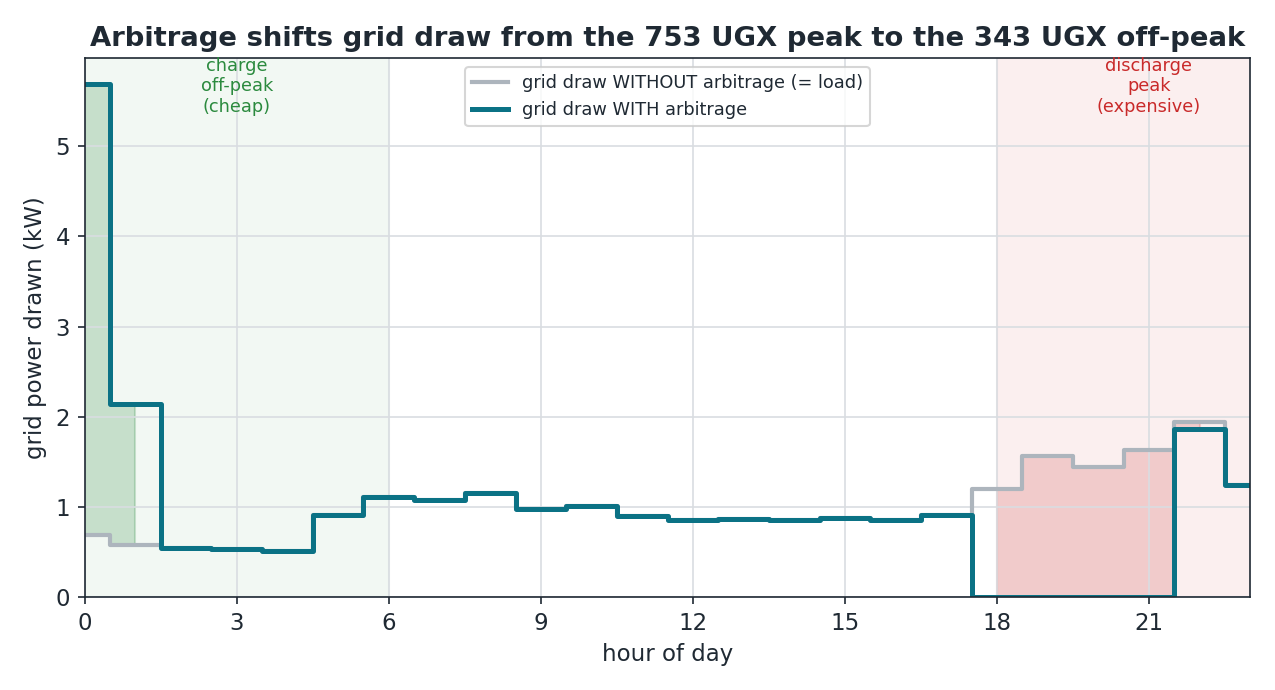
The line shows grid power drawn across a day. Arbitrage adds a charge block in the cheap off-peak window (grid draw rises) and removes draw during the expensive evening peak (the battery covers it instead).
Results
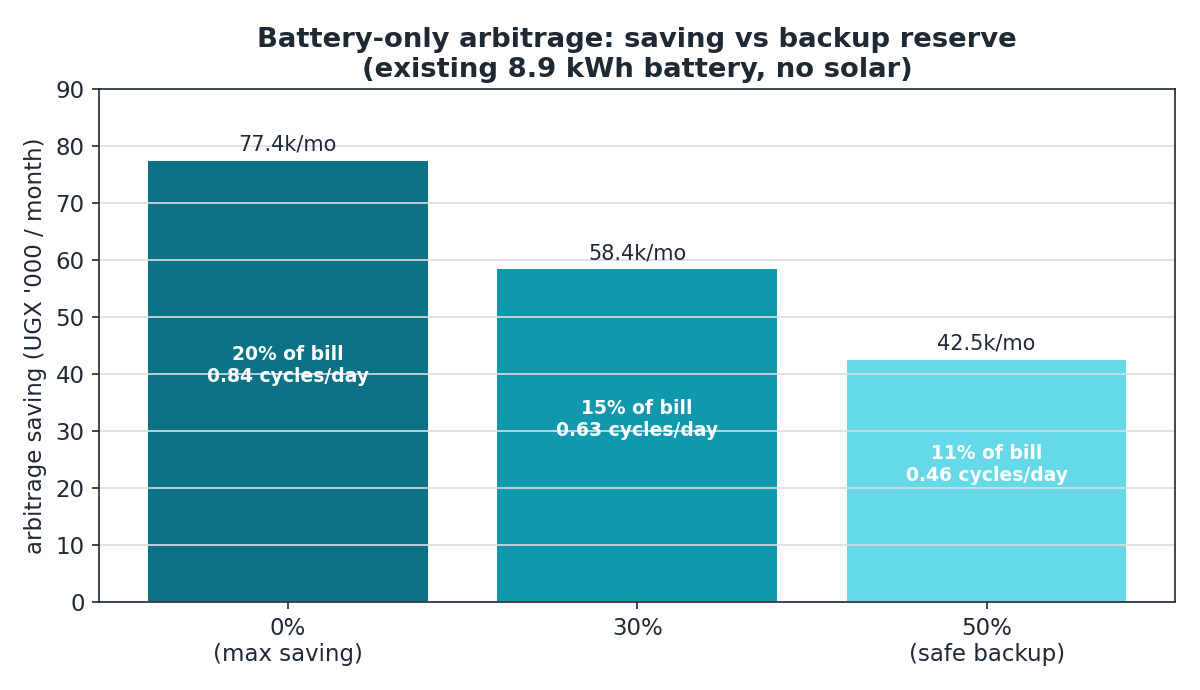
Savings depend on how much of the battery is reserved for backup rather than used for arbitrage:
| Reserve held for backup | Saving per month | Percent of energy bill | Peak kWh shifted per day | Cycles per day |
|---|---|---|---|---|
| 0 percent (max saving) | 77,400 | 20.1 percent | 7.0 | 0.84 |
| 30 percent | 58,400 | 15.2 percent | 5.3 | 0.63 |
| 50 percent (safe backup) | 42,500 | 11.0 percent | 3.8 | 0.46 |
What it means
- Arbitrage alone saves about 42,000 to 77,000 UGX per month on hardware NFE already owns, with zero solar. Modest but real.
- The reliability dial is explicit and cheap on wear. Holding 50 percent for backup roughly halves the saving versus 0 percent, but at under one cycle per day on a 6,000 cycle battery that is 15 to 20 years or more of life. Arbitrage does not age the battery.
- The logic that earns this (charge off-peak, discharge peak, hold a floor) is exactly what the inverter's own settings already do, so the native settings capture most of this today with no extra code. OpenEMS controllers only out-earn native settings once there is forecasting or solar to be smart about.
- This confirms the strategic read: arbitrage is a nice-to-have, not the money story. Solar is (see Solar Plus Battery Economic Case, where the same battery plus a 4 kWp array offsets about 62 percent of the bill and pays back in under two years).
Caveats
The policy is greedy (charge full off-peak, discharge to floor, idle in shoulder); a forecast-driven controller should land near this or slightly above. The model ignores the fixed service charge, which is not offsettable, and treats the battery as arbitrage-dedicated, whereas its real primary role is backup, which is why the reserve tradeoff matters.
Note: this battery-only arbitrage is the value captured BEFORE solar. It is not additive with the solar case. Once a solar array is installed it claims the single daily battery cycle (charging for free), so the solar case supersedes grid arbitrage rather than stacking on top of it. See the solar page for the test.