
Battery Arbitrage Economic Case (Sezibwa)
[!info] Conservative basis: UEDCL Code 10.2 Q3 2026 tariff (666.5 / 562.1 / 429.7 UGX/kWh), real load. No solar and no capex, so weather and PV price do not affect this case.
Headline
The battery NFE already owns can earn a little money with no solar at all, by charging during the cheap off-peak window and discharging through the expensive evening peak. On the real siteload loadand the current tariff this saves about 43,22,000 to 79,40,000 UGX per month (about 116 to 2011 percent of the bill) depending on how much reserve is held back for backup. ItModest, isand freesmaller money on owned hardware, butthan it isused modest.to be, because the tariff spread has compressed. Solar is the real story (see Solar Plus Battery Economic Case).
This[!warning]caseThe arbitrage margin hasnoroughlycapexhalved on the current tariff The old Sept-2025 tariff had a peak-to-off-peak spread of 410 UGX/kWh (the753batteryvs 343). The current Q3 2026 spread isalreadyonlybought)237andUGX/kWhno(666.5solar,vs 429.7). After the battery's 90 percent round-trip efficiency, gross arbitrage value falls from roughly 372 to about 189 UGX/kWh — soweatherthesedoesnumbers are about half the earlier draft's. Do notaffectquoteit.an older 43k-79k figure.
Method
Transparent scoping model on the real load, not OpenEMS. Load source is the aggregate meter (meter_100), about 21 kWh/day, validated internally against the 10 customer submeters (independent UEDCL bill still to confirm).load. Battery 8.9 kWh usable, 90 percent round-trip, 5 kW cap. Tariff UEDCL Code 10.2: off-peak 343, shoulder 577.11, peak 753 UGX/kWh. Charge off-peak toward full, discharge to cover the evening peak down to a reserve floor.
Why the siteTariff is a goodconfigurable arbitrage candidate
The load trough is overnightinput (cheapestQ3 power)2026 andused the peak is the evening (about 1.95 kW at 22:00), inside the price peak. The site consumes most when power is both most expensive and highest, so shifting that consumption to off-peak is worth real money.here).
Results
Savings depend on how much of the battery is reserved for backup rather than arbitrage:
| Reserve held for backup | Saving per month | Percent of energy bill |
|---|---|---|
| 0 percent (max saving) | about |
about |
| 30 percent | about |
about |
| 50 percent (safe backup) | about |
about |
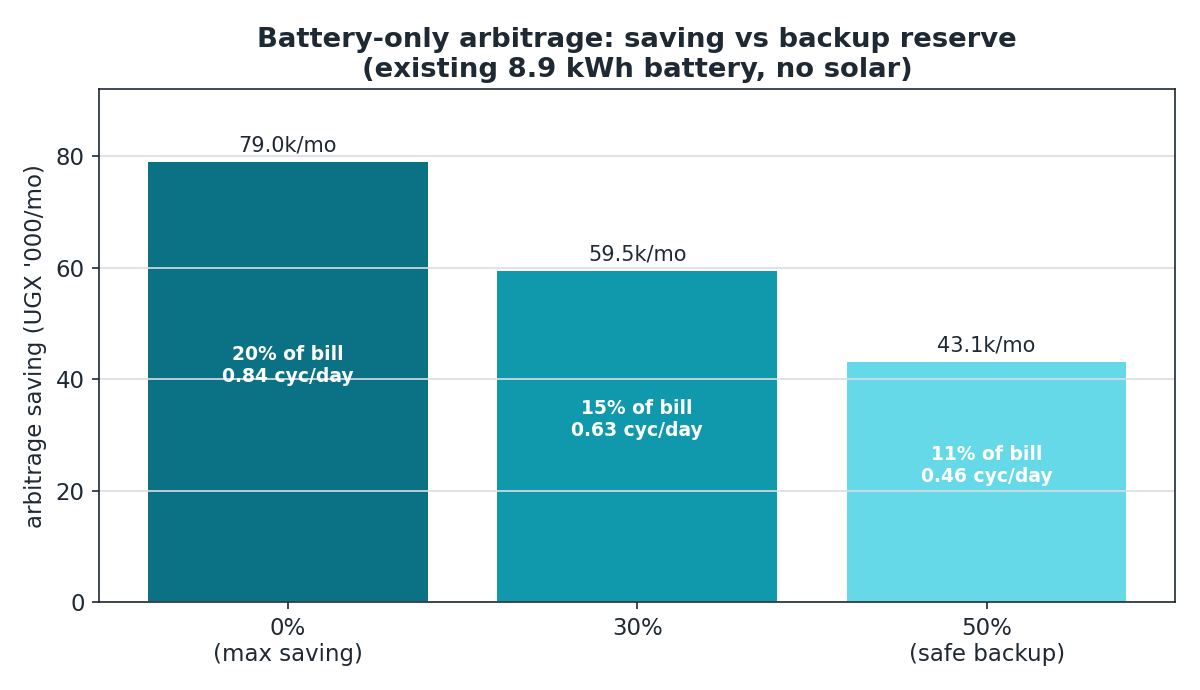
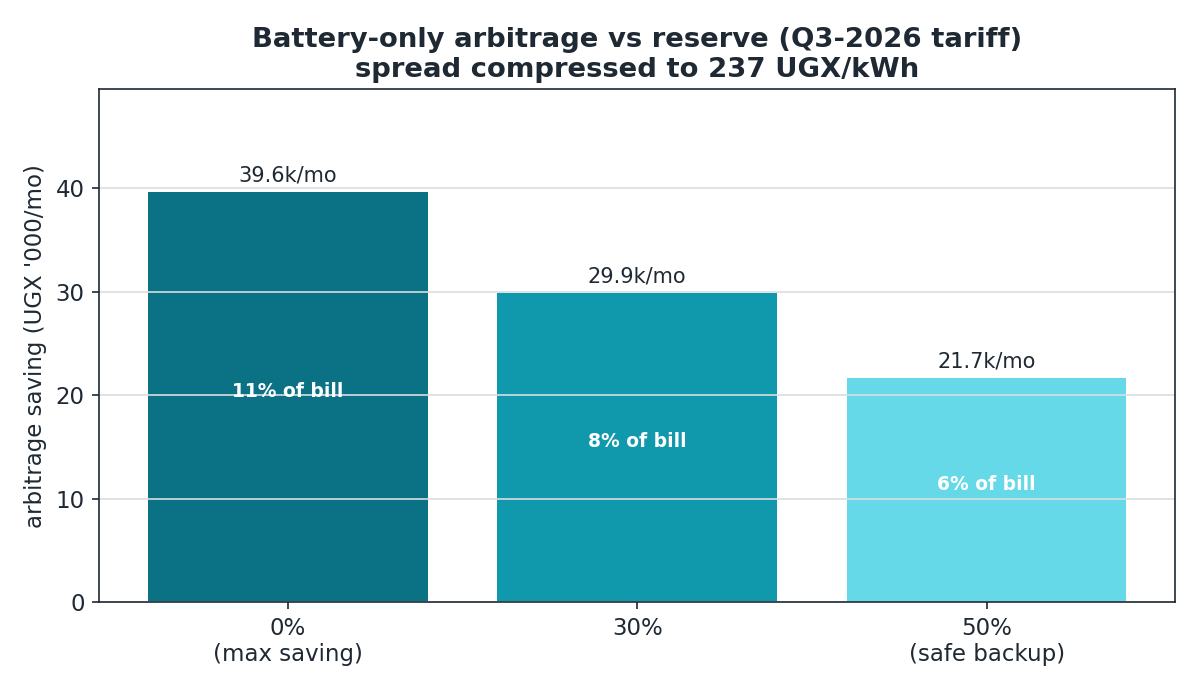
Investment metrics
No money is invested (15the percent cost of capital)
Therethere is no returnIRR ratioor becausepayback. noThe money20-year value of the arbitrage stream, discounted at 15 percent, is invested;about it1.9M UGX (2.6M at 10 percent, 1.3M at 25 percent). It is pure upside on owned hardware that declines as the battery ages.
It is not quite "free money"
Even with no incremental capex, cycling the battery consumes a slice of its finite life, so there is a real degradation/opportunity cost per kWh cycled. On the compressed current spread that cost is no longer negligible relative to the ~189 UGX/kWh gross margin. The economically correct rule is therefore not "arbitrage whenever there is a price spread" but:
Arbitrage only when the tariff spread is large enough to beat the marginal degradation cost and still leave the required backup reserve.
That makes optimal arbitrage a Microgrid OS control problem (net of losses and degradation, subject to reserve), not a fixed inverter setting.
What it means
- Arbitrage alone saves about
43,22,000 to79,40,000UGX perUGX/month (116 to2011 percent of the bill),onhardwareownedNFEhardware,already owns, with zero solar. The percentage, notand theshillingmarginfigure,shrinksisfurtherwhatnettellsofyou whether it is worth scaling. Modest but real.degradation. - The reliability dial is cheap on wear:
holding50 percentfor backupreserve roughly halves the saving versus 0 percent, but at under one cycle per dayon a 6,000-cyclethe batterythat islasts 15 years ormore of life. The logic that earns this (charge off-peak, discharge peak, hold a floor) is what the inverter's own settings already do, so native settings capture most of it today with no extra code.more.- Strategic read: arbitrage is a
nice-to-have,minor ancillary benefit, not the money story. Solar is (see the Solar Plus Battery Economic Case, wherethe same battery plus4 kWp offsetsabout 56~55 percent of the billandatpays~48backpercentin about 1.9 years)IRR).
Battery aging over 20 years
Because this case is entirely battery-dependent, it is the most exposed to aging.aging: With usablewith capacity fading to 50 percent by year 20, the 30-percent-reserve saving falls from about 59,500 UGX/month today to about 30,000 by year 20. It roughly halves.halves Over 20 yearsover the undiscounted total is about 10.8M UGX; at a 15 percent discount it is worth about 3.9M in today's money.horizon. Pairing the battery with solar makes the income far less sensitive to aging, because daytime solar self-consumption does not depend on the battery.aging.
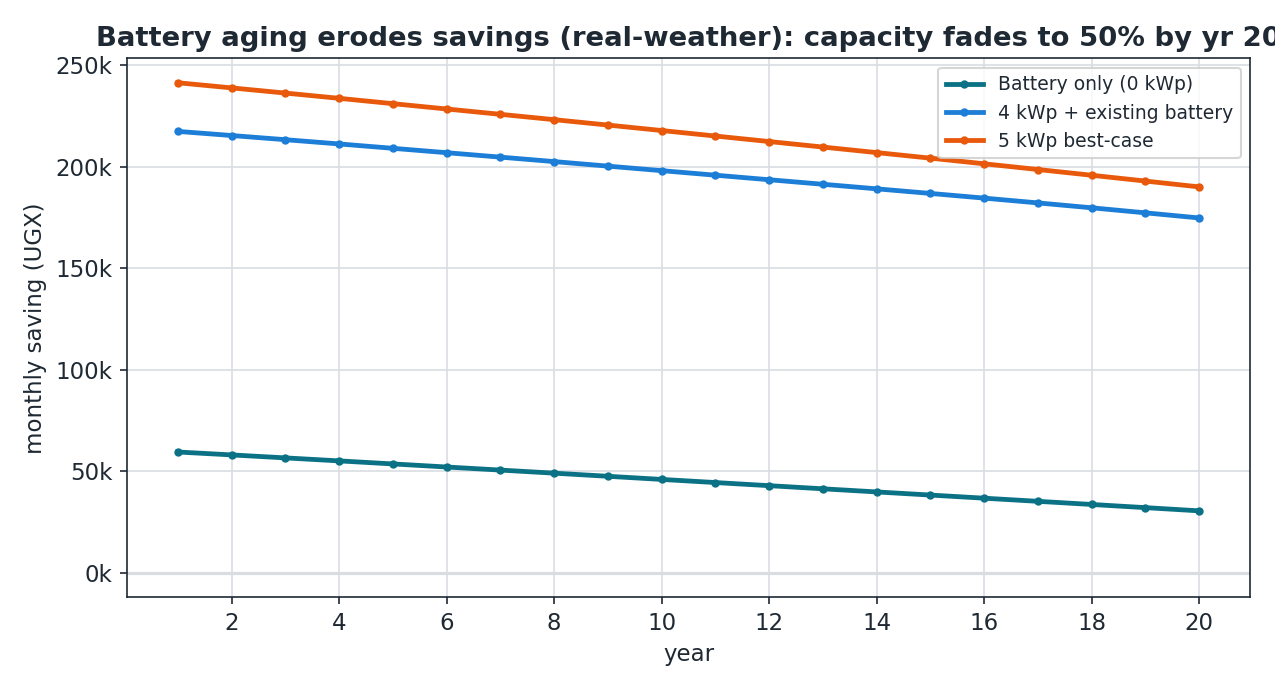
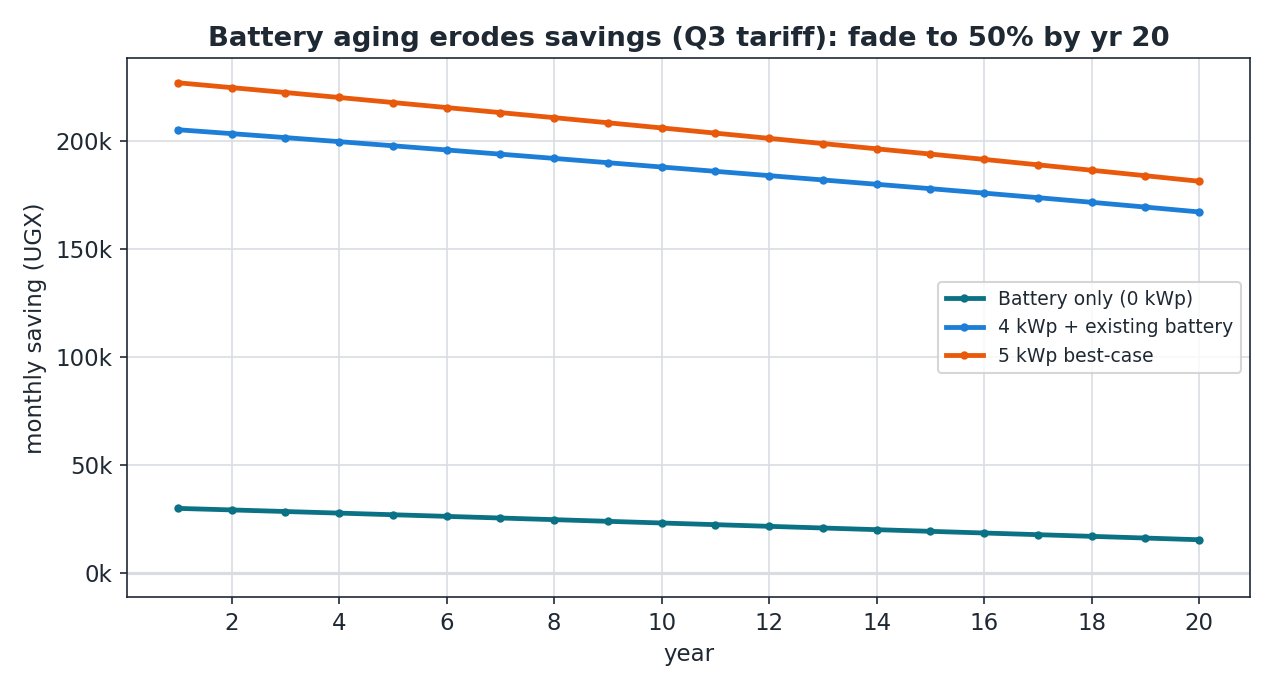
ForSee the joint optimization using this aging model, seealso Optimal Solar and Battery Allocation; for how cheap battery must get before expanding it pays, seeand Battery Price Break-Even.
Caveats
Greedy policy (charge full off-peak, discharge to floor, shoulder idle);policy; a forecast-drivendriven, degradation-aware controller shouldwould landarbitrage nearless thisoften orbut slightlymore above.profitably. Ignores the fixed monthly service charge (not offsettable). and treatsTreats the battery as arbitrage-dedicated, whereas its real primary role is backup, which is why the reserve tradeoff matters.