
Battery Arbitrage Economic Case (Sezibwa)
[!info] Conservative basis: UEDCL Code 10.2 Q3 2026 tariff (
Peak666.5 /Shoulder562.1 /Off-Peak429.7 UGX/kWh), real load.The tariff schedule is a configurable model input so later ERA/UEDCL revisions can be substituted directly.No solar and no capex, so weather and PV price do not affect this case.
Headline
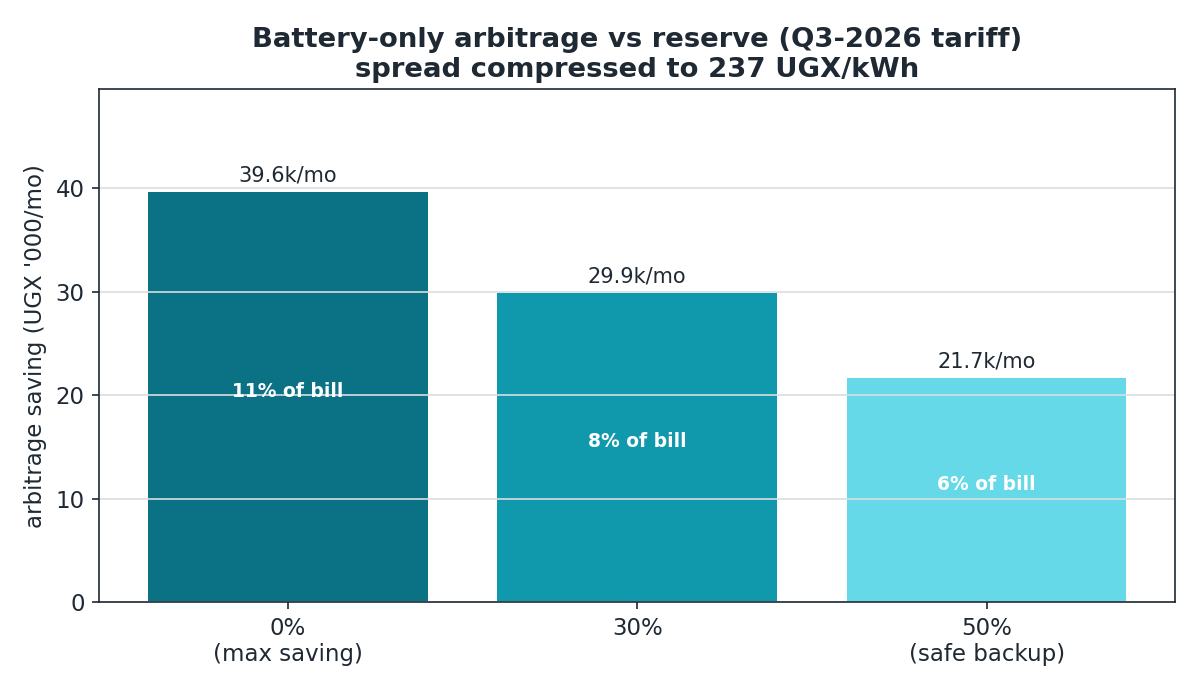
The battery NFE already owns can createearn incrementala valuelittle from sunk hardwaremoney with no solar,solar at all, by charging during the cheap off-peak window and discharging through the expensive evening peak. On the real load and the current tariff this saves about 22,000 to 40,000 UGX per month (about 6 to 11 percent of the bill) depending on how much reserve is held for backup. Modest, and smaller than it used to be, because the tariff spread has compressed. Solar is the real story (see Solar Plus Battery Economic Case).
[!warning] The arbitrage margin has roughly halved on the current tariff The old Sept-2025 tariff had a peak-to-off-peak spread of 410 UGX/kWh (753 vs 343). The current Q3 2026 spread is only 237 UGX/kWh (666.5 vs 429.7). After the battery's 90 percent round-trip efficiency, gross arbitrage value falls from roughly 372 to about 189 UGX/kWh — so these numbers are about half the earlier draft's. Do not quote an older 43k-79k figure.
Method
Transparent scoping model on the real load. Battery 8.9 kWh usable, 90 percent round-trip, 12 kW inverter cap (never binding at these levels). Charge off-peak toward full, discharge to cover the evening peak down to a reserve floor. Tariff is a configurable input (Q3 2026 used here).
Results
| Reserve held for backup | Saving per month | Percent of energy bill |
|---|---|---|
| 0 percent (max saving) | about 39,600 | about 11 percent |
| 30 percent | about 29,900 | about 8 percent |
| 50 percent (safe backup) | about 21,700 | about 6 percent |
How the numbers are built (auditable working)
Consumption used: meter_100, the 3-phase aggregate (~22.3 kWh/day)
| Band | kWh/day | avg kW |
|---|---|---|
| Off-peak (00-06) | 3.6 | 0.60 |
| Shoulder (06-18) | 10.5 | 0.88 |
| Peak (18-24) | 8.2 | 1.36 |
Per phase (daily): L1 10.3 kWh (46 percent), L2 5.2 (23 percent), L3 5.8 (26 percent).
Which customer is on which phase (inferred by voltage match, all high-confidence)
| Phase | Load (kWh/day) | Customer meters (kWh/day) |
|---|---|---|
| L1 | 10.3 (46 percent) | 002 (5.7), 003 (4.5), 008 (0.1), 011 (0.1) |
| L2 | 5.1 (23 percent) | 009 (2.3), 007 (1.6), 010 (1.2) |
| L3 | 5.3 (26 percent) | 006 (2.7), 005 (2.1), 004 (0.5) |
The two biggest consumers (002 and 003) both sit on L1, so L1 carries about half the site. This is a phase-balancing / power-quality issue (voltage sag on L1; the fix is to move 002 or 003 to another phase), not an arbitrage issue: the SRNE is a three-phase inverter and shifts the total energy across all phases, which is what the arbitrage uses. (Customer-sum per phase 10.3/5.1/5.3 matches meter_100's own per-phase 10.3/5.2/5.8, a clean cross-check.)
Step by step
- Tag every 15-minute interval as off-peak / shoulder / peak.
- Baseline (no battery): each kWh costs its band price.
- Off-peak (00-06): charge the battery from the grid at 429.7 UGX/kWh, respecting the reserve floor, the 8.9 kWh usable cap, and 90 percent round-trip.
- Peak (18-24): discharge to cover load instead of buying at 666.5 UGX/kWh, down to the reserve floor.
- Shoulder: idle.
- Saving = baseline cost minus arbitrage cost, annualised.
The margin, and why round-trip efficiency matters
A battery is not a perfect bucket: energy makes a round trip (grid to battery to load) and loses about 10 percent to heat. 90 percent round-trip means to get 1 kWh back out you must put about 1.11 kWh in (1 divided by 0.9).
So, per 1 kWh delivered during peak:
- Charging cost: 1.11 kWh x 429.7 = about 477 UGX (this is the off-peak price grossed up for the loss, i.e. 429.7 / 0.9).
- Avoided peak purchase: 1 kWh x 666.5 = 666.5 UGX.
- Gross margin = 666.5 - 429.7/0.9 = about 189 UGX/kWh.
The raw price spread is 666.5 - 429.7 = 237 UGX/kWh; the round-trip loss eats about 48 of that, leaving about 189 usable. "Gross" is before the per-cycle battery wear cost, which on this thin margin is no longer negligible (see the "not free money" note below). The battery cycles once a day, so it can shift at most 8.9 x (1 - reserve) kWh, and peak load is only 8.2 kWh anyway, which is why the monthly figures are modest.
Investment metrics
No money is invested (the battery is owned), so there is no IRR or payback. The 20-year value of the arbitrage stream, discounted at 15 percent, is about 1.9M UGX (2.6M at 10 percent, 1.3M at 25 percent). It is upside on owned hardware that declines as the battery ages.
IncrementalIt valueis fromnot sunkquite hardware"free money"
TheEven hardwarewith costno isincremental sunk, butcapex, cycling stillthe battery consumes a slice of the battery'sits finite life.life, Arbitrageso thereforethere carriesis a real marginal degradation and degradation/opportunity cost per kWh cycled. On the compressed current spread that cost is no longer negligible relative to the ~189 UGX/kWh gross margin. The economically correct rule is therefore not "arbitrage whenever there is a price spread" but:
Arbitrage only when the tariff spread is large enough to beat the marginal degradation cost and still leave the required backup reserve.
That makes optimal arbitrage a Microgrid OS control problem (net of losses and degradation, subject to reserve), not a fixed inverter setting.
What it means
- Arbitrage alone saves about 22,000 to 40,000 UGX/month (6 to 11 percent of the bill) on owned hardware, and the margin shrinks further net of degradation.
- The reliability dial is cheap on wear: 50 percent reserve roughly halves the saving versus 0 percent, but at under one cycle per day the battery lasts 15 years or more.
- Strategic read: arbitrage is a minor ancillary benefit, not the money story. Solar is (see the Solar Plus Battery Economic Case, where 4 kWp offsets ~55 percent of the bill at ~48 percent IRR).
Battery aging over 20 years
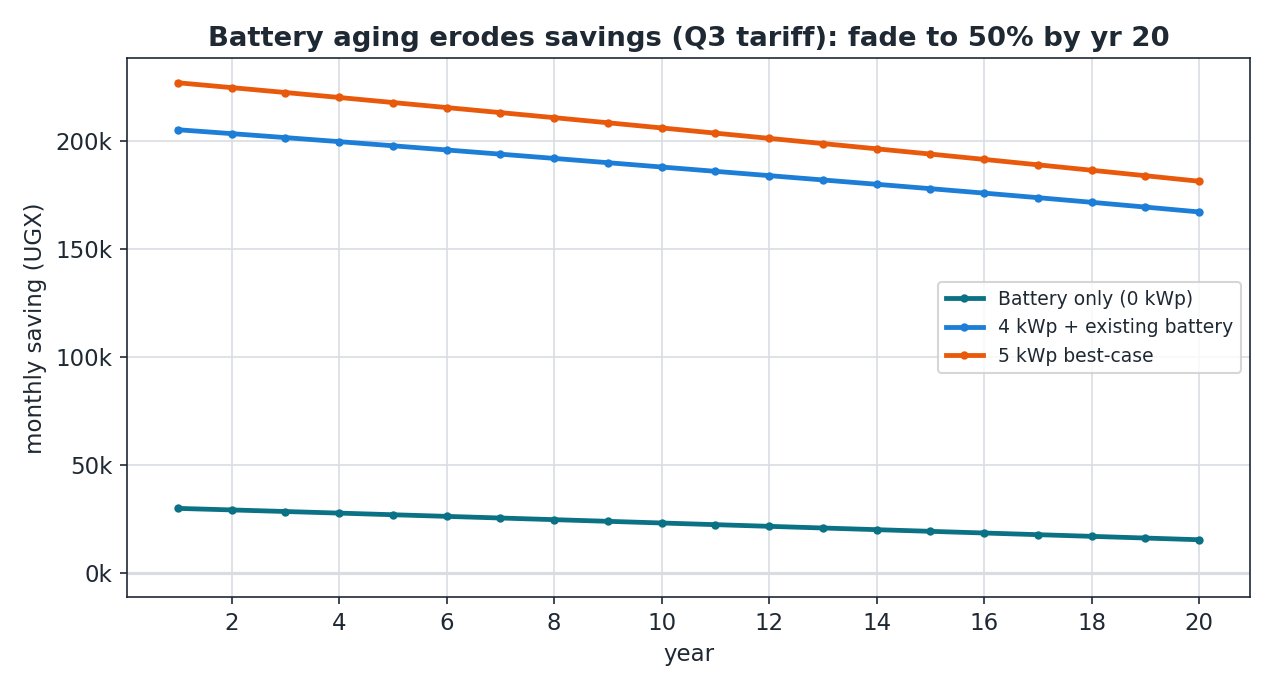
Because this case is entirely battery-dependent, it is the most exposed to aging: with capacity fading to 50 percent by year 20, the 30-percent-reserve saving roughly halves over the horizon. Pairing the battery with solar makes the income far less sensitive to aging.
See also Optimal Solar and Battery Allocation and Battery Price Break-Even.
Caveats
Greedy policy; a forecast-driven, degradation-aware controller would arbitrage less often but more profitably. Ignores the fixed monthly service charge (not offsettable). Treats the battery as arbitrage-dedicated, whereas its real primary role is backup, which is why the reserve tradeoff matters.