
Battery Price Break-Even (Sezibwa)
[!info] Conservative, bank-facing basis (revised after independent review) Turnkey installed capex and real day-to-day weather. Independent of the other docs because it rests on a battery-price assumption rather than a fixed quote.
The question
The optimal-allocation case found that at today's battery price, adding battery capacity lowers the return: the money is better spent on solar. But Aaron's point stands: the long-term microgrid model wants more storage, so the real question is a price one. How cheap does battery have to get before expanding it pays? This document answers that, and it is deliberately independent because it rests on a price assumption rather than a fixed quote.
It also takes Aaron's framing as the base case: net metering is not the play (the best value for onsite generation is selling it onsite to the consumer,onsite, not feeding it back to a grid that already has a generation surplus). So this analysis uses no feed-in and asks only what storage is worth for shifting onsite solar into the evening.
Method
The same 20-year model (real load, real weather, battery aging to 50 percent by year 20, 0.5turnkey percent per year panel fade,solar, 15 percent discount, solar about 990,000 UGX per kWp),discount) but with the battery price swept as a variable instead of fixed.. At each price the model re-finds the best allocation of solar and battery and compares its 20-year NPV against the best allocation that adds no battery.
Today's price for reference: theprice: SR-SE10B is 5,568,000 UGX for 8.9 kWh usable, which is about 626,000 UGX per kWh.
Result
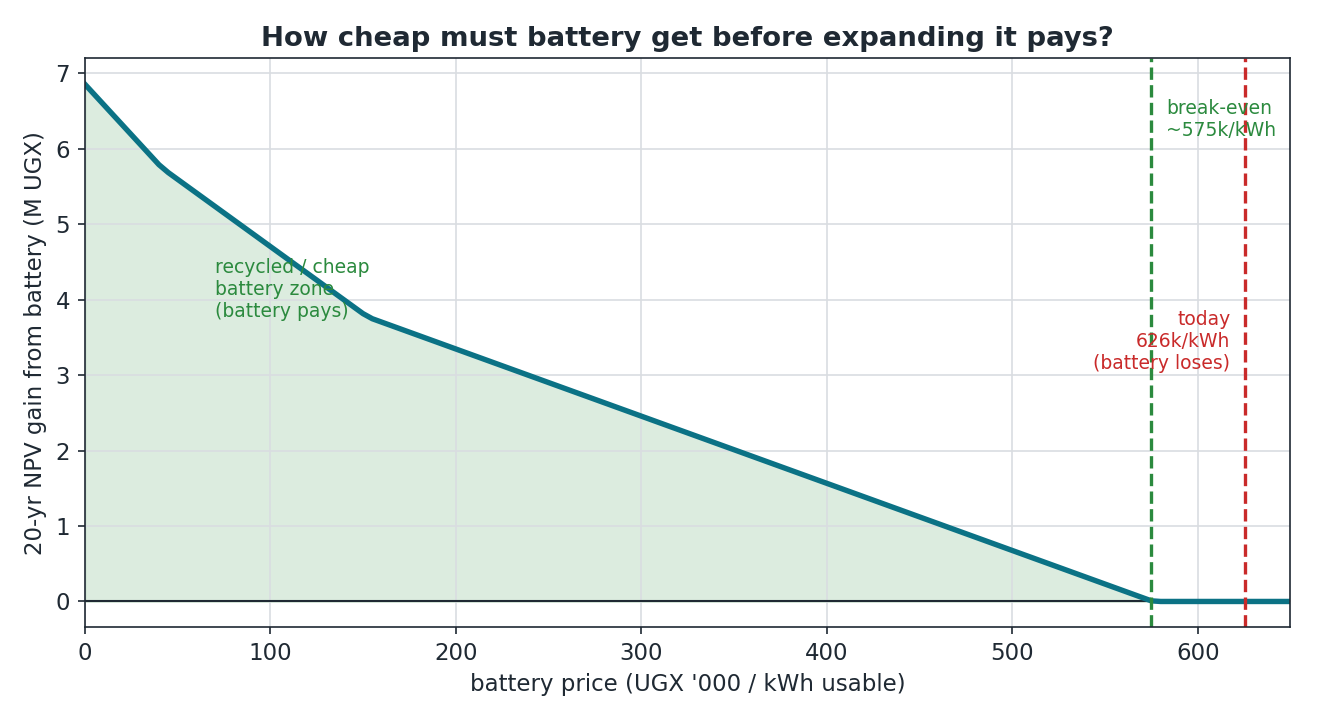
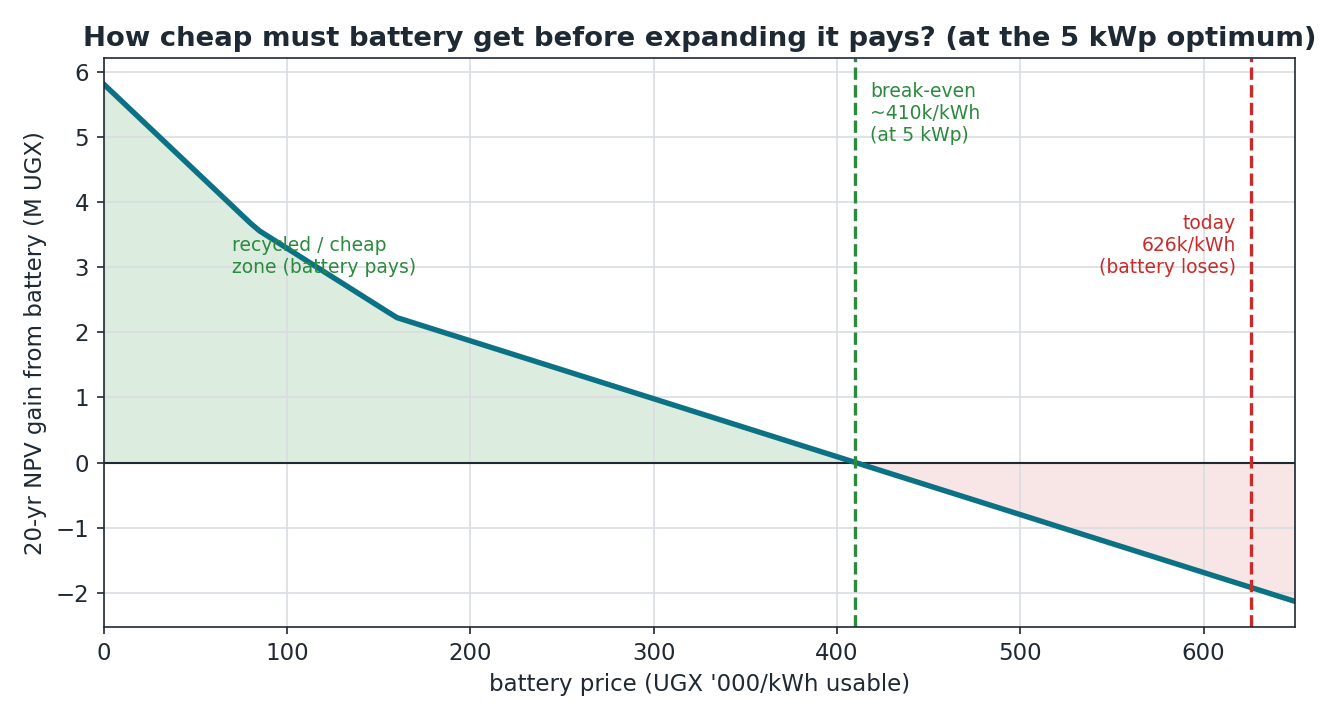
The linebreak-even is theanchor-dependent 20-year(it NPVdepends gainedhow bymuch addingsolar battery,you asalready have, because a functionbigger ofarray spills more surplus that a battery price.could Abovesoak the break-even it is zero or negative (spend on solar instead). Below it, battery starts to add value, and the gain grows as the price falls.up):
| Break-even battery price | |||
|---|---|---|---|
| about |
about 66 percent ( |
||
| 6 |
about | ||
| about | 82 |||
Findings
Break-even is about 575,000 UGX per kWh, only about 8 percent below today's price.So battery is right atAt the
edge:5akWpmodestoptimum,price drop makes the first added unit marginally worthwhile.Marginal is not a business case.Forbatteryexpansion to deliver material value (a few million in NPV), the price needs tomust fall toroughlyabout200,410,000UGXUGX/kWhper kWh,(about a thirdofcheapertoday'sthanprice,today)or lower.At a cheap or free source,before thestorage-heavyfirstmicrogridextramodelunitworks.pays.NearBelowzero cost,that, theoptimumgainbecomes 6 kWp plus three battery units, adding about 6.9M UGX of NPV. This is where a battery-rich standalone system finally beats a solar-only one.This validates the recycled-battery strategy.Sourcing second-life cells (for example from cars, which discard packs while still holding 60 to 80 percent capacity) is exactly the path to the price range where expansion pays. The number to aim for is roughly200,000 UGX per kWh or below; the closer to free, the stronger the case.
Investment metrics (15 percent cost of capital)
| Allocation | Upfront | Payback | ROI (20-yr cumulative) | IRR | |
|---|---|---|---|---|---|
| 6 kWp + 1 unit at 200,000 per kWh | |||||
| 6 kWp + 3 units recycled / free | 1. |
Note
Findings
- Break-even at the
tension:5 kWp optimum is about 410,000 UGX/kWh, roughly a third below today. Higher if you have already scaled solar to 6 kWp, lower at 4 kWp. - For material value you want battery well below break-even, toward 200,000
perUGX/kWhkWh,oraddinglessbattery(6raiseskWp + 1 unit gives about 13.2M NPV(moreattotalthatwealth)price). - At a
still-goodcheapbut lower marginal return. Withor freeorsource the storage-heavy model wins outright: recycled cellsbothgiverise.6MetricskWpatplusathree15units,percentaboutcost17.6Mof capital (the assumed financing rate). Payback is the time to recover the upfront cost; ROI is the total lifetime return on that cost; IRR is the project's effective annual return,NPV and alender54fundspercentaIRR,projectbetterwhenthanitssolar-only. - This
comfortably exceedsvalidates theloanrecycled-batteryrate;strategy.NPVSecond-lifeiscells (discarded by cars while still holding 60 to 80 percent) are thewealthpathcreated expressed in today's money. Solar stays strongly positive across any realistic rate (10 to 24 percent) becauseinto thepaybackpriceisrangesowhereshort; the discount rate mainly affects the battery-expansioncase.pays. Aim for roughly 200,000 UGX/kWh or below.
Caveats
Second-life cells are already partly aged, so the
"fade to 50 percent over 20 years"fade-to-50-percent-over-20-years assumption is optimistic for them; a shorter effective lifewould raiseraises the price target (makemakes it stricter).The direction holds: cheap battery unlocks the case, but recycled cells should be de-rated for their remaining life.- This prices energy value
only.only;Batterybattery also buysbackup and autonomy,backup, which has its own value not countedhere; that argues for some battery regardless of the energy-only break-even.
Related
Builds on Optimal Solar and Battery Allocation. Companion cases: Battery Arbitrage (alone) and Solar Plus Battery.