
Battery Price Break-Even (Sezibwa)
Data provenance
[!info]UnderlyingConservativedata:basis.theTariff:aggregateUEDCLmeterCodemeter_10010.2plus the 10 customer sub-meters, overQ32026-03-192026to 2026-08-10, from the modbus energy-logger archive (Peaksources:666.5pi-direct/andShouldernextcloud-import),562.1i.e./theOff-Peakpre-429.7andUGX/kWh).early-OpenEMSTheperiod.scheduleLoad basis is aconfigurableconservativemodel21.3inputkWh/day.forNote
future ERA/UEDCL revisions. Turnkey capex, real weather. Independent of(2026-08-20): theothersitedocshasbecausesinceitmigratedreststo OpenEMS, which is now the live source. OpenEMS-sourced daily figures from mid-August show inconsistencies (the aggregate roughly doubled exactly at the source switchover, and onasomebattery-price assumption.
The question
At today's battery price, adding battery capacity lowersdays the return:customer-meter sum exceeds the money is better spent on solar. Aaron's point stands: the long-term microgrid model wants more storage,aggregate), so the real question is a price one. How cheap does battery have to get before expanding it pays? That turns the result into a procurement target.
Base case is no economically usable export for Sezibwa (ERA's Net Metering Regulations 2024 exist, but eligibility, interconnection and credit valuethey are unresolved and typically pay below retail). So this asks only what storage is worth for shifting onsite solar into the evening.
Method
The same 20-year model (real load, real weather, battery aging to 50 percent by year 20, turnkey solar, configurable Q3 2026 tariff schedule, 15 percent discount) with the battery price swepttreated as a variable.data-quality Atissue eachto priceresolve before use; this analysis stays on the modelvalidated re-findsarchive. Phase assignments reflect the bestwiring allocationas observed up to about May 2026 and comparesshould itsbe NPVre-verified against the best allocation that adds no battery. Today's price: SR-SE10B is 5,568,000 UGX for 8.9 kWh usable, about 626,000 UGX per kWh.
Result
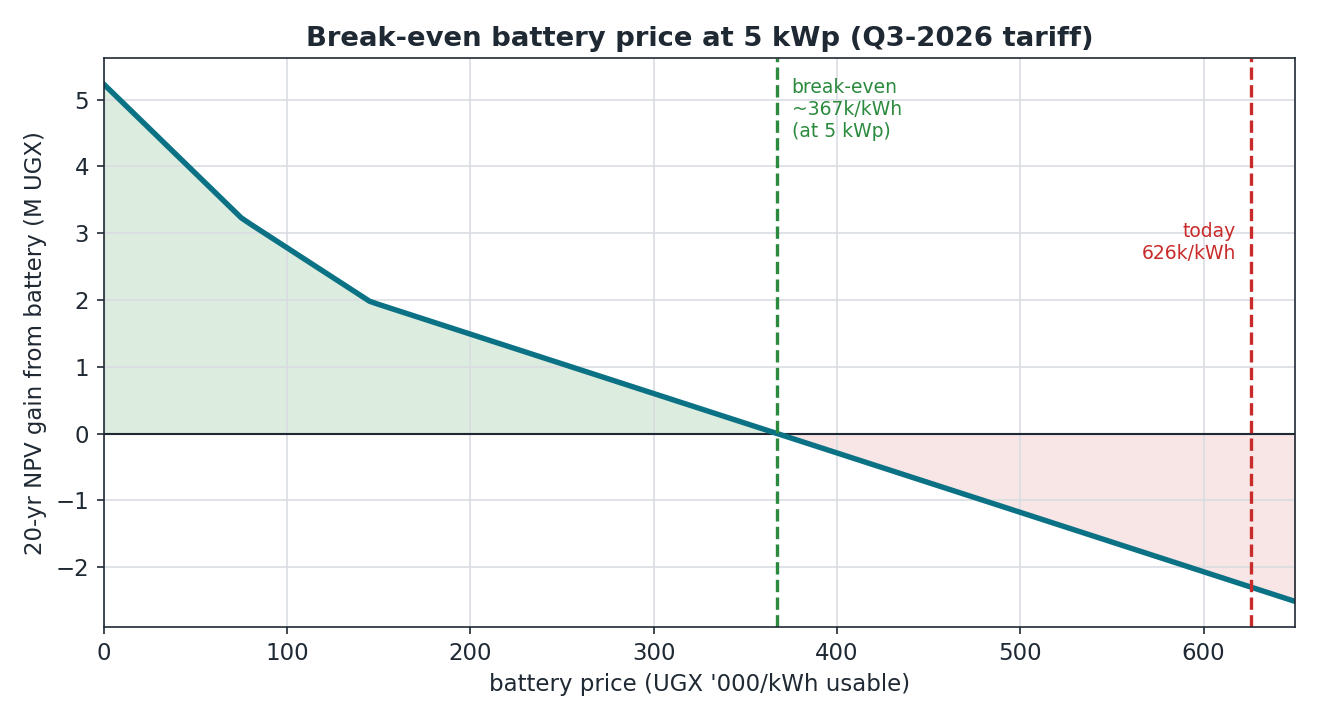
The break-even is anchor-dependent (it depends how much solar you already have, because a bigger array spills more surplus a battery could soak up). On the current tariff:
[!note] 4 kWp versus 5 kWp4 kWp is the low-spill efficiency sweet spot;5 kWp is the maximum-NPV optimum.The fifth kWp spills some energy but creates enough additional useful generation to raise total NPV. Its greater surplus also explains why added storage breaks even at a higher price at 5 kWp than at 4 kWp.
At the 5 kWp optimum, battery must fall to about 367,000 UGX/kWh (roughly 40 percent cheaper) before the first extra unit pays. (On the compressed Q3 tariff this threshold is lower than an earlier draft's estimate, because storage now shifts cheaper energy.)
Investment metrics (at cheaper battery)
Findings
Break-even at the 5 kWp optimum is about 367,000 UGX/kWhon the current tariff — highersetup ifyouany connections havealreadybeenscaled to 6 kWp, lower at 4 kWp.For material value you want battery well below break-even, toward ~200,000 UGX/kWh.Second-life storage is a promising hypothesis, not a validated strategy.What this analysis validates is "cheap storage," not recycled batteries specifically. Very low-cost storage would make a storage-heavy configuration attractive. But this model doesnotyet validate recycled/EV cells as the route there: a second-life battery starts already partially aged, so the fade-to-50-percent-over-20-years assumption is optimistic for it. Whether recycled cells actually deliver low installed cost needs its own model (acquisition, testing and grading, BMS integration, pack assembly, safety, warranty risk, heterogeneous cell health, and a shorter remaining life). Promising avenue, but the finance should not run ahead of that evidence.
Toward a break-even surface
A single break-even price is an oversimplification. The right output is a surface over four axes: battery price x remaining life x solar capacity x reliability/outage value. Remaining life matters as much as price: for example, 250,000 UGX/kWh for a cell expected to last 5 years can be worse than 400,000 UGX/kWh for one expected to last 12 years. And once the battery's backup value in outages is monetised, the threshold price rises. This surface, computed per site, is what NFE's site optimizer should eventually output.changed.
Caveats
This prices energy value only; battery also buys backup, not counted here. A second-life-specific techno-economic model is required before recycled storage is treated as validated.
Related
Builds on Optimal Solar and Battery Allocation. Companion cases: Battery Arbitrage, Solar Plus Battery.