
Optimal Solar and Battery Allocation (Sezibwa)
Headline
This is the third and most complete case: instead of fixing the array or the battery and asking "is it worth it", it sweeps both dimensions at once to find the allocation with the best 20-year return. The answer is clear and slightly counterintuitive:
The most business-optimal allocation is solar-heavy and battery-light. Put the money into panels on the battery already owned. Adding battery capacity lowers the return.
- No feed-in (today): about 5 kWp on the existing 8.9 kWh battery. 20-year NPV about 13.4M UGX, payback about 1.6 years.
- With feed-in (if
thenetnon-residentialmeteringpolicy lands)arrives): about 8 kWp on the same battery. 20-year NPV about 21.9M UGX. - In both cases, buying a second or third battery unit lowers NPV.
Method
A 2-D sweep over solar array (0 to 8 kWp) and battery capacity (the existing one unit, or plus one, plus two SR-SE10B units). For every combination the model runs the real Sezibwa load through 20 years and computes the discounted value of the savings minus the capex.
Assumptions (all adjustable):
| Assumption | Value |
|---|---|
| Horizon | 20 years |
| Battery aging | usable capacity fades linearly to 50 percent by year 20 (conservative, per Aaron) |
| Panel aging | 0.5 percent per year |
| Discount rate | 15 percent (commercial) |
| Solar capex | about 990,000 UGX per kWp installed (from the Rincol catalog build) |
| Extra battery capex | 5,568,000 UGX per added SR-SE10B (8.9 kWh usable) |
| Existing inverter + 1 battery | sunk (already bought, 9.4M) |
| Feed-in | two scenarios: none (surplus spills), or surplus sold at 343 UGX per kWh |
Result
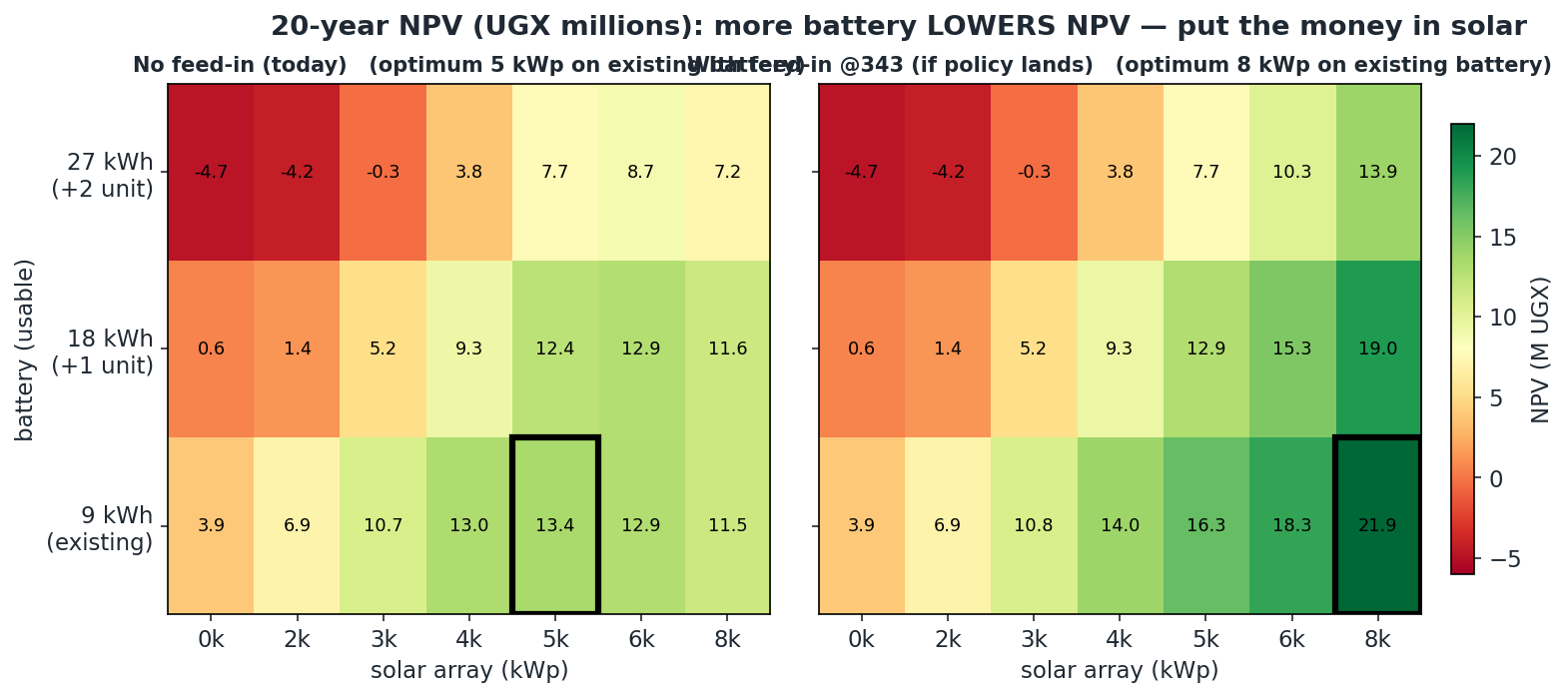
The greenest cells sit on the bottom row, which is the battery NFE already owns. Moving up (more battery) turns the map redder at every solar size. Moving right (more solar) raises NPV until spill or, with feed-in, keeps rising.
Findings
- Do not buy more battery for return. At every solar size, adding a battery unit lowers 20-year NPV; two extra units go negative. The battery capex is not recovered within the horizon.
- The reason is threefold: battery is expensive per kWh (5.57M for 8.9 kWh is about 626,000 per kWh) versus solar; the conservative aging assumption (fade to 50 percent) erodes the battery's contribution over the horizon; and the 15 percent discount rate weights the faded later years lightly.
- Solar income is resilient to battery aging. Battery-only savings halve over 20 years, but the solar cases decline only about a fifth, because daytime solar self-consumption does not depend on the battery at all. Only the evening-shift slice fades.
- Feed-in changes the size, not the shape. If
non-residentialnetnet-metering arrives, the optimum shifts to more solar (about 8 kWp) because surplus is sold rather than spilled, but the answer is still to spend on panels, not battery.
The one important caveat for the bank case
This model prices energy savings only. It does not price the battery's real job, which is backup and reliability during grid outages. So the honest framing for a lender is:
- Solar (and the existing battery) is the return story. Finance it on the payback and NPV above.
- Additional battery, if wanted, is a resilience decision (more hours of autonomy during outages), not a return decision. It should be justified separately, not folded into the ROI case, or the numbers look weak.
Recommendation
Fund about 5 kWp of solar on the existing battery now (about 5M UGX, payback about 1.6 years). Keep the case robust to policy by noting that if non-residentialnet net-metering arrives, scaling to about 8 kWp becomes the better allocation. Treat any extra battery as reliability capex with its own justification, not as part of the return.
Related
Companion cases: Battery Arbitrage Economic Case (battery alone, no solar) and Solar Plus Battery Economic Case (the fixed 4 kWp case on the existing battery). Both now include the same battery-aging treatment used here.