
Optimal Solar and Battery Allocation (Sezibwa)
[!info] Conservative, bank-facing basis. Tariff: UEDCL Code 10.2 Q3 2026 (666.5 / 562.1 / 429.7, configurable input). Turnkey capex, real weather. Reproducible from
nfe_solar_model.py.
Headline
Sweeping both dimensions (solar size and battery capacity) to find the best 20-year return gives a clear, slightly counterintuitive answer:
The most business-optimal allocation is solar-heavy and battery-light. Put the money into panels on the battery already owned. Adding battery capacity lowers the return at today's battery price.
- No feed-in (today): about 5 kWp on the existing 8.9 kWh battery. Turnkey capex about 6.3M UGX, IRR about 42 percent, simple payback about 2.3 years, discounted payback about 3.1 years, 20-year NPV about 9.8M at 15 percent.
- With a usable export arrangement: about 8 kWp on the same battery. Capex about 10.1M, IRR about 46 percent, NPV about 18.5M.
- In both, buying a second or third battery unit lowers NPV.
Method
A 2-D sweep over solar (0 to 8 kWp) and battery (existing one unit, or plus one or two SR-SE10B units). For each combination the model runs the real load through 20 years and computes discounted savings minus turnkey capex.
| Assumption | Value |
|---|---|
| Tariff | UEDCL Code 10.2 Q3 2026 (configurable) |
| Horizon | 20 years |
| Battery aging | usable capacity fades linearly to 50 percent by year 20 |
| Weather | seeded variable-irradiance year |
| Discount rate | shown at 10 / 15 / 20 / 25 percent |
| Solar capex | about 1.26M UGX per kWp turnkey |
| Extra battery capex | 5.568M UGX per SR-SE10B (8.9 kWh usable) |
| Existing inverter + 1 battery | sunk (9.4M already spent) |
Result
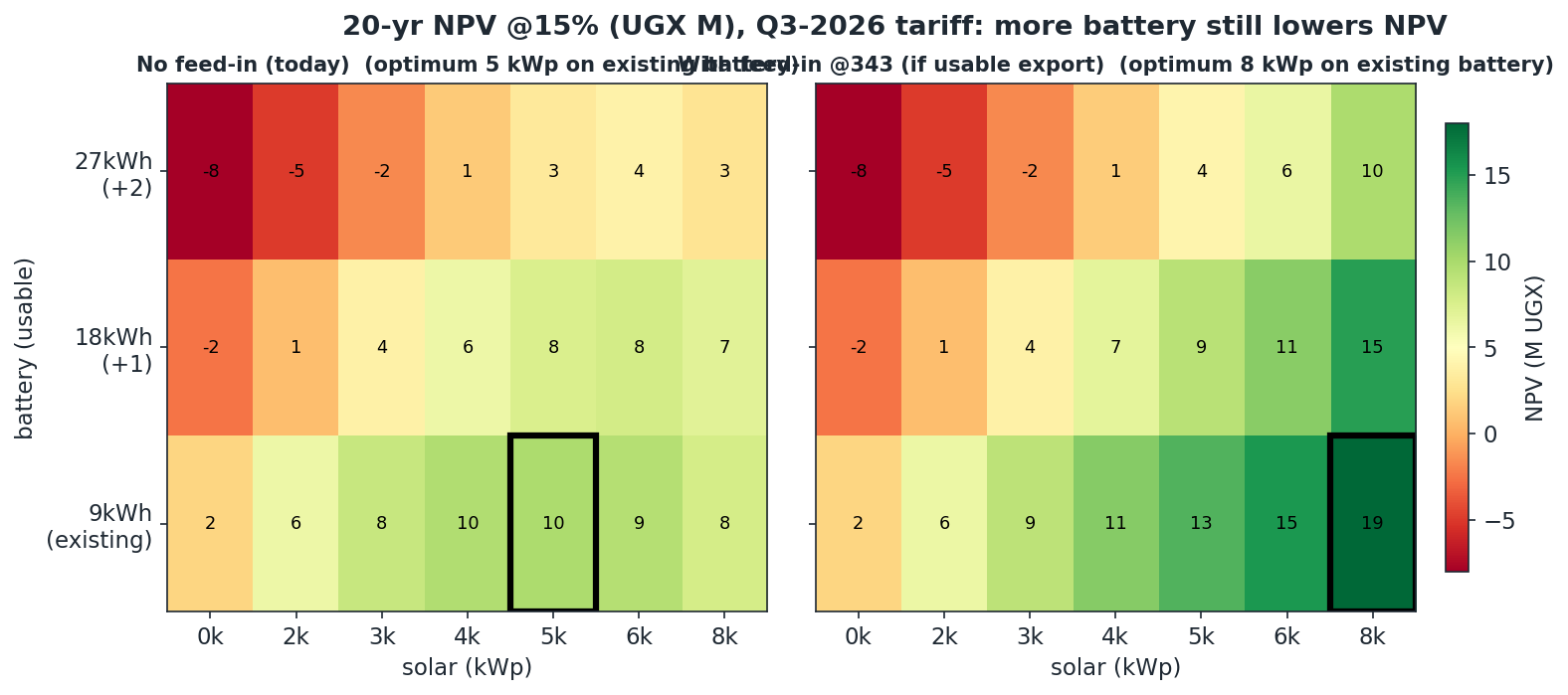
The greenest cells sit on the bottom row, the battery NFE already owns. Moving up (more battery) turns the map redder at every solar size.
Investment metrics and sensitivity
NPV shown across discount rates so you can see which allocation survives expensive capital (metrics ranked NPV, IRR, discounted payback, simple payback, then cumulative ROI):
| Allocation | Capex | IRR | Simple / disc. payback | NPV @10% | @15% | @20% | @25% |
|---|---|---|---|---|---|---|---|
| 5 kWp (no export, today) | 6.3M | 42% | 2.3 / 3.1 yr | 15.4M | 9.8M | 6.4M | 4.1M |
| 8 kWp (with usable export) | 10.1M | 46% | 2.1 / 2.8 yr | 28.5M | 18.5M | 12.3M | 8.2M |
Both survive a 25 percent cost of capital comfortably. (The undiscounted 20-year cumulative ROI is large, ~680 to 780 percent, but it is not a decision metric; NPV and IRR carry the case.)
Findings
- Do not buy more battery for return. At every solar size, adding a battery unit lowers 20-year NPV; two units go negative. The battery capex is not recovered within the horizon at today's ~626,000 UGX/kWh.
- Solar income is resilient to battery aging; battery-only savings halve over 20 years, the solar cases decline far less.
- Value, not penetration. Beyond ~4 to 5 kWp, extra panels spill and returns diminish unless storage gets cheaper or export becomes usable.
Battery replacement strategy
The model conservatively assumes the battery simply fades to 50 percent over 20 years. A real long-horizon plan should choose one of three strategies, and the economics differ:
- Operate the original battery for all 20 years (what the model assumes — the pessimistic bound; usable capacity, and so the evening-shift slice, keeps shrinking).
- Replace once when usable capacity hits a chosen threshold (say ~70 percent around year 10 to 12): restores capacity at the cost of a fresh battery, worth it only if battery prices have fallen (see the break-even case).
- Augment gradually by adding cells as load grows rather than replacing.
Importantly, the recommended allocation (solar-heavy, existing battery) is the least exposed to this: solar self-consumption does not depend on the battery, so battery replacement is a reliability/backup decision, not a driver of the solar return.
The caveat for the bank case
This prices energy savings only. It does not price the battery's real job, backup and reliability during outages. Solar is the return story; additional battery is a resilience decision justified separately.
Recommendation
Fund about 5 kWp of solar on the existing battery now (about 6.3M turnkey, IRR about 42 percent). If a usable export arrangement materialises, scaling to about 8 kWp becomes better. For how cheap battery must get before expanding it pays, see Battery Price Break-Even. Companion cases: Battery Arbitrage, Solar Plus Battery.