
Solar Plus Battery Economic Case (Sezibwa)
[!info] Conservative, bank-facing basis (revised after two independent reviews) Tariff: UEDCL Code 10.2 Q3 2026 (Peak 666.5 / Shoulder 562.1 / Off-Peak 429.7 UGX/kWh), taken as a configurable input, not hard-coded. Capex: turnkey installed price (what a lender finances). Generation: real day-to-day weather (seeded variable year). All three pull the numbers down from an earlier draft; these are the numbers to take to a lender. Reproducible from
nfe_solar_model.py.
Headline
Adding 4 kWp of solar (7 x 600 Wp) to the existing SRNE inverter and 8.9 kWh battery offsets about 55 percent of the site's electricity bill on the real load, current tariff and real weather. The inverter and battery are already bought (9.4M UGX sunk), so the decision is only the marginal cost of the panels.
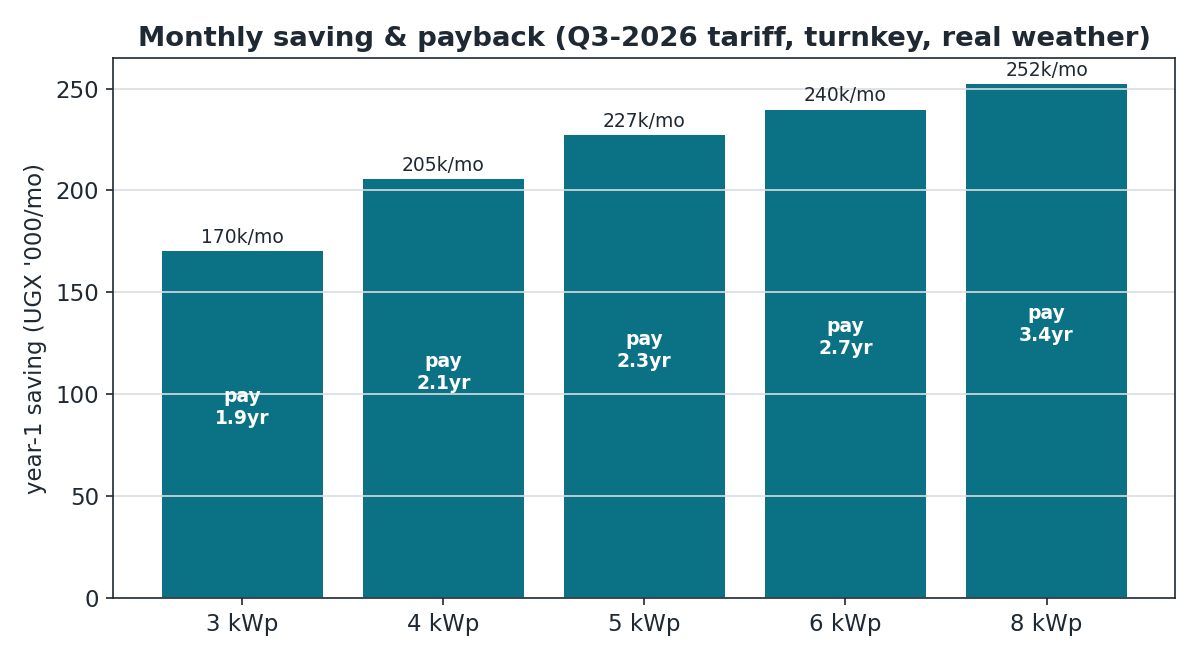
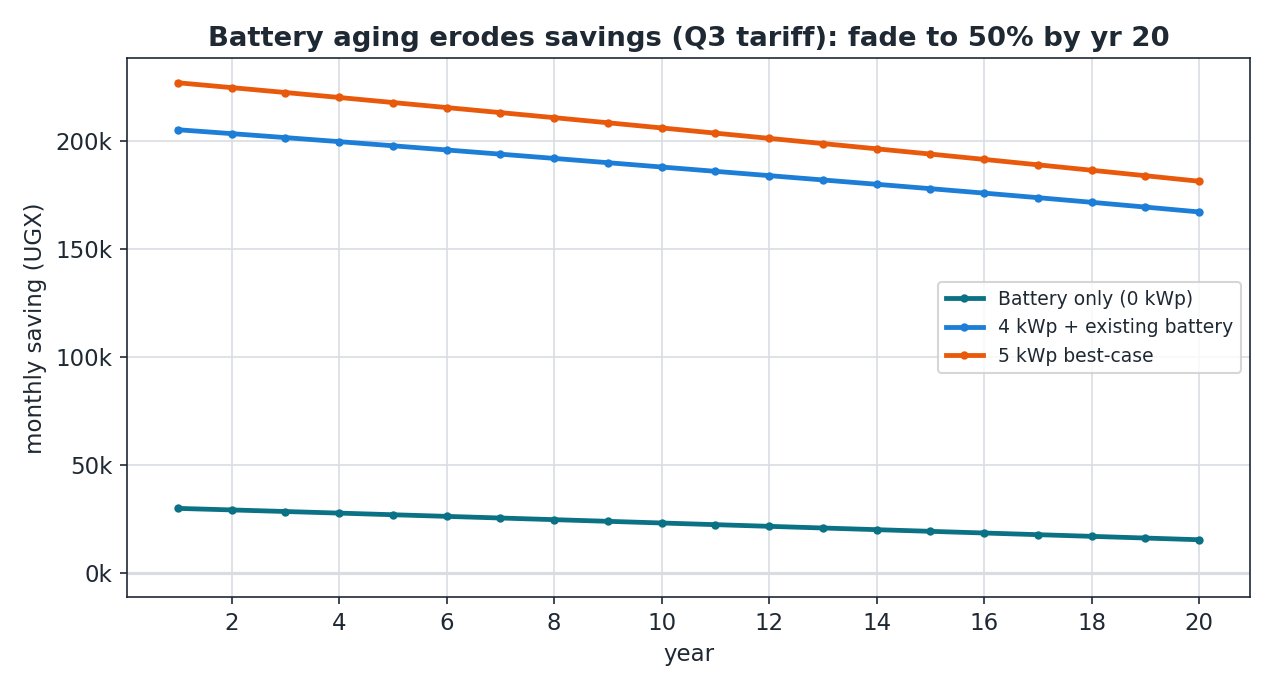
- Year-1 saving about 205,000 UGX per month (about 55 percent of a ~374,000 UGX/month bill).
- Turnkey installed cost about 5.0M UGX.
- IRR about 48 percent; simple payback about 2.1 years, discounted payback about 2.7 years; 20-year NPV about 9.6M UGX at 15 percent.
Load basis
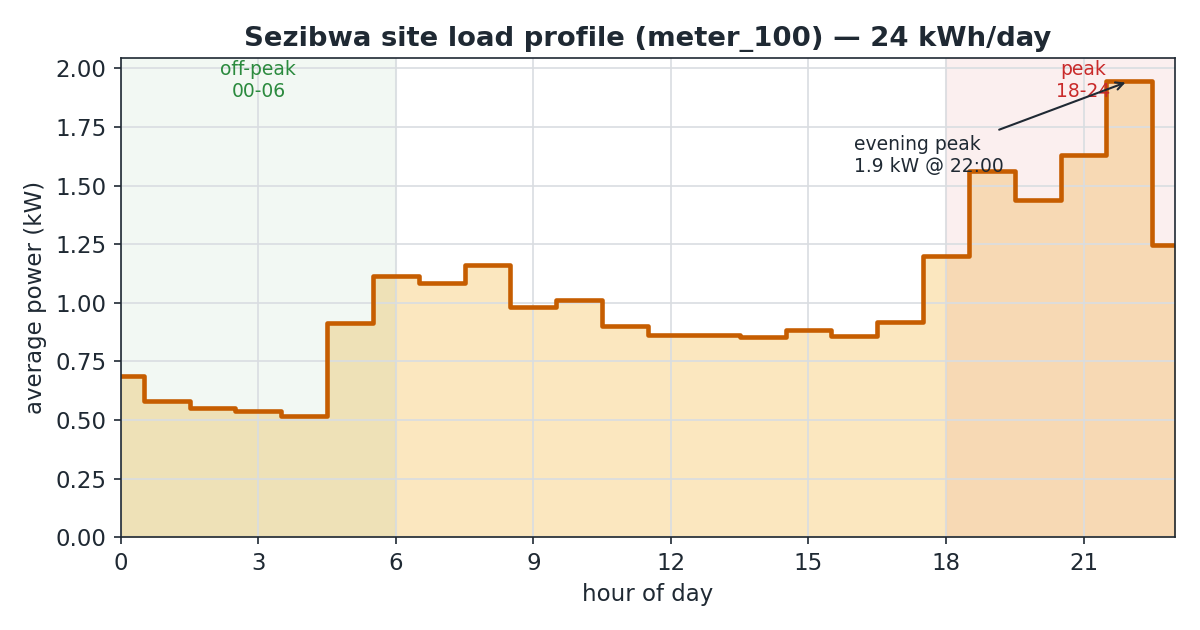
The aggregate meter (meter_100) has now recorded five consecutive months (March to August 2026), and every month sits between 21 and 25 kWh per day:
| Month | kWh/day |
|---|---|
| April 2026 | 22.5 |
| May 2026 | 22.2 |
| June 2026 | 21.3 |
| July 2026 | 25.0 |
| August 2026 (to date) | 25.4 |
Full-month average about 22 kWh/day (~660 kWh/month), trending up as more customers connect, and cross-validated against the independent sum of the 10 customer submeters to within 4 percent (ratio 1.04). The model uses a deliberately conservative 21.3 kWh/day, so the savings are if anything understated. An older bill showing ~14 kWh/day is a September 2025 period, six months before the meter began logging, and is not representative of the current site.
Why solar, and how much
The load trough is overnight (cheap off-peak) and the load peak is the evening, inside the peak tariff window (18:00 to 24:00 at 666.5 UGX/kWh). Solar generates midday, so the two miss by about six hours. The battery bridges the evening slice; the bigger win is solar serving the daytime load directly.
Midday surplus past a full 8.9 kWh battery is curtailed (spilled), because there is no economically usable export for Sezibwa today (see the net-metering note below). A bigger array fills the fixed battery faster and spills more.
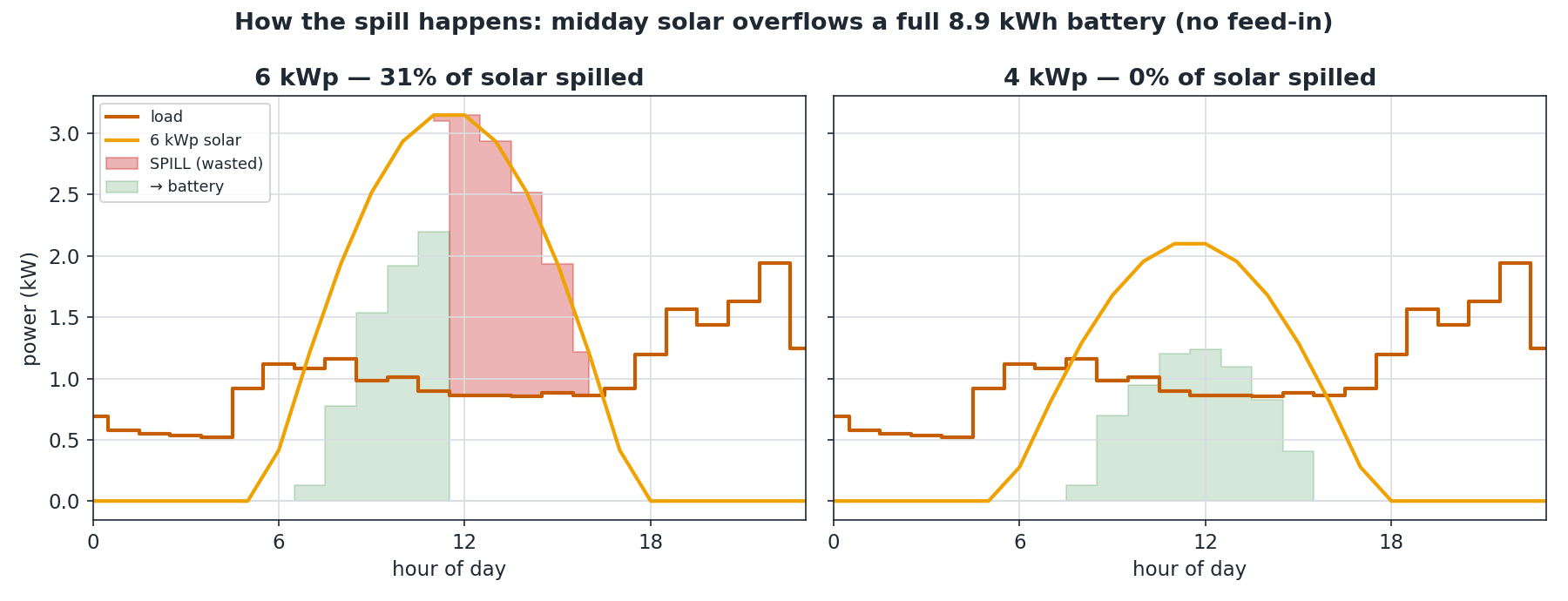
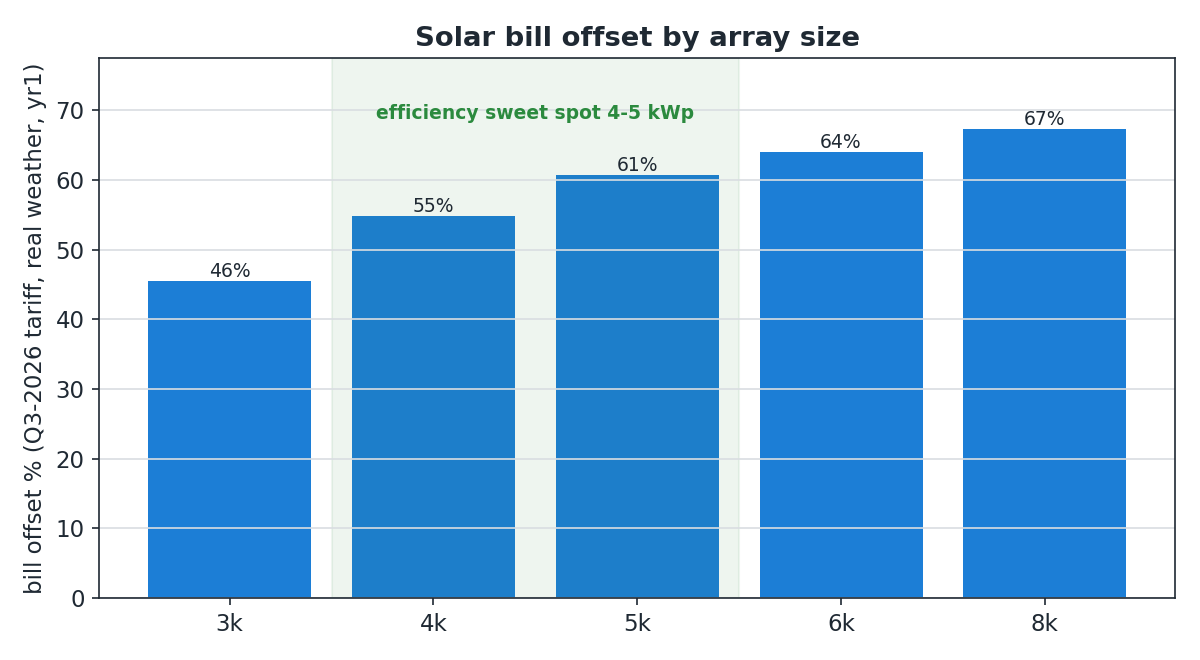
[!note] 4 kWp versus 5 kWp — two different questions, not a contradiction 4 kWp is the efficiency sweet spot: it offsets ~55 percent of the bill while curtailing almost nothing. 5 kWp is the financial NPV optimum (see the optimal-allocation case): the fifth kWp still spills a little, but its useful generation is worth slightly more than its marginal cost, so total NPV is marginally higher. Minimising curtailment and maximising NPV are different objectives; both conclusions are correct.
[!note] Net metering ERA has published the Electricity (Net Metering) Regulations, 2024, so an export framework exists in principle. But eligibility for this site, the interconnection process, and the credit value are unresolved, and net-metering credits typically pay well below retail. The base case therefore assumes no economically usable export for Sezibwa, which is why surplus is curtailed rather than sold.
Capex (from the Rincol catalog)
| Basis | 4 kWp installed cost |
|---|---|
| Turnkey (bank-financed, incl. DC PV surge arrester and MC4) | about 5.0M UGX |
| At-cost floor (if NFE self-builds via Rincol) | about 4.0M UGX |
Investment metrics
Ranked as an investor reads them (NPV and IRR first; cumulative ROI last because it is undiscounted):
| Metric | Value |
|---|---|
| IRR | about 48 percent |
| NPV at 10 / 15 / 20 / 25 percent | 14.7 / 9.6 / 6.5 / 4.4M UGX |
| Simple payback | about 2.1 years |
| Discounted payback (at 15%) | about 2.7 years |
| 20-year cumulative ROI (undiscounted) | ~790 percent |
| Upfront cost (turnkey) | about 5.0M UGX |
IRR is the effective annual return; a lender funds a project when its IRR comfortably exceeds the loan rate (here 48 percent versus an 18 to 26 percent loan). The NPV stays clearly positive even at a punishing 25 percent cost of capital, so the case does not depend on cheap money.
Battery aging over 20 years
With the battery's usable capacity fading to 50 percent by year 20 (conservative), the saving declines only gently, far less than a battery-only system which halves, because daytime solar self-consumption does not depend on the battery. Solar makes the income resilient to aging. (A battery replacement strategy is discussed in the optimal-allocation case; the existing battery here is sunk, so its fade is a maintenance question, not part of this investment.)
Related
Companion cases (same basis): Battery Arbitrage (alone), Optimal Solar and Battery Allocation, Battery Price Break-Even.