
Tech Huddle - Behind the Meter Connection for each customer
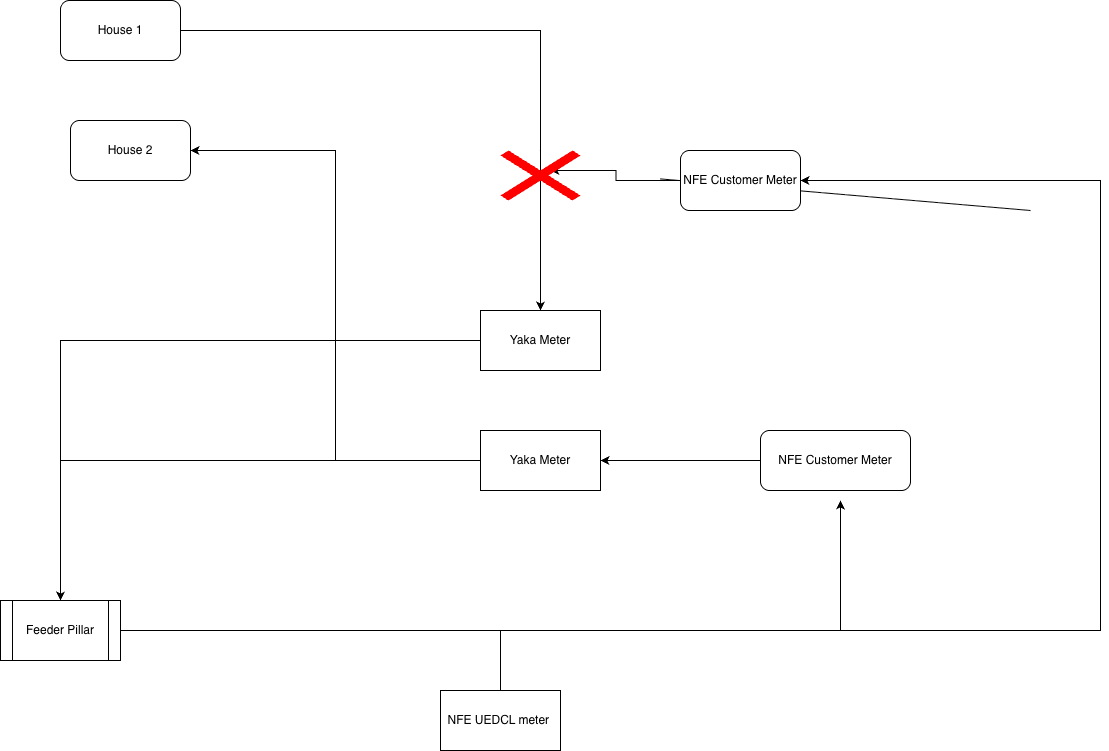
How each customer is metered and controlled behind the bulk connection, in the Street-EMS design. Companion to the authoritative page "NFE metering strategy + Glen Street-EMS".
The question
Behind NFE's single bulk utility connection sit many single-phase tenants. "Behind the meter connection for each customer" is how we meter, bill, and control each of them individually without a separate utility meter per tenant.
Today (CHINT + Pi)
Each tenant has a CHINT DDSU666 postpaid meter on a DIN rail. A Raspberry Pi gateway polls them over Modbus RTU / RS485 and feeds OpenEMS. Billing is postpaid off the meter reads. Control (disconnect) is manual at the breaker.
Street-EMS (next generation)
One cabinet meters and controls up to 9 tenants (3 per phase) with no per-tenant meter:
- Metering: 3 stacked CircuitSetup 6-channel CT boards on the EMS controller give 18 CT channels: one per tenant (9), one per phase mains (3), and 6 spare. Each tenant's usage is a dedicated CT (no separate meter box).
- Control: each tenant runs through a contactor (K1..K9) whose coil is driven by an opto-isolated SSR from the EMS. That is the per-customer remote connect/disconnect used for prepaid enforcement and protection trips.
- Safety: three Ivy residual-current monitors (one per phase) give continuous leakage and neutral-imbalance insight across all tenants on that phase.
- Per-tenant policy: the EMS holds a JSON "mode" per tenant (prepaid expiry, over V/I/kW/kWh, over-generation/storage), and can warn (RGBW LED or e-paper, flash cadence) before a graceful cutoff, optionally leaving a small post-sunset lighting allowance from battery.
Ratified: 1P (do not switch neutral except for EV), 80A rating for future EV. See the authoritative page for the full line diagram, firmware vision, and workshop context.