
Microgrid Capability Map
The Microgrid OS capability model describes what the platform enables people, devices and software to do. Capabilities are therefore named as behaviours — using verbs or object–verb phrases — rather than as domain nouns such as Assets, Alerts, Payments or Storage.
This keeps capability boundaries stable even as implementations change. For example, Measure Energy Use can be implemented by OpenEMS today and by other metering providers later; Collect Payments can be implemented by MTN MoMo, Airtel Money, bank integrations or manual reconciliation.
Important: the capability map and the Generation 1 / 2 / 3 model describe different things.
The capability map defines what the Microgrid OS does. The generation model describes how open, locally maintainable and community-controlled the current implementation of a capability is.
Capability map
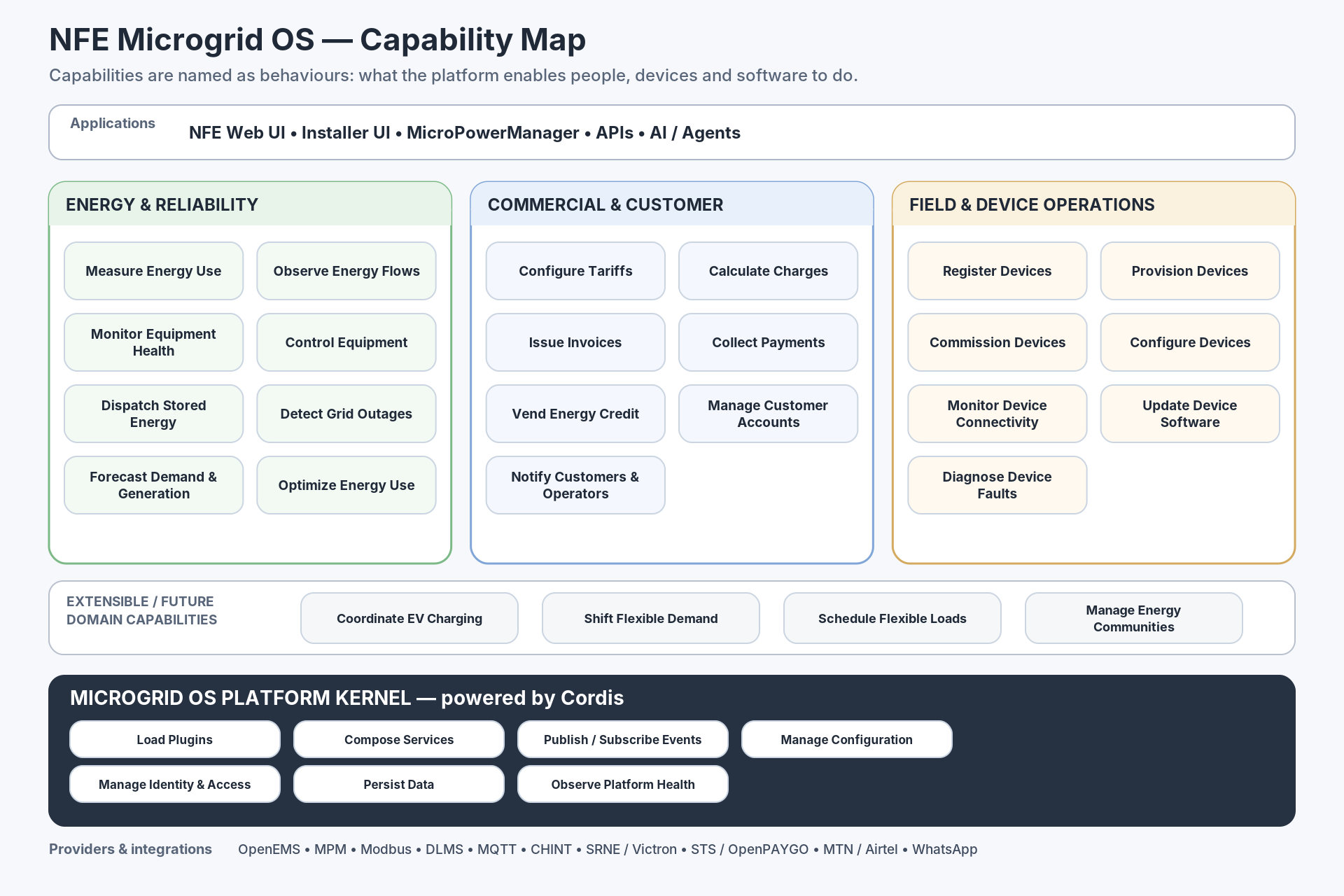
How this changes the previous map
| Previous noun-oriented area | Capability-oriented framing |
|---|---|
| Metering | Measure Energy Use |
| Storage | Dispatch Stored Energy, Observe Energy Flows, Monitor Equipment Health |
| Solar Generation | Observe Energy Flows, Forecast Generation, Control Equipment |
| Billing | Configure Tariffs, Calculate Charges, Issue Invoices |
| Payments | Collect Payments, Vend Energy Credit |
| Customer Relationship Management | Manage Customer Accounts, Notify Customers & Operators |
| Alerts | Detect Grid Outages, Diagnose Device Faults, Notify Customers & Operators |
| Assets | Register Devices, Provision Devices, Commission Devices, Configure Devices |
Generation model
Generation should be tracked per implementation of a capability, not baked into the capability name itself.
- Generation 1 — proprietary hardware/software; imported; expensive to acquire and repair; limited community control.
- Generation 2 — open-source software with locally obtainable but generally proprietary hardware; multiple implementers/SaaS providers are possible.
- Generation 3 — open hardware, firmware and software; equipment can be assembled and repaired locally; maximum community choice and maintainability.
This lets NFE move a capability from one implementation generation to another without changing the capability contract itself.
Our capabilities are currently evolving across 3 generations. See our roadmap for progress updates.
No comments to display
No comments to display